Axios AI+

December 15, 2025

As Hanukkah begins a season of holidays across many cultures, may the light in the world shine through the darkness. Today's AI+ is 1,043 words, a 4-minute read.
1 big thing: The jobs where people are using AI the most

AI use is taking off in the workplace, per new Gallup data out today, even as workers fear it'll cost them their jobs.
Why it matters: In certain industries, the technology is now widespread, and the very nature of how some professionals work is changing.
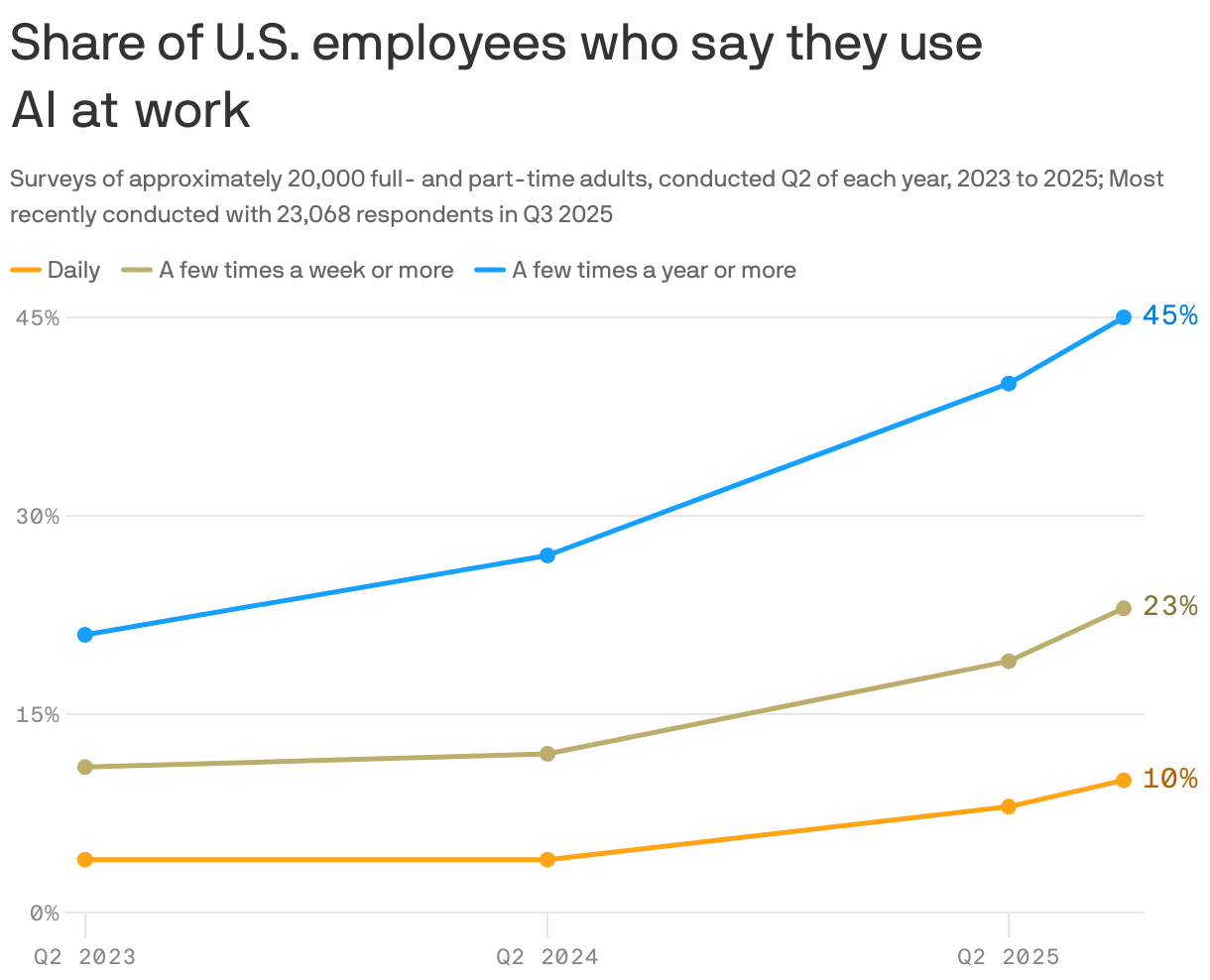
By the numbers: Those who say they're using AI a few times a year or more at work jumped to 45% in the third quarter of the year — up from 27% in the second quarter of 2024.
- Weekly usage rose to 23% from 12% last year.
- The share of workers who use AI every day is still pretty small — just 10% in the third quarter of the year.
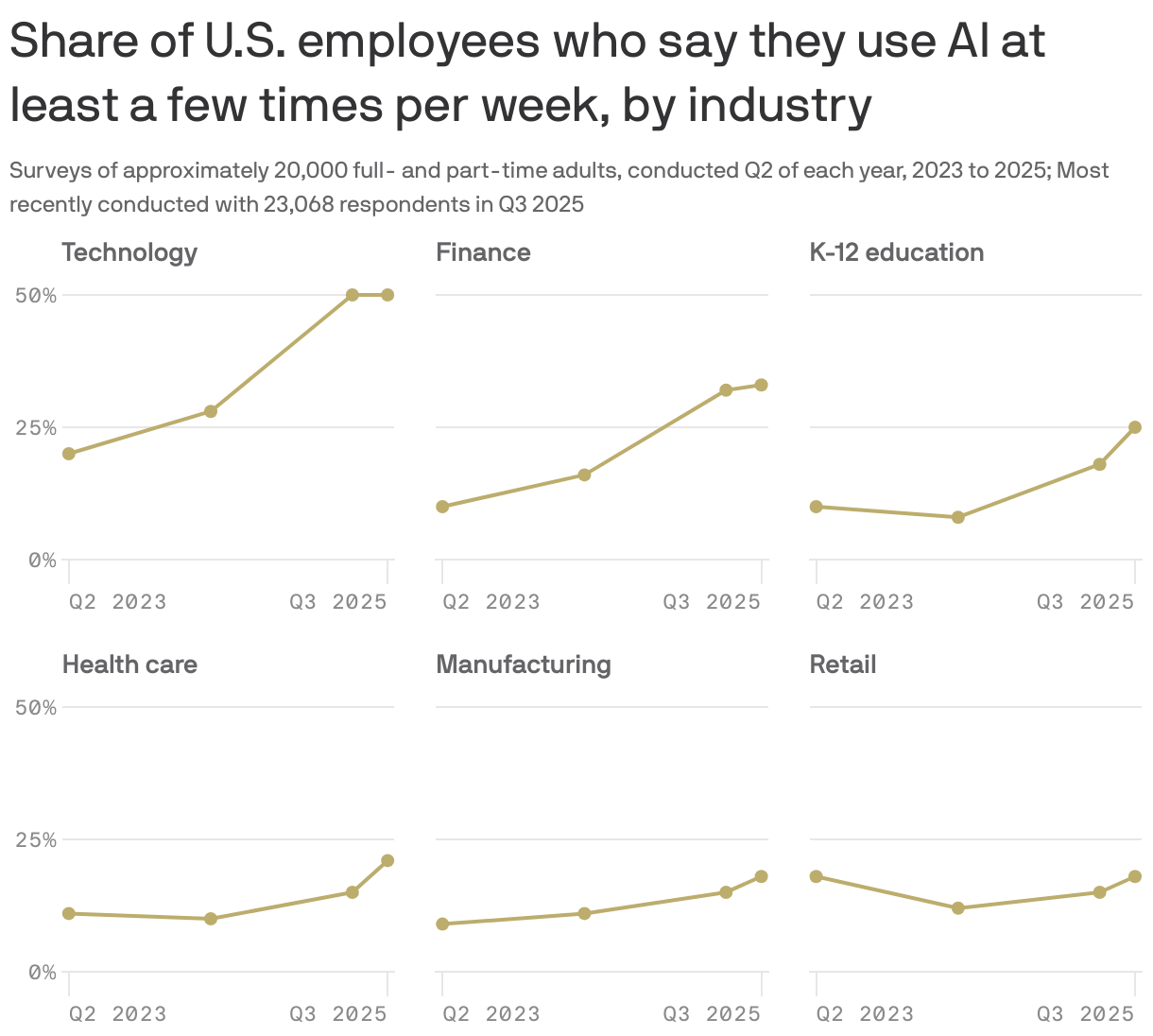
Zoom in: Gallup surveyed all kinds of workers. Those in so-called "knowledge jobs" have adopted AI at far higher rates than those in service sectors or more blue-collar sectors.
- 50% of tech workers, 33% of those in finance and 30% in professional services used AI in their role at least a few times per week.
- Those are much higher numbers than in retail (18%), manufacturing (18%) and health care (21%).
- The higher up you are in the company, the more likely it is you're using AI, per Gallup.
Zoom out: Chatbots are the most frequently used AI type — used by more than 60% of AI adopters.
The bottom line: More than a quarter century ago, the introduction of Google search kickstarted Internet adoption at work.
- Perhaps ChatGPT's emergence just three years ago will lead to similar uptake — but it's not there yet.

2. OpenAI isn't too big to fail. It's bigger.

OpenAI CEO Sam Altman is feeling the heat from Google, continued lawsuits from families and more than $1 trillion in spending promises on the line.
Why it matters: The ChatGPT-maker is so central to the entire AI economy that other companies and investors could find themselves at significant risk.
The big picture: OpenAI is confronting rising costs, a bruising talent war and uncertainty about its consumer strategy.
- Altman is refocusing the company on improving ChatGPT and the new models powering it, the Wall Street Journal reports.
Between the lines: A technical failure is unlikely, as the company keeps making progress with ChatGPT in the face of competitive challenges.
- But increasingly complex interlocking deals among a small group of companies, plus the impact of a weakening labor market, are starting to rattle investors.
- The mere suggestion that some data centers Oracle is building for OpenAI might be delayed was enough to move tech stocks last week.
What they're saying: OpenAI's individual role in the greater economy "feels like it should be inconsequential," venture capitalist and MIT research fellow Paul Kedrosky told Axios. "But I think that's a gross misunderstanding of the nature of what's happening in the market."
- An OpenAI crisis could trigger a significant disruption, Kedrosky said: "This whole interlocking structure just freezes solid."
State of play: If OpenAI falters, "the foundations for the entire [AI] sector become fragile," Daleep Singh, former deputy national security adviser and current head of global macroeconomic research at PGIM, told Axios. "You have to think about the financial contagion."
The intrigue: Kedrosky said OpenAI's dominance is partly due to sentiment. OpenAI and ChatGPT introduced the idea of AI to the masses, both users and investors.
- Now it's part of the zeitgeist, entrenched in all of our lives, even those who rarely use it.
Zoom out: Its size and deep financial connections to other companies have raised the specter of OpenAI being "too big to fail."
3. It's beginning to look a lot like (AI) Christmas

Churches across the U.S. and abroad are quietly experimenting with AI-generated Christmas content, from Nativity visuals and kids' lessons to full Christmas Eve sermons.
Why it matters: Christmas services draw some of the year's largest crowds, and churches' growing reliance on AI raises questions about authenticity, reverence, and whether algorithms can handle the faith's deepest themes.
The big picture: With limited staff, pastors and volunteers are turning to AI tools to speed up tasks as church attendance declines and churches across the country close their doors.
- Few churches are openly admitting to using AI for Christmas programming, but the abundance of options shows there's a market and that many churches are taking advantage of them.
Between the lines: The rise of AI at Christmas is tied to churches trying "to put their best foot forward" during the holiday influx, as more Americans drift away from organized religion, Greg Cootsona, executive director of the nonprofit AI and Faith, told Axios.
- Religious communities have historically been early adopters of communication tools — from radio to livestreams — to "get the word out." AI fits that pattern, Cootsona said.
The other side: The dean of Grace Cathedral in San Francisco tested AI last Christmas Eve, asking ChatGPT to write jokes and a Nativity sermon, but found it "flat" and had "no heart."
- Todd Brewer, a New Testament scholar, asked ChatGPT to write a 1,000-word Christmas sermon based on the Nativity narrative. He said it was better than some authentic sermons he'd heard, but it still lacked empathy.
Friction point: Many AI Christmas images also reinforce stereotypes about Jesus and the Holy Family being white with European features instead of more historically accurate Middle Eastern ones, said Rev. Chris Hope, founder of the Boston-based Hope Group, a church consulting firm.
4. Training data
- The AI boom and resulting shortage of construction workers is shifting municipal resources away from other infrastructure projects, such as road work. (Bloomberg)
- States are proposing their own rules to regulate AI in health care, despite President Trump's executive order demanding a single federal framework for AI rules. (Axios)
- AI is replacing the work bestie. (Axios)
- OpenAI and xAI are reportedly wooing talent by loosening restrictions requiring employees to work at the companies for at least six months before their equity vests. (Wall Street Journal)
5. + This
Limited Run Games is bringing back the 1987 Jaws video game for the Nintendo Entertainment System for modern consoles. The limited-edition re-release starts at $34.99 for a physical cartridge for the Switch or disc for PS5, with preorders starting on Friday.
Thanks to Megan Morrone for editing this newsletter and Matt Piper for copy editing.
Sign up for Axios AI+