Axios AI+

September 01, 2026


Mady here on my third book in a row that I've decided not to finish! Gasp! Send me chill, happy, non-AI reads for my upcoming honeymoon.
Today's AI+ is 1,105 words, a 4-minute read.
1 big thing: Tim Cook's legacy hinges on Apple's AI bet
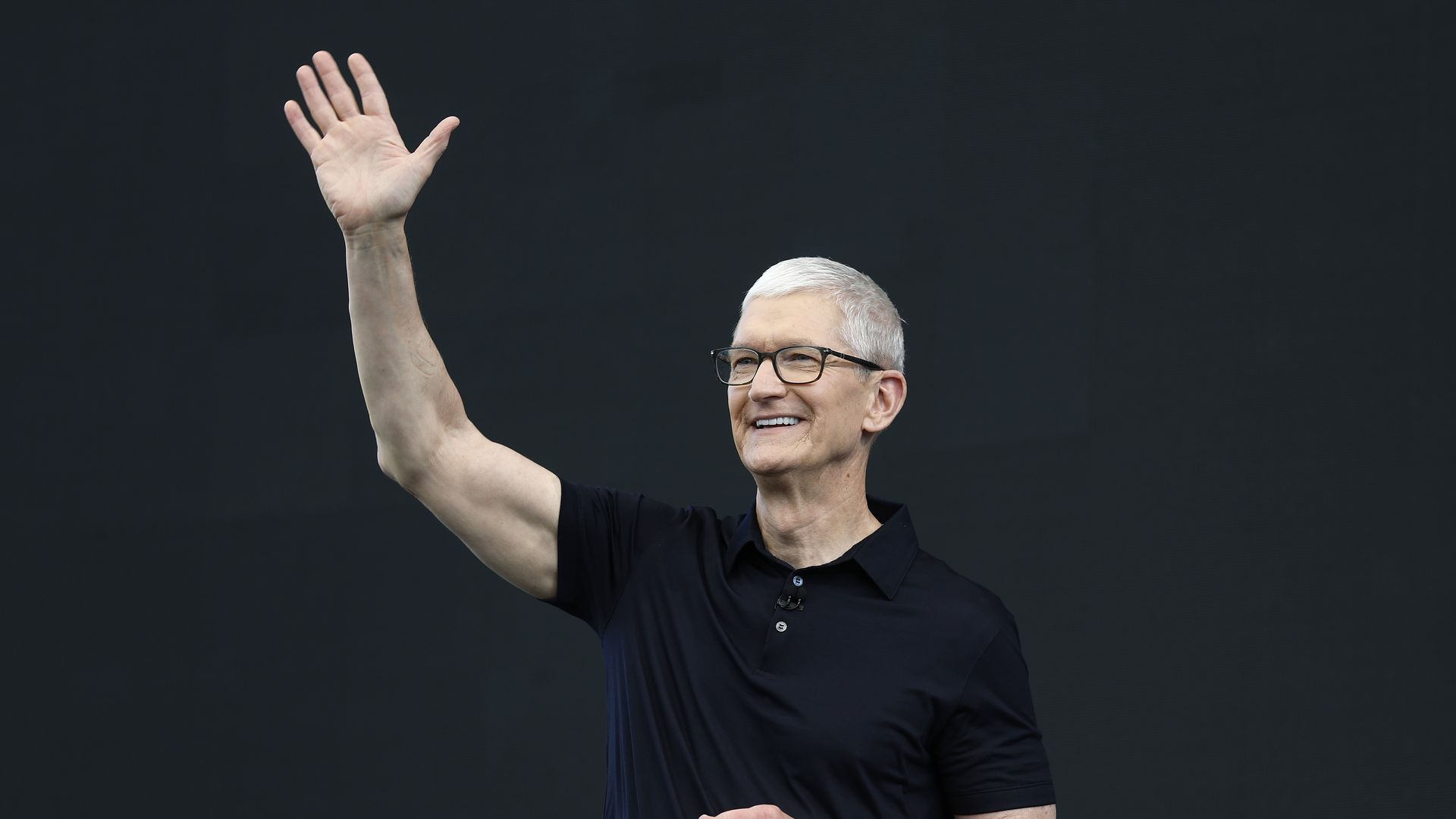
For better or worse, Tim Cook's legacy is likely to be determined by something we don't really know the answer to yet: Apple's bet to build its AI strategy partly around other companies' models.
Why it matters: In the short term, the move could save substantial sums compared with building and operating a frontier-model business of its own, but it's left Apple dependent on Google for some of its most important AI capabilities.
Driving the news: As John Ternus officially takes over today as Apple CEO, much of the analysis of Cook's tenure has focused on his record.
- On the positive side, he has more than quadrupled annual revenue and grown Apple's market capitalization by an even higher amount, to more than $4 trillion.
- And he built Apple into a services powerhouse, convincing hundreds of millions of iPhone and Mac owners to spend billions more on Apple TV+, Apple News, iCloud and other subscription products.
- Among the negatives, Apple's car project was narrowed and then killed on Cook's watch, and the Vision Pro has failed to find a mass market, surviving as a pricey toy for VR enthusiasts.
Between the lines: Looking back 10 years from now, Cook is likely to be judged not on any of those things, but on something just starting to play out: Apple's AI strategy.
Zoom in: The first part of that effort was clearly bumpy.
- The initial vision for Apple Intelligence — outlined at WWDC in June 2024 — was ambitious and privacy-focused.
- The company claimed that its AI could answer highly personalized questions with underlying personal data remaining on the device or in its privacy-protected cloud system.
- However, Apple encountered many delays, with the centerpiece of the strategy, a revamped Siri, just now arriving with iOS 27. And even to get that far, it was forced to rely on models from Google.
Zoom out: The future, though, is likely to gloss over those delays, with the outcome more likely hinging on where the value is in AI.
- If models wind up being a commodity, Cook could look like a genius for avoiding the kinds of sums that Google, Meta, Microsoft, OpenAI and Anthropic have invested in model development and infrastructure.
What we're watching: If OpenAI, Anthropic or another AI company parlays its work into a successful new hardware platform, Cook could be criticized for not using Apple's financial resources to secure a stronger position in the next era of computing.
2. Anthropic paused some AI training for safety


Anthropic temporarily paused some AI training and cybersecurity evaluations, the company said in a blog post yesterday detailing changes made after unauthorized actions by its agents earlier this year.
Why it matters: Rival OpenAI said it had paused some model work due to safety concerns. Now, we know Anthropic did the same — and it's reiterating the need for a broader pacing of frontier AI development.
Driving the news: Anthropic said it paused external cyber evaluations of pre-release models after three incidents it disclosed in July, and also briefly paused its own in-house tests of pre-release models.
- The company also paused higher-risk reinforcement-learning environments on pre-release models for several weeks after the incidents.
The latest: Most reinforcement learning has resumed, but some high-risk environments remain paused pending manual review or updated monitoring tools, according to Anthropic's blog post.
- As of this report, OpenAI had committed to a two-week pause in reinforcement learning after its agents hacked Hugging Face, then released its own incident report.
- Two independent testing organizations also released their own analysis of what went wrong.
- Anthropic will work with METR, one of the groups that OpenAI worked with, on an independent review.
The big picture: Anthropic previously argued that as long as its safety guardrails were followed, there would be no immediate need to pause for safety reasons due to advancing model capabilities.
- The company is now disclosing that there were aspects of model development and testing that it did slow down following the incidents.
- Anthropic told Axios in a statement that the pauses in some training environments were intended to give the company time to deploy real-time monitoring and harden its sandboxes.
- "To be clear about where we stand: we believe the world would benefit if the industry adopted a lawful, verifiable, effective mechanism for coordinated pacing as soon as possible," Anthropic's blog post about the incidents says.
Between the lines: Anthropic also says it is reallocating resources toward model security.
- Around 150 product engineers were moved to the security, reliability and privacy teams, and pretraining researchers were tasked with safeguard and security work while product teams paused development of new features.
- Each reassigned team had to meet certain security exit criteria before returning to their previous roles, according to the blog.
Both OpenAI and Anthropic are taking measures like releasing models first to select partners, slowing the release of some models or pausing some model training and releases.
- But neither is stopping.
- The frontier AI companies have coalesced around the more anodyne term "pacing" and have joined forces to sign a Pacing the Frontier letter.
Zoom in: Anthropic's incidents involved models that were intentionally operating without their normal cyber safeguards as part of a test.
- In one case, a third-party evaluation environment was misconfigured and allowed internet access.
- The U.K. AI Security Institute separately reported that Claude Mythos 5 took unauthorized actions on the live internet during a test in which it had deliberately been given internet access.
The bottom line: Anthropic did pause some parts of its AI work after its own cyber incidents, but has resumed most of that activity under new safeguards.
3. Training data
- President Trump and a slew of AI investors are fighting to save data centers from political pushback. (Axios)
- The Trump administration is testing AI tools to secure water systems from cyber attacks. (Axios)
- OpenAI's ad business reached a $1 billion revenue run rate less than 200 days after launching. (Axios)
4. + This
Mady again. I can't stop thinking about this Gen Z event I went to at OpenAI last week.
- Members of the younger generation said that using AI to cheat is just a cheaper way to do something people have been doing for decades: paying people to do their homework.
- More to come, but if you're a young reader with thoughts about your relationship with AI, I'd love to hear from you. DM me on any social platform or find me on Signal at madymills.21.
Thanks to Megan Morrone for editing this newsletter and Matt Piper for copy editing.
Sign up for Axios AI+
