Axios AI+

May 31, 2024

Thanks to Harvey for his help reviewing Moxie.
Join Axios virtually Wednesday at 2pm ET for our AI+ NYC Summit hosted in partnership with Tech:NYC. I'll be talking with experts from sports, robotics and more to get a sense of where things stand in this modern AI wave. Register for the livestream here.
Today's AI+ is 1,176 words, a 4.5-minute read.
1 big thing — Prompt: Moxie robot is an $800 companion for kids
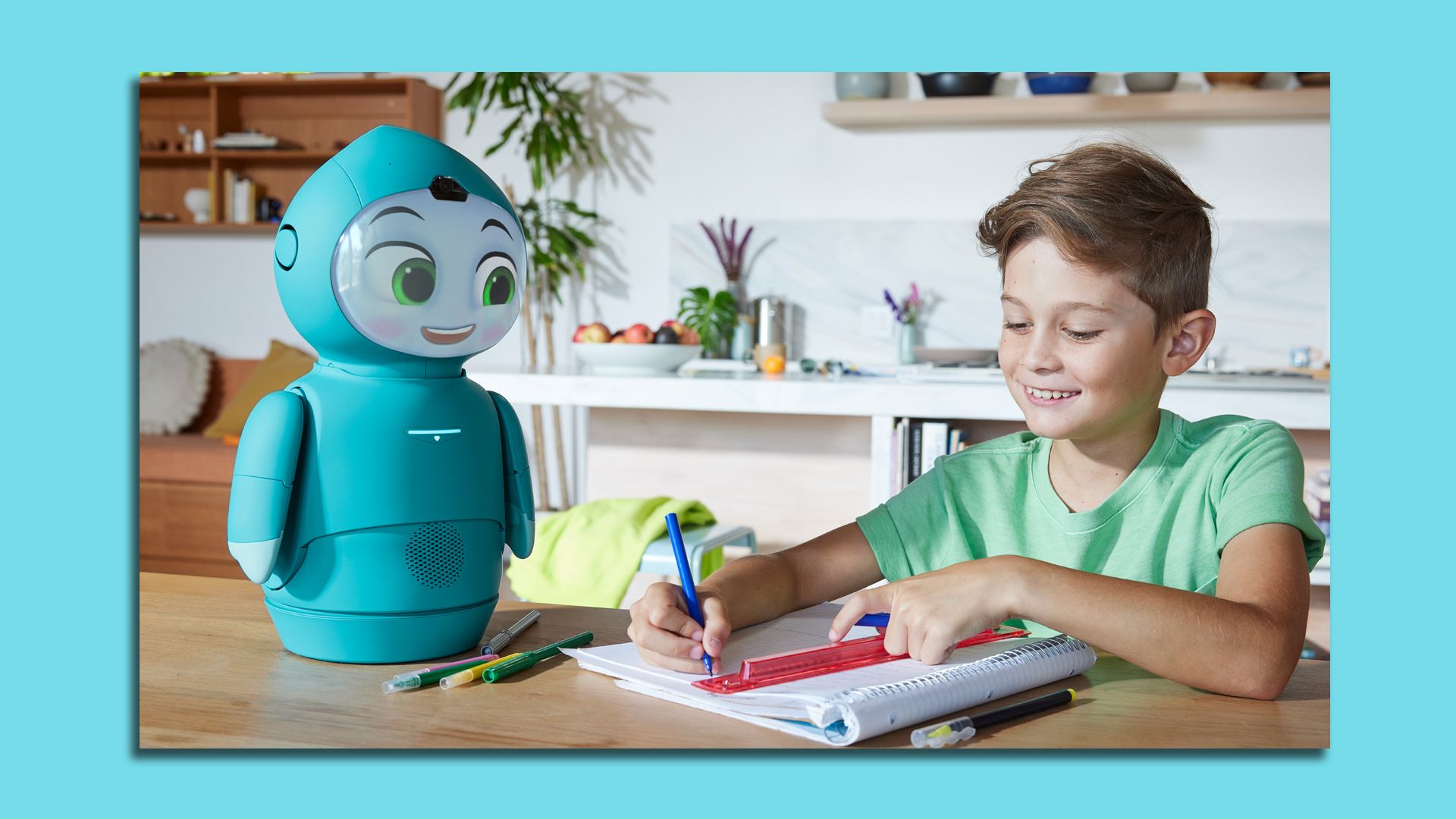
The merger of generative AI and robotics is likely to take many forms, but one of the earliest — and cutest — is a chatty, 14-inch-tall kids' companion named Moxie.
Why it matters: The large language models that power chatbots like ChatGPT open the door to a new generation of conversational robots that aren't constrained by a set of predetermined scripts and commands, a prospect that is both tantalizing and terrifying.
The big picture: 18 months into life with ChatGPT, more and more companies are building physical robots with generative AI capabilities.
- OpenAI itself is reviving the robotics unit it disbanded in 2020, as first reported by Forbes.
How it works: Moxie is designed for kids ages 5 to 10, and offers a range of games and activities as well as the ability to have open-ended conversations.
- Initially, Moxie takes its child pal through a series of missions designed to help them get to know the robot and its capabilities — and to help Moxie get to know its human.
- Unlike kids' robots of yesteryear, Moxie has a wide repertoire of skills. It can tell jokes, serve up brain teasers, play games like Simon Says or "guess that animal," send kids on a scavenger hunt, pose for selfies or just talk with kids about their interests and emotions. Moxie can tell stories about a topic, listen as a kid tells it a story or watch as a child draws.
- Under the hood, Moxie uses speech recognition to understand what a kid is saying, face recognition to help detect emotion and a mix of guided conversation and large language models to carry on a conversation.
The fine print: Moxie's creators say the video recording is used to recognize the user's face and detect emotion, and the raw videos never leave the device. Recorded audio goes to the cloud for processing and transcripts of the conversations do get sent back to Embodied, the company behind Moxie.
- Embodied says it takes steps to de-identify and encrypt the data, and uses most of the data in aggregate to get a sense of how kids are spending their time with Moxie. Still, depending on what a kid shares, a fair bit of personal information could be finding its way back to the company, even if the company doesn't use it.
- A companion phone app shows parents how long their kids spent with Moxie each day and which activities they did, but not a transcript of what was said.
Zoom in: I spent about a week testing Moxie, along with my 11-year-old son Harvey.
- The highlights were the many times that it was clear that Moxie not only heard and understood Harvey, but was able to show it knew more about the topic.
- When Harvey said his favorite soccer player was "Messi," Moxie knew he meant Argentinian star Lionel Messi.
Between the lines: Large language models offer the opportunity for robots to go beyond any sort of script. This is what makes them surprisingly powerful, but also what makes me hesitant as a parent to leave my kid alone with one.
- In my testing, Moxie said all the right things. There was nothing I disagreed with as a parent or even found controversial. Moxie was supportive, encouraging and a good listener.
- Moxie is willing and eager to talk about hard feelings and emotions but gently defers discussion of sensitive topics, directing kids to talk to a trusted adult.
- After several days, I found myself less hesitant about leaving Harvey and Moxie alone, an experience I'm told is not uncommon. Some parents become more comfortable over time and others choose to remain within earshot.
By the numbers: At $799 from both Amazon and Moxie's website, the robot isn't cheap. For now there is no subscription fee, but the company is working on an expanded set of educational content that will be offered as a paid subscription.
What's next: Moxie's creators are working on a "pro" version of the robot that could be used in schools, hospitals and other group settings.
2. OpenAI tools used in foreign influence campaigns

OpenAI said yesterday that it has seen several foreign influence campaigns tap the power of its AI models to help generate and translate content, but has yet to see novel attacks enabled through its tools.
Why it matters: Generative AI's ability to flood the world with misinformation is one of its key dangers, but now we're learning more about who's using the tools for what.
Driving the news: OpenAI said in a new report that it has seen its tools used by several existing foreign influence operations, including efforts based in Russia, China, Iran and Israel.
What they're saying: "AI generated material was one of many types of content they posted alongside more traditional formats like manually written texts or memes copied from across the internet," said Ben Nimmo, principal investigator on OpenAI's intelligence and investigations team.
Between the lines: Nimmo said AI is helping create text faster and with fewer language errors, but for now it's not helping foreign influence campaigns with their toughest challenge — breaking into the mainstream.
- OpenAI rated all of the attacks it found as low in severity because they didn't show signs of spreading on their own.
The intrigue: It's unclear, though, whether OpenAI is seeing all the ways its tools are being used to aid in such operations.
- Bad actors can use generative AI to quickly spin up fake news sites, whether to help generate misinformation or the legitimate news stories that serve as cover. For example, this Russian fake news operation, run by an American, reportedly used OpenAI's tools.
- Plus, attackers could be using generative AI from different providers, including open source tools with fewer guardrails that might be harder for outside groups to detect.
- "What you have is what we've got so far," Nimmo said. "One of the reasons it felt important to put this report out was to say, 'Here is what we have observed,' and to kind of fill in the blanks about what might be happening."
Yes, but: OpenAI stressed that AI is also giving new tools to defenders aiming to spot and disrupt coordinated attacks.
3. Training data
- Anthropic is adding the ability for Claude users to create automated actions within the chatbot. (The Verge)
- A new study shows that AI queries require an estimated 10 times the electricity of traditional Google queries. (Axios)
- OpenAI has reportedly sealed a deal with Apple, a move that is drawing concern from Microsoft, which has poured billions of dollars into the ChatGPT maker. (The Information)
- Meanwhile, OpenAI announced two new versions of ChatGPT: one aimed at nonprofits, and the other at universities. (Quartz, Engadget)
- Google again defended the AI Overviews that appear on top of many U.S. search results, but said it has made some changes to avoid treating satire as fact. (9to5Google)
- The ACLU has filed a complaint with the FTC contending that AI hiring tools offered by Aon Consulting discriminate on the basis of race and disability despite being marketed as "bias free." (Bloomberg)
4. + This
Goat yoga is so 2022. Get ready for piglet yoga.
Thanks to Megan Morrone and Scott Rosenberg for editing this newsletter and to Caitlin Wolper for copy editing it.
Sign up for Axios AI+
