
Axios AI+

August 20, 2025

My new hero is this bear. Today's AI+ is 1,082 words, a 4-minute read.
1 big thing: NFL coaches' new AI assist
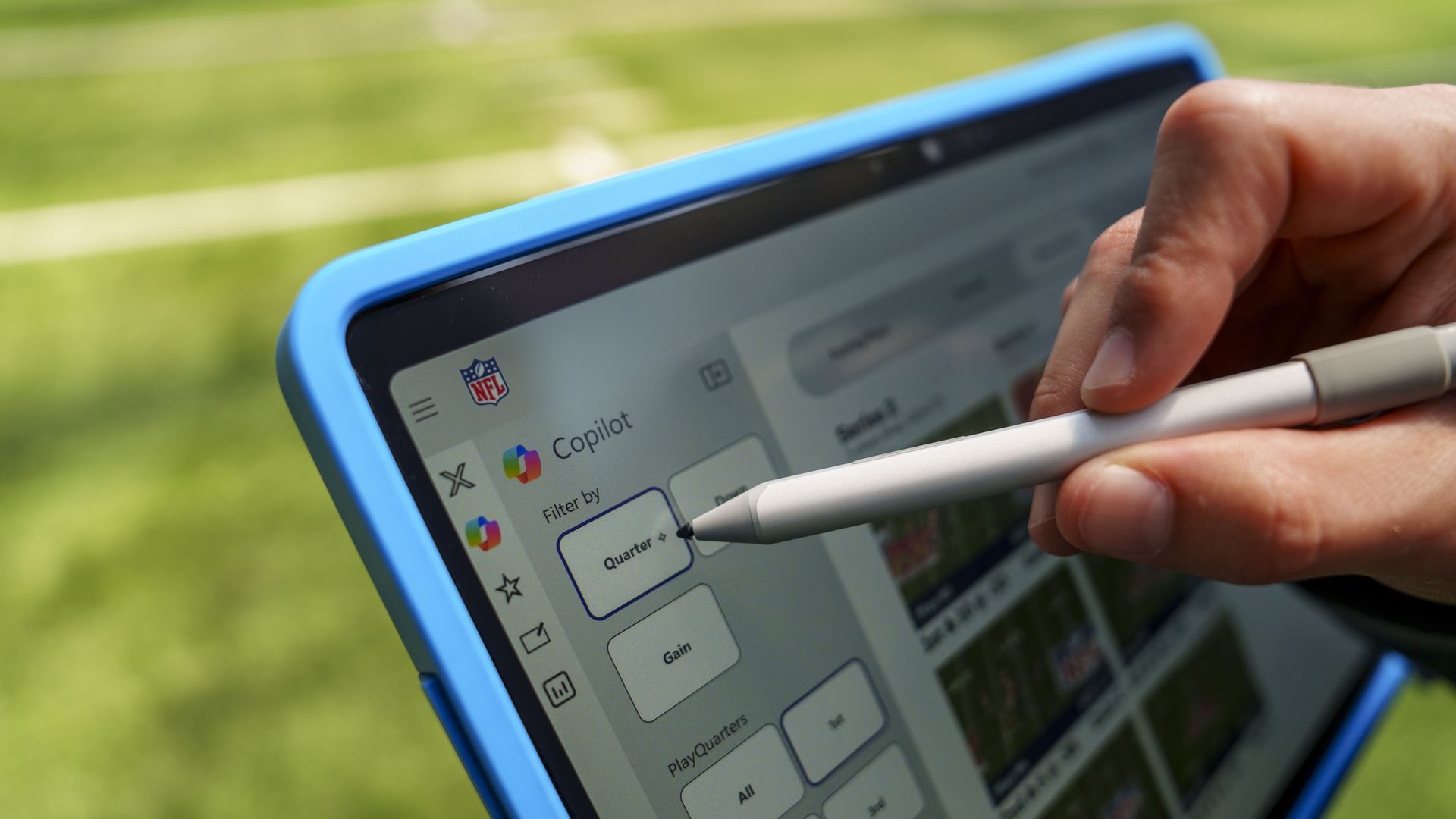
The National Football League's ubiquitous — and oft-maligned — Surface tablets are getting an AI-infused upgrade, officials from the league and Microsoft tell Axios.
Why it matters: The league is trying to give coaches faster access to the data they want, while stopping short of letting the AI make decisions.
Driving the news: The NFL and Microsoft today announced an expanded, multiyear extension of their longtime partnership.
- As part of the upgrade, teams will get new Qualcomm-powered Copilot+ tablets, with 2,500 new devices leaguewide, provided by Microsoft.
- The tablets on the field allow coaches and players to use Copilot to quickly pull up video clips from specific scenarios such as scoring plays or those on a certain down.
Zoom in: Coaches up in the booth will have access to AI copilots that help them navigate massive Excel spreadsheets to track things like personnel groupings and snap counts.
- In the past, coaches would track everything in the game using Excel, but often resorted to pen and paper to do their analysis of the data.
- The league is also expanding its use of Microsoft devices to help folks on the business side with game-day operations.
- Some teams, such as the San Francisco 49ers, have already been using AI to help with tracking wait times at entrances and concessions. (The league has let teams experiment with AI for non-football operations on game day but has, until now, prohibited on-field use.)
Catch up quick: The NFL has been using Microsoft's tablets since 2014. There were initial glitches and frustrations — including a few memorable moments of players and coaches manhandling the tablets.
- "Whatever's in their hand is going to be the receiving end of the displeasure of the results," NFL deputy CIO Aaron Amendolia told Axios.
- Adding insult to injury, the Microsoft-branded tablets were regularly referred to as "iPad-like tools."
The big picture: Harnessing massive amounts of data to make better decisions has been a trend in sports for some time. The key is to ensure the technology is reliable and equitable, Amendolia said.
- The NFL is also using AI to help identify unsafe plays and develop better protective gear and practices, in partnership with Amazon, as Axios showed off at last year's AI+ Summit in New York.
Between the lines: The league hopes that the new devices relieve frustrations rather than adding to them. The primary goal of the tablets has always been to get teams more information faster.
- Coaches only have about 40 seconds between plays. Before the Surface, it used to take several minutes to see data on what worked and what didn't in a play.
- "There was this time lag that was preventing coaches and players from making faster decisions," Microsoft corporate VP Bryson Gordon told Axios.
Go deeper: Olympics have big AI plans
2. Meta's AI shake-up spooks investors


Meta's stock dropped on reports of the company looking at downsizing its artificial intelligence division.
Why it matters: This is a warning to investors, particularly those enthusiastic about the AI revolution: The spending spigot can get turned off at a moment's notice.
Driving the news: Meta's AI division will undergo a reorganization, according to the New York Times. The Information had earlier reported a planned restructuring.
- Some AI executives are expected to leave Meta.
Between the lines: This is what Wall Street fears most: a pullback in AI spending from the companies that are propping up the entire stock market.
- Investors were reportedly also spooked Tuesday by OpenAI CEO Sam Altman's suggestion that there's a bubble in AI stocks and a report from MIT finding that 95% of companies' generative AI pilot projects are failing.
By the numbers: The top 10 companies in the S&P 500, which account for nearly 40% of the index based on market capitalization, are also each other's customers.
- Meta, Microsoft, Alphabet and Amazon are expected to spend $400 billion on AI next year.
- That capital expenditure translates to sales for other tech giants, ranging from Nvidia to Broadcom.
- Because the biggest tech companies in the S&P 500 are each other's biggest customers, a pullback in spending by one could weigh on earnings across the group.
What they're saying: "Whenever you see these huge [capital expenditure] booms, there's so much demand for it, there's so much money to be made, that, almost inevitably, you overbuild," says Trevor Slaven, global head of asset allocation and multi-asset portfolio solutions at Barings, with over $400 billion in assets under management.
- Big Tech firms are "contributing essentially the same amount of GDP growth as the entire consumer base, which is just unprecedented," Slaven tells Axios.
Context: The Meta news is coming when stocks are already hovering near all-time highs and investors are anxiously anticipating news about any rate cuts that could come from the Federal Reserve.
The bottom line: A pullback in AI spending isn't fully priced into the market, and at these valuations, it's a risk investors aren't prepared to face.

3. Newsrooms tap AI experts
Newsrooms across the country are scrambling to hire AI leads as they explore AI tools, deals, lawsuits and processes.
Why it matters: News companies don't typically have the deep pockets that tech firms do when it comes to hiring engineers and technical experts. But they're starting to make the investment.
Driving the news: Politico yesterday named Francesca Barber as executive vice president, AI and innovation.
- "This role is about empowering every reporter, editor, and publishing professional to be more effective and creative," Politico global editor-in-chief John Harris and CEO Goli Sheikholeslami said in a statement.
- Time, CNN, Fortune, Reuters and the Washington Post have hired or promoted new AI leads.
Become a Media Trends member to get data reports, exclusive events, special scoops, expert insights and more.
4. Training data
- Nvidia is said to be developing a chip for China that outperforms the H20. (Reuters)
- Silicon Valley's obsession with attaining AGI — and reining in its nightmare scenarios — is a distraction from competition with China in applying AI for practical gains today, argues Eric Schmidt in an op-ed. (New York Times)
- "Shared" conversations with Elon Musk's Grok chatbot are automatically searchable on Google, but many users don't realize that and post personal details or problematic content — like a plan to assassinate Musk. (Forbes)
5. + This
Russia used a deepfake image to manufacture a snub-that-wasn't, wrongly suggesting that President Trump made European leaders wait in a hallway outside his office before discussing Ukraine.
Thanks to Scott Rosenberg and Megan Morrone for editing this newsletter and Matt Piper for copy editing.
Sign up for Axios AI+