Axios AI+

June 17, 2025

Today is National Root Beer Day, National Apple Strudel Day and National Eat Your Vegetables Day. Decisions, decisions, decisions.
Today's AI+ is 1,041 words, a 4-minute read.
1 big thing: AI's power couple on a precipice
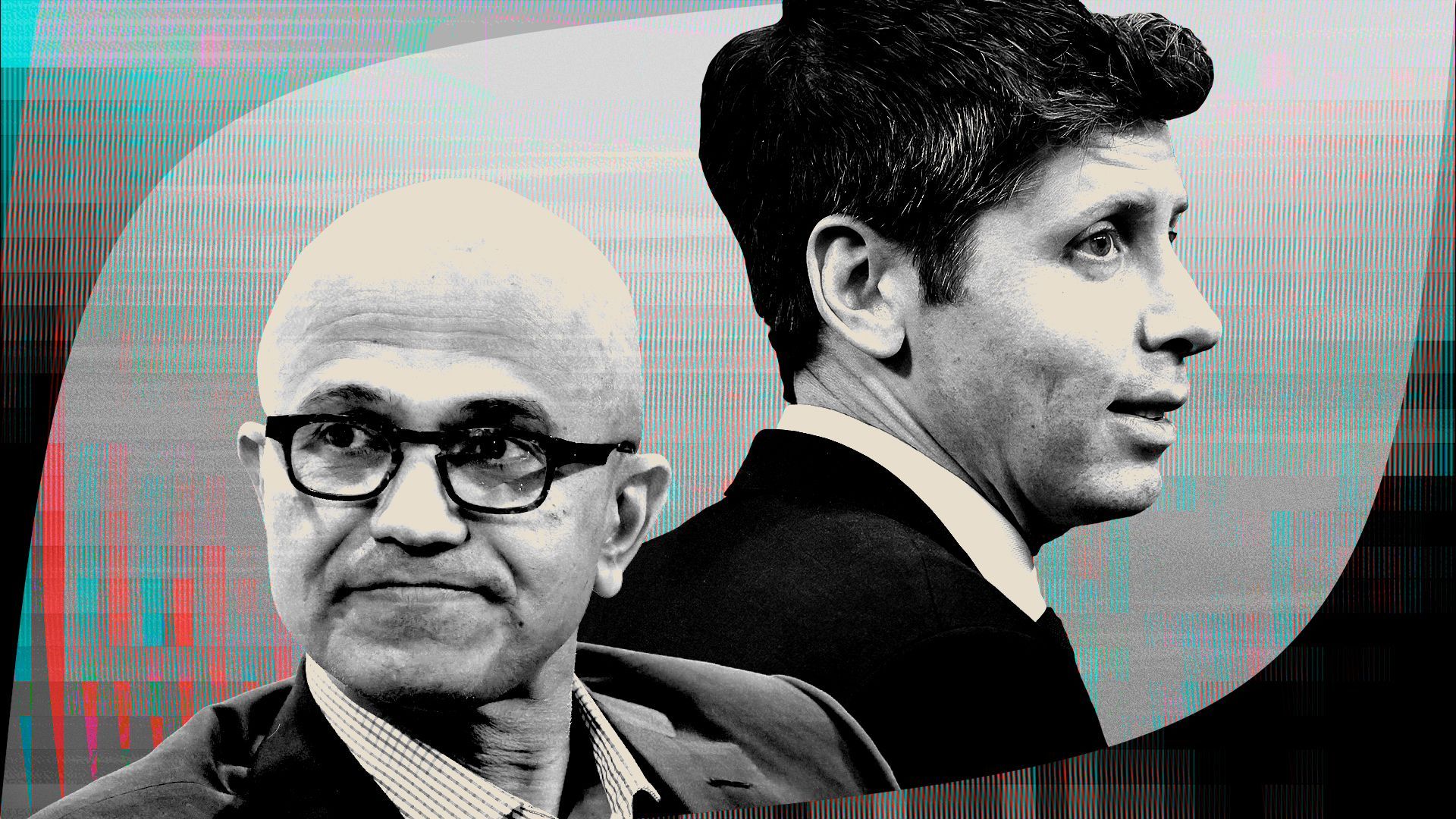
Microsoft and OpenAI are engaged in tense negotiations that could unravel one of the most important alliances in AI and fundamentally reorder the industry.
Why it matters: Microsoft has injected billions of dollars into OpenAI and made it a cornerstone of its AI strategy, but the companies have also remained rivals that, in many cases, offer competing AI services.
State of play: The two companies have been in talks for months to amend their partnership, with OpenAI needing approval from Microsoft to move forward with the corporate restructuring it has promised recent investors it would make.
Driving the news: The Wall Street Journal reported yesterday that tensions have escalated between the two companies, with OpenAI considering a "nuclear option" of accusing Microsoft of violating antitrust laws.
- That's a risky gambit that could backfire as tighter government oversight could ultimately fall on OpenAI itself.
Zoom in: The latest sticking point is over whether Microsoft would have access to the intellectual property behind Windsurf, the coding startup OpenAI reportedly acquired last month.
- Under their most recent agreement, signed in 2023, Microsoft has access to all of OpenAI's technology, including any it gets via acquisition. An exception could be made, but it would have to be negotiated.
- OpenAI, meanwhile, has been floating the notion that both companies might save themselves some regulatory headaches if Microsoft doesn't have access to Windsurf, given it already owns GitHub, which makes a competing product.
- It's the latest in a series of issues that have cropped up between the companies, which find themselves in the position of being both partners and competitors.
Zoom out: Ultimately, there are far larger issues at play than whether Microsoft has access to Windsurf's technology.
OpenAI needs Microsoft's go-ahead for a restructuring that OpenAI wants to achieve soon in order to meet commitments it made to recent investors. That means translating Microsoft's current share of OpenAI profits, up to a certain point, into a specific stake in the company.
- Another big sticking point relates to a trigger in their existing deal that calls for Microsoft's access to be significantly curtailed once OpenAI has reached the threshold of artificial general intelligence.
- Right now Microsoft has extremely broad rights until AGI is reached and limited access beyond that point.
- Heaps of dollars are on the table, from the size of the stake in OpenAI's operation that Microsoft gets, to how much server business OpenAI sends Microsoft's way, to how much the two companies collaborate or compete for consumer and corporate subscriptions.
- Late yesterday The Information reported that OpenAI wants Microsoft to forgo its rights to future profits in exchange for a roughly 33% stake in the restructured company, according to a person who had spoken to OpenAI executives.
Between the lines: This negotiation is dauntingly complex in its technological, financial and legal dimensions, but sources close to both companies share considerable hope they'll eventually find a workable deal.
Yes, but: Both companies are also eager to show each other — and the world — that they have alternative plans and are ready to play rough if need be.
Microsoft has been expanding its own bench of AI talent, from its deal to bring in Mustafa Suleyman to the more recent move tapping Jay Parikh as head of a Core AI unit.
- It has also been expanding its offering of non-OpenAI models via Azure, most recently adding xAI's Grok to the mix.
OpenAI, which once got all its compute capacity from Microsoft, has moved to diversify, first with its Stargate project with Oracle and SoftBank and more recently in a deal with Google to use its cloud as well.
What they're saying: "We have a long-term, productive partnership that has delivered amazing AI tools for everyone," the companies said in a joint statement. "Talks are ongoing and we are optimistic we will continue to build together for years to come."
2. Welcome to the "infinite workday"

/2025/06/16/1750090910248.gif?w=3840)
Working 9 to 5 was once a way to make a living, in the parlance of Dolly Parton, but today's workday? It never ends.
Why it matters: That's the startling finding of a report out today from Microsoft on the "infinite workday," which begins before many knowledge workers get out of bed, ends late in the evening and stretches into the weekend.
- "The modern workday for many has no clear start or finish," write the authors of the Work Trend Index Special Report, which looked at anonymized data from millions of global users of Microsoft 365's productivity apps — Outlook, Teams, PowerPoint and more.
Our thought bubble: Workers are competing with AI, which never needs a break.
By the numbers: It's hard to stay focused during formal office hours. Knowledge workers are interrupted by a ping from an app — like email, calendar or messaging — every 1.75 minutes, or 275 times, during the official 8-hour workday, finds the analysis, which looked at data from a 12-month period ending February 2025.
- Meanwhile, as workers are more distributed around the country and world, thanks to the rise of remote work, 1 in 5 meetings are now happening outside "regular" work hours.
- Meetings after 8pm are up 16% from last year, and the average employee now sends or receives 50-plus messages outside of core business hours.
- These folks aren't sleeping in come the morning, either: A "broad base" of workers are up at 6am working, says Colette Stallbaumer, co-founder of Microsoft WorkLab and the general manager for Microsoft 365 Copilot.
The bottom line: Microsoft argues that AI can help offset some of this work — but so far it doesn't seem to be making a dent.
3. Training data
- Meta added a warning label that its AI feed was public after several outlets reported that most users seemed unaware that others could see their highly personal interactions with the bot. (Business Insider)
- OpenAI has landed a $200 million contract with the Defense Department. (CNBC)
4. + This
Alaska had its first-ever heat warning over the past weekend. On the one hand, it's good to know this is the result of a National Weather Service decision to change how it handles such warnings there, and not itself a sign of climate change. On the other hand, we're just a little unsettled that the NWS even needs to think about how it warns Alaskans about heat waves.
Thanks to Scott Rosenberg and Megan Morrone for editing this newsletter and Matt Piper for copy editing.
Sign up for Axios AI+
