Axios AI+

March 01, 2024
Ina here. Today's AI+ is 1,131 words, a 4.5-minute read.
🌮Join us at the Axios House at SXSW from March 9-11 for drinks and discussions about the future of the internet, corporate communications, sustainability and more. Request an invite.
1 big thing: Musk sues Altman, OpenAI for "maximizing profits"
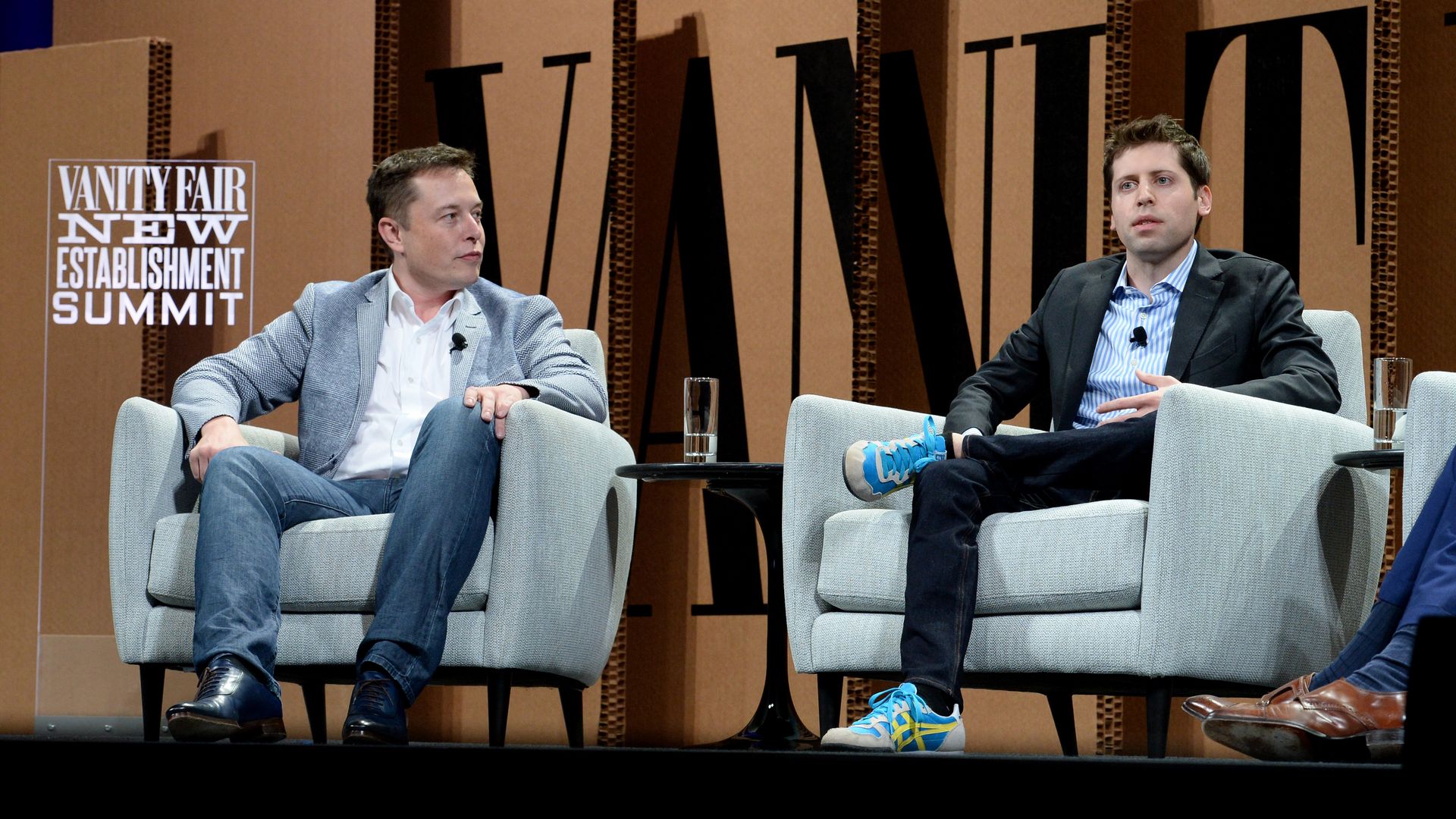
Musk and Altman share a stage in 2015 at a San Francisco event. Photo: Michael Kovac/Getty Images for Vanity Fair
Elon Musk filed a lawsuit Thursday against OpenAI and its CEO Sam Altman, alleging they have abandoned the company's founding agreement to pursue AI research for the good of humanity rather than profit, Axios' Ivana Saric and Scott Rosenberg report.
Why it matters: This latest twist in a long feud between the two influential figures comes as a generative AI revolution kicked off by OpenAI's ChatGPT is sweeping through the world — and many of the technology's creators continue to warn of its perils.
State of play: In a breach of contract suit filed in a California state court, Musk — who co-founded OpenAI as a non-profit — alleged that he, Altman, Greg Brockman and other co-founders had agreed the company would be an open-source nonprofit seeking to develop artificial intelligence "for the benefit of humanity."
- The lawsuit noted that Altman, Brockman and OpenAI, Inc "reaffirmed" the founding agreement with Musk on "multiple occasions."
- Yet, "in 2023, Defendants Mr. Altman, Mr. Brockman, and OpenAI set the Founding Agreement aflame," the lawsuit stated.
Friction point: OpenAI released its GPT-4 model last year. Musk's lawsuit alleges its internal design is shrouded in secrecy driven by "commercial considerations."
- "OpenAI Inc. has been transformed into a closed-source de facto subsidiary of the largest technology company in the world: Microsoft," the lawsuit stated.
- OpenAI is "not just developing but is actually refining" artificial intelligence technology "to maximize profits for Microsoft," it added.
- OpenAI did not immediately respond Friday to a request from Axios seeking comment on Musk's lawsuit.
Context: Altman shifted OpenAI's strategy beginning around 2019 when it became clear that developing advanced AI would require massive amounts of money.
- The non-profit set up a for-profit subsidiary as a vehicle for other firms to invest in the effort. Potential profits are capped at 100 times the value investors put in. Control remains in the hands of the small non-profit and its board.
- Microsoft has invested many billions in OpenAI — largely in the form of in-kind contributions of cloud-computing resources required to train and operate OpenAI's giant models.
The intrigue: Musk has founded his own AI startup, X.ai, as a for-profit entity.
- Its chatbot, Grok, specializes in a "free speech" oriented approach, in contrast to other products — including OpenAI's — that aim to limit harmful speech and bias.
- The lawsuit follows an epic boardroom drama at OpenAI last November, when the company's directors fired Altman, saying they could no longer trust him. Altman was restored as CEO after employees rebelled.
Our thought bubble: The suit lets Musk spotlight OpenAI's complex and still fraught evolution from a tiny non-profit organization to the standard-bearer of a tech revolution with billions, or even trillions, at stake.
- Whether or not the suit sees any success, it will keep the questions raised by OpenAI's board last November alive, at the same time that OpenAI also faces antitrust challenges over its Microsoft alliance and the SEC is reportedly investigating the company's communications with investors during the board crisis.
The other side: Altman is an extremely effective communicator and has made a cogent case that if OpenAI is to have a positive impact on AI's development, it needs to be in the big-model game — and playing that game requires billions.
2. China's patent surge


For the first time, the number of international patents filed by inventors in China has surpassed applications from the U.S., Axios' Alison Snyder reports.
Why it matters: Patent data is a key indicator of science and technology prowess — and the economic and national security strength that comes with it.
- "[We've] never seen a country grow its patenting both at the rate and the volume" as China has, says Robert Atkinson, president of the Information Technology and Innovation Foundation (ITIF).
By the numbers: Inventors in China applied for roughly 68,600 patents in 2022 through the Patent Cooperation Treaty, which allows inventors to file across many countries at once, according to a report published today from the National Science Foundation's National Center for Science and Engineering Statistics (NCSES).
- There were about 58,200 U.S.-based applications the same year — the most recent year for which the data has been compiled.
Flashback: In 2015, the U.S. had twice as many applications as China and in 2020, China pulled even with the U.S.
Zoom in: AI-related patents saw tremendous growth. In 2012, AI inventors in China were granted 650 worldwide utility patents — those given for non-obvious inventions. By 2022, that number climbed to more than 40,000.
- U.S.-associated AI patents also grew from about 920 to 9,400 during the same time.
- They encompassed different AI techniques (for example, machine learning), applications (i.e. computer vision or robotics) and fields where they might be used (life sciences, banking and others). This was all before ChatGPT stormed the scene at the end of 2022.
- According to the congressionally mandated report, China had the highest number of patents in the top three categories of patents issued — machine learning, computer vision and personal devices and computing.
Caveat: Utility patents are counted from the patents issued in a particular country and the standards may differ.
- China "systematically over patents and the patents are not necessarily good," Atkinson says.
Zoom out: For the first time, the biennial report looked at patenting in critical and emerging technologies identified in the CHIPS and Science Act.
- These include AI, advanced materials, semiconductors, quantum information science, tech and biotech.
- Close to 190,000 USPTO utility patents were granted in these technologies — about 45% overall were granted to U.S. inventors.
- For many technology fields, the share granted to U.S. inventors was roughly 50%, but for some, it was less: 31% for energy-related technologies and 35% for advanced materials.
Yes, but: "Patents are an output, not an outcome," Atkinson says. An abundance of patents doesn't necessarily translate to a successful product or technology.
The big picture: Instead of focusing on how to address the rest of the world's advances, the emphasis should be on "a renewed commitment to make sure the United States leads" in workforce, patenting, investment, education and innovation, says Dario Gil, director of IBM Research and a member of the National Science Board.
3. Training data
- Microsoft is adding some new AI features to Windows 11, including a tool to remove unwanted objects from photos.
- Former Google AI ethics researcher Margaret Mitchell says ethical AI research is not to blame for Google's Gemini missteps. (Time)
- Startup H2O AI released Danube, a small LLM designed for mobile use. (VentureBeat)
- Enterprise AI company Cohere is opening a New York office.
4. + This
For those still obsessed with the AI-enabled Wonka dumpster fire, I have good news. Here are some of the scenes recreated in Lego and Animal Crossing.
- Speaking of Lego and Animal Crossing, the first sets featuring characters from the Nintendo video game go on sale today.
Thanks to Scott Rosenberg and Megan Morrone for editing this newsletter.
Sign up for Axios AI+

Scoops on the AI revolution and transformative tech, from Ina Fried, Madison Mills, Ashley Gold and Maria Curi.
