Axios AI+
December 04, 2025

I'm excited for today's Axios AI+ Summit in San Francisco, and I think there will be plenty to talk about with Demis Hassabis, Aaron Levie, Gary Marcus and many more of the smartest minds in the field. Tune in here at 2pm PT/5pm ET.
Today's AI+ is 1,090 words, a 4-minute read.
1 big thing: Young workers demand better AI

Almost all young knowledge workers are using AI at work. Now what?
- A survey out today finds that knowledge workers under 40 want AI to be less generic, with styles tailored to how they actually write and speak.
Why it matters: The youngest workers are typically on the bleeding edge — first to adopt new technology and a leading indicator of where it's headed next.
Catch up quick: Last year, the same survey conducted by Google Workspace, along with Harris Poll, found that 93% of full-time Gen Z workers and 79% of millennials were using two or more AI tools per week.
Where it stands: But life comes at you fast. AI adoption moves at breakneck speed. The novelty's worn off.
By the numbers: 92% of young leaders say they want AI with personalization — tailored to their writing style or that of their organization.
- They also want easy integration with relevant personal information that can help them pull work together, like from emails, planning docs and meeting notes.
- 90% said they would be more inclined or much more inclined to use AI at work if it was more personalized.
"People's bars are higher now in terms of their expectations," Yulie Kwon Kim, vice president of product at Google Workspace, told Axios this week.
- Last year, if AI could generate an email or doc for you, it was fun. "But now if you really want to use it in your work, that's not enough."
How they did it: In September, Google fielded its second "Young Leaders" survey of 1,007 U.S.-based knowledge workers, age 22-39, who currently have or aspire to hold a leadership position at work.
Zoom out: Most respondents appear to be power users. 77% said they considered themselves someone who "actively designs or engineers parts" of their workflow with AI.
- And 93% agreed that AI has made them more confident in their skills as a professional.
Between the lines: It makes sense that workers would prefer their AI to be more personalized. People don't want the things they write to sound generic, or like a bot wrote it.
- Younger folks, for whom AI is more native, are on the lookout for content that feels phony, Kim said.
- "It's still very important that things feel authentic."
Reality check: Personalization sounds simple, but it's technically messy.
- True style-matching requires long-term memory and access to sensitive work data, things most enterprise AI systems aren't ready to handle at scale.
What to watch: Most AI in the market isn't that good at this yet. That's an opportunity for AI companies.
- For certain writers earning a living from their personal writing style — ahem — it's a measure of relief.
2. AI geothermal discovery hints at the future

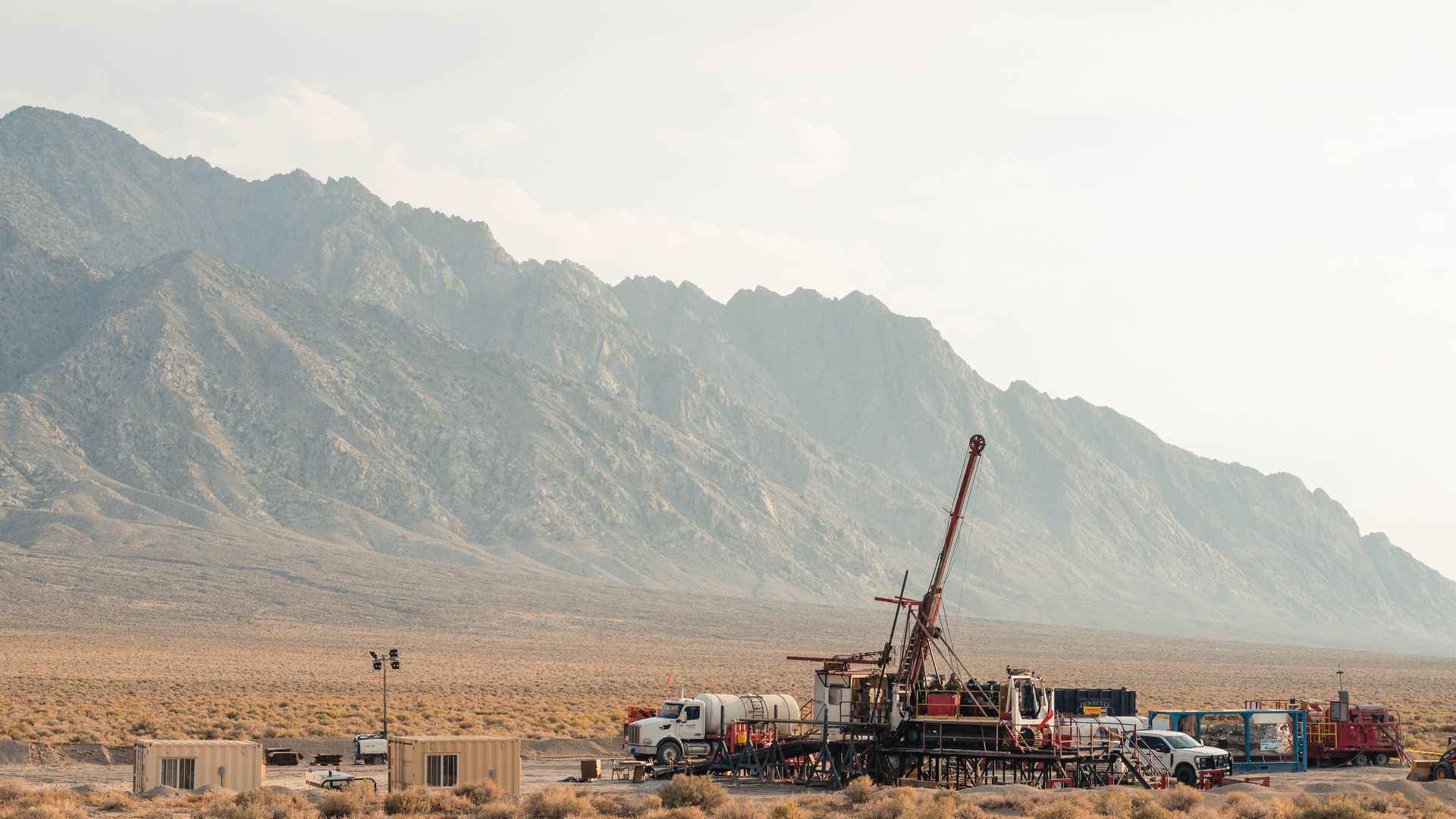
A geothermal energy company announced today that it has discovered — with AI's help — the first commercially viable system of its kind in over 30 years.
Why it matters: Zanskar Geothermal and Minerals officials said the underground find, in a remote area of western Nevada, offers fresh evidence that geothermal can become an attractive option to meet soaring U.S. energy demand.
- Geothermal is the rare alternative energy source with wide bipartisan backing. Democrats are attracted to its zero-emissions footprint, while Republicans like its potential to offer round-the-clock power.
Driving the news: The Nevada formation, dubbed "Big Blind," had no surface signs of geothermal activity or any prior history of exploration.
- Zanskar scientists used computer models to locate a geothermal anomaly that indicated exceptionally high heat flow at the site.
- They fed data into Zanskar's AI prediction engine, which helped narrow down the list of options.
Zoom in: The result led to "fewer bad wells" being drilled, Joel Edwards, Zanskar's co-founder and chief technology officer, told Axios. That reduces the cost of the projects, he said.
- Carl Hoiland, the company's other co-founder and CEO, said AI technology "has allowed us to target deeper and more precisely."
- "The analogy here is really every other natural-resource industry, from oil to minerals to shale gas," he said. "They all started on what was at the surface and over time got better at going deeper."
Context: The Big Blind discovery follows Zanskar's work at two other geothermal sites — Pumpernickel in northern Nevada and Lightning Dock in New Mexico.
- Unlike Big Blind, both sites had been known to have evidence of geothermal activity, but neither had been fully examined to identify their potential.
What's next: The company plans to seek permits to develop Big Blind into a commercial venture. It hopes the site will provide power by later this decade.
The big picture: The International Energy Agency predicted that geothermal could meet up to 15% of global power demand growth through 2050 — but said greater government policy support, specialized labor, and other boosts will be necessary.
- Congress and the Trump administration strongly support geothermal energy. Energy Secretary Chris Wright in March called it "an awesome resource that's under our feet" that could provide the power needed for AI innovation.
- The giant tax and spending bill that President Trump signed into law this summer cut tax credits for many renewable energy tax incentives but preserved them for geothermal.
The bottom line: "If you sort of read the tea leaves in the public space, the perception is that naturally occurring systems are tapped out," Edwards said.
- "This is sort of showing that, actually, there's a wave of these things coming, and this is just the beginning."
3. Training data
- Memory giant Micron is exiting the consumer business to shuttle more of its memory and storage products to AI data centers. (Axios)
- Meta has poached top Apple design executive Alan Dye to lead a new lab that Mark Zuckerberg says will "bring together design, fashion, and technology to define the next generation of our products and experiences." (Bloomberg)
- OpenAI is buying Neptune, a 60-person Polish startup that helps AI companies improve model training. (Bloomberg)
- Salesforce posted a better-than-expected earnings report and forecast, while Snowflake's profit margin outlook was lower than some were projecting. (CNBC, Bloomberg)
4. + This
Tiffany, the 1980s pop singer, is making a resurgence thanks to her music being used in the new season of "Stranger Things," with her hit "I Think We're Alone Now" topping the list of most searched-for tracks on Shazam.
Thanks to Megan Morrone for editing this newsletter and Matt Piper for copy editing.
Sign up for Axios AI+
