Axios AI+
November 06, 2024

I finished the Lego Polaroid camera before the polls closed on the East Coast (see below).
Today's newsletter is 1,170 words, a 4.5-minute read.
1 big thing: Trump win gives young AI a ticket to run wild


American voters have just decided — among many other things — that artificial intelligence will grow up in a permissive, anything-goes household, rather than under the guidance of stricter parents.
Between the lines: Trump's reputation may be that of a strongman, and his MAGA brand of conservatism embraces tough talk, but last night's Republican victory makes it a lot more likely that AI will run wild as it develops.
The big picture: AI makers describe the process of training a model as something like raising a small child.
- That's one reason "values-free" AI doesn't exist. Every generative AI model encodes a set of biases and assumptions drawn from the data it's given and the rules its makers impose.
AI companies faced two very different roads this election season.
- Vice President Harris oversaw the Biden administration's AI policymaking that led to the AI executive order and related efforts.
- These are less hard-line regulations than balancing acts, but they do aim to impose some caution and transparency on the new industry.
Trump hasn't said much about AI.
Yes, but: His close ally Elon Musk is the leading advocate (and funder) of AI systems that favor "anti-woke" principles over guardrails limiting hate speech, bullying and misinformation.
Zoom in: In a second Trump administration, two key factors are likely to combine to discourage federal efforts to set limits on AI.
- Traditional Republicans have long embraced laissez-faire policies and been hostile to regulation.
- Meanwhile, the MAGA belief that Big Tech platforms censor conservatives has made Trump-era Republicans detest efforts to moderate content online or to build systems that place boundaries on acceptable speech.
Zoom out: AI's creators and leaders remain deeply divided over the technology's potential for good or harm, even as the tech industry races to deploy it in every corner of society.
- Many AI advocates and investors see AI blessing the future with abundance and productivity, and serving human needs with universal AI tutors and medical aides.
- OpenAI CEO Sam Altman recently told a developers' event in London that "working on these models definitely feels like being on the side of the angels."
- On the other side of the debate is a crowd of AI experts worried about the technology destroying the human race.
- Others simply point out that AI, particularly when it's used in applications like facial recognition or hiring/firing algorithms, can automate discrimination.
"Opaque and unaccountable AI systems" can lead to "the suppression of civil rights and individual opportunity," warn the authors of an article in Foreign Policy last week.
- Former Harris adviser Ami Fields-Meyer and Data & Society director Janet Haven write: "Ungoverned, AI undermines democratic practice, norms, and the rule of law — fundamental commitments that underpin a robust liberal democracy — and opens pathways toward a new type of illiberalism."
State of play: Industry insiders argue that putting too tight a rein on AI will hobble the U.S. in a global race to best China.
- Other experts believe the U.S.'s opportunity lies in building AI that's carefully designed to fortify democracy, hamper authoritarianism and shun surveillance-state tactics.
What we're watching: This election could prove the last time the public gets to weigh in on the right way to "parent" AI. Four years from now, the technology will be older — and more set in its ways.
2. What Trump II means for tech policy


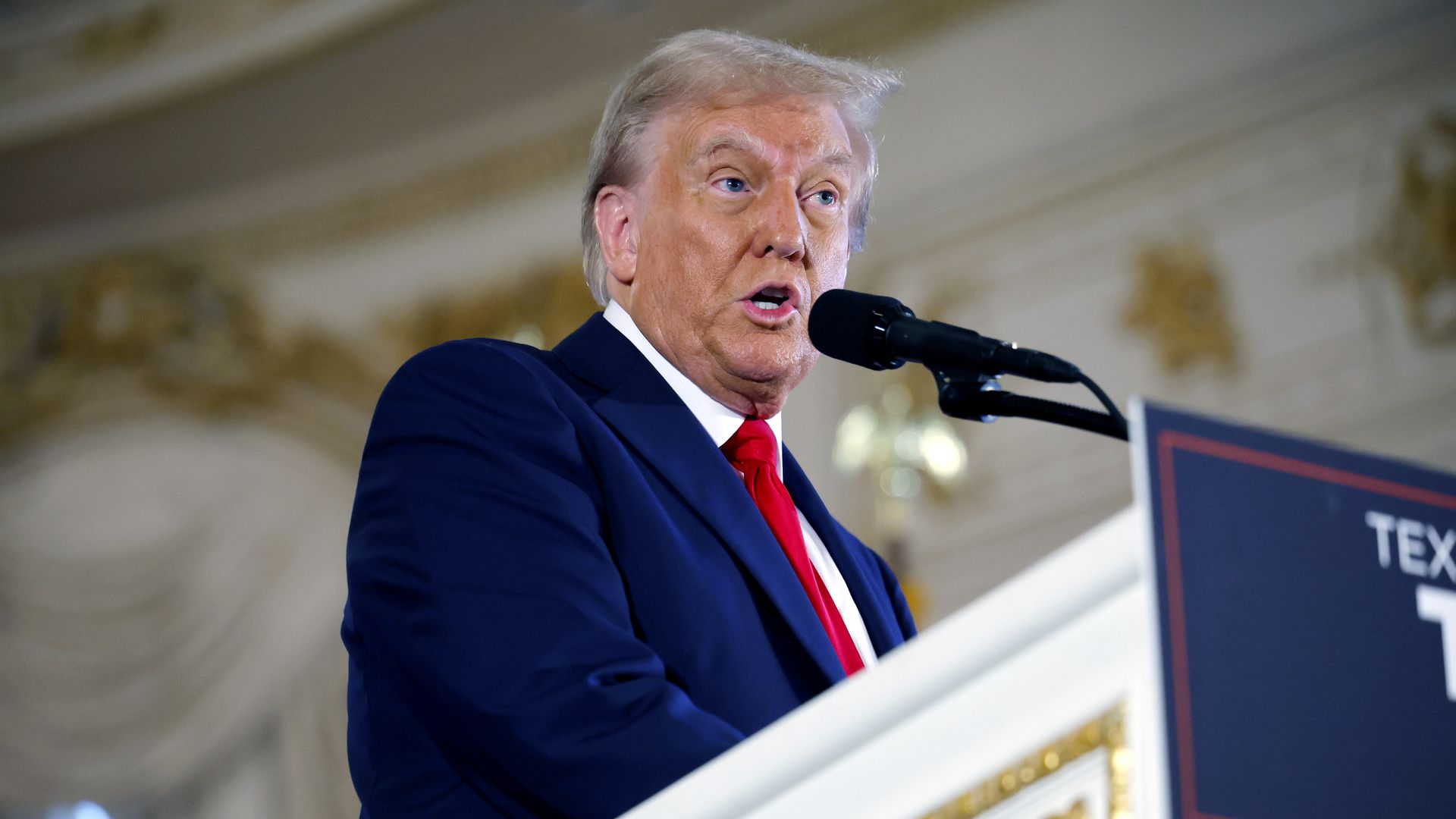
With Donald Trump's second administration, anti-Big Tech rhetoric will ramp up and champions of AI deregulation will dominate, but expect any policy positions to quickly shift depending on the president's whims.
The big picture: Trump often flip-flops and changes his mind, bringing uncertainty to the tech policy space for the next four years. Who has his ear — and when — will determine much of his time in the White House, rather than any stated policies.
- Vice President-elect JD Vance does, however, bring along a more defined view of tech to the administration, embracing populism and skepticism of the Big Tech behemoths.
Here's what the Trump-Vance win could mean for tech policy.
AI regulation: Deregulation is the name of the game now. Talk of AI safety, risk mitigation and regulating the industry will be replaced by a focus on rolling back regulations to unleash the industry and compete with China.
- The AI executive order is now a year old, and many of the instructions and reporting requirements are well underway, so any repeal effort would be largely moot. But the Trump administration could still remove the reporting requirements for companies with dual-use foundation models.
- Expect much of the conversation on AI to revolve around national security, competition with Beijing and avoiding burdensome regulation, rather than implementing safety standards or guardrails.
- One of Trump's most enthusiastic backers — Elon Musk — would have a lot to gain with a friendly White House as he raises billions for his xAI startup and navigates a host of government contracts and lawsuits.
Antitrust: Many of the Big Tech cases that continue today began under the first Trump administration.
- Personnel picks will determine how aggressive the approach under the next administration will be, but both Trump and Vance have blasted Big Tech consolidation and power.
Section 230 and content moderation: Trump and Republicans frequently complained about Section 230 of the Communications Decency Act and accused social media companies of bias during and after his first stint in the White House.
- Any overhaul of Section 230 will be hard to come by in light of recent Supreme Court cases around content moderation.
- Trump could back off on all of that talk, as his Truth Social relies on Section 230 to operate.
- But Section 230 makes Big Tech an easy target, and lawmakers on the Hill like to talk about repealing it.
TikTok: TikTok is now facing a ban in the U.S. if it doesn't divest from Chinese owner ByteDance, pending its court challenge.
- Trump may have started the process that led TikTok to where it is today, but he's said on the campaign trail that he no longer wants to ban TikTok.
Privacy: The push to pass a federal privacy bill remains at a standstill after efforts blew up in the House.
- If nothing shifts in the lame duck, expect a renewed effort from pro-business interests and advocacy groups for a federal standard next year. That would be the case no matter who ended up in the White House.
If you need smart, quick intel on federal tech policy for your job, get Axios Pro.
3. Training data
- AI coding tools are causing problems at companies that rely too much on them. (The Information)
- The Columbia County Board of Elections in Georgia — a swing state — reportedly considered using AI developed by Republicans that would have made it easier to challenge voter registrations. (404 Media)
- Mozilla is cutting 30% of staff. (TechCrunch)
- AI-powered search startup Perplexity is reportedly raising $500 million to triple its valuation in a new funding round. (Wall Street Journal)
- Nvidia surpasses Apple as the world's largest company by market capitalization, thanks to AI. (Bloomberg)
4. + This

I'll be honest. I wasn't really very productive after the polls closed.
Thanks to Megan Morrone and Scott Rosenberg for editing this newsletter and to Caitlin Wolper for copy editing it.
Sign up for Axios AI+
