Axios AI+
January 30, 2024

Hi, it's Ryan. Today's AI+ is 1,091 words, a 4-minute read.
1 big thing: Next up, your chatbot wellness coach

Illustration: Aïda Amer/Axios
A startup best known for offering AI companions for romance and friendship is expanding into coaching, yoga and meditation — the latest AI industry effort to encourage personal relationships with chatbots, Ina reports.
Why it matters: The idea that talking to a computer can make people feel less lonely may seem counterintuitive, but there is evidence chatbots can do just that.
Driving the news: Luka, which makes AI conversation app Replika and romantic AI chat app Blush, is today announcing Tomo, an app that aims to use AI to create the digital equivalent of a wellness retreat complete with a life coach.
How it works: Tomo is a subscription mobile app that offers more than 250 activities led by an AI avatar guide, including yoga, meditation, and positive affirmations.
- Tomo is launching first on iOS in the App Store with a 3-day free trial. After that, paid membership is $8 per week or $50 per year. An Android version is set to launch in Google's Play store later this year.
The big picture: It's all part of a push by Luka to create customized AI chatbots to fill a range of human needs.
- "It doesn't matter if an AI is real or not," Luka founder Eugenia Kuyda told Axios. "The feelings are real."
- Last week, an academic journal run by Nature published a study done by Stanford and Luka that showed those who used Replika saw a decrease in suicidal ideation.
- "This is not a surprising effect we found," Kuyda said. "This is why we started Replika."
Yes, but: Tomo is designed to enhance wellbeing, not to replace a trained mental health professional, Kuyda said. "It's an AI coach. That's what it is."
Between the lines: Acceptance of the role AI chatbots can play is growing. Within a year or two, the idea of having relationships with AI will be commonplace, she argues.
- She likened it to online dating, which was once frowned upon.
- Luka executives have also been making the case that chatbots offer a safe space for people to try out dialogue and improve their human relationships.
What's next: Luka has been developing a version of Tomo that works on Apple's new Vision Pro headset. The immersive aspect, Kuyda says, makes it a good match for the wellness features Tomo offers — whereas "when you are just on your phone, it is very easy to get distracted."
2. AI could help replace Baby Boomers
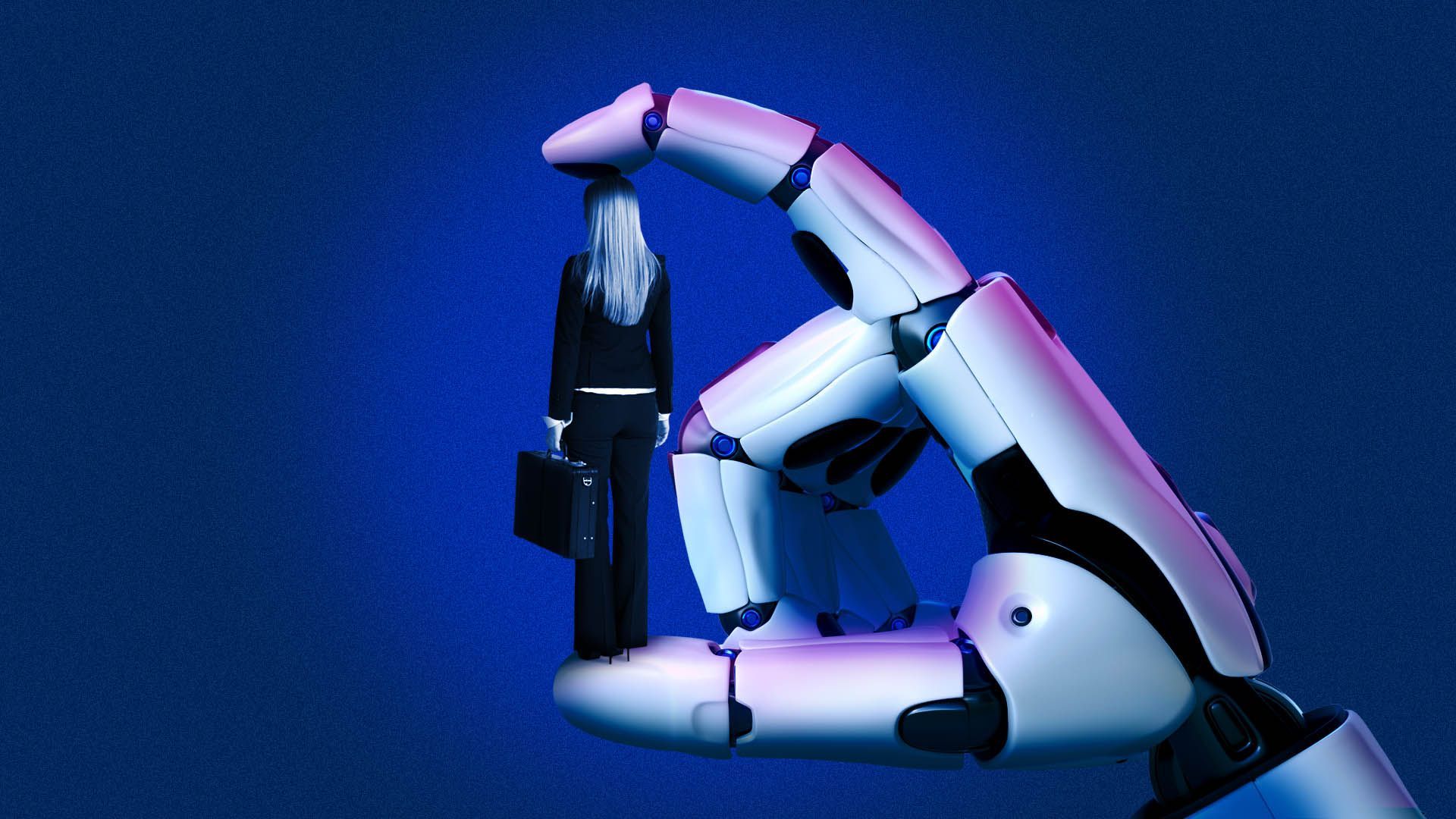
Illustration: Sarah Grillo/Axios
AI-driven productivity gains may be the world's best hope to limit the pain of a demographic squeeze, reports Axios' Neil Irwin.
Why it matters: AI will be at the center of jobs debates in coming years — because of a shortage of working-age humans in many advanced and middle income economies, and because improving AI and robotics also risks mass displacement of workers.
- The big macroeconomic question for the coming decade is which force proves more powerful — the undersupply of workers or the displacement of jobs caused by AI.
State of play: The Baby Boom generation is entering retirement, and comparatively smaller generations are entering their prime working years.
- There is no equivalent of China's massive population poised to join the global economy, as happened starting in the 1980s.
- With global tensions rising, there is a risk that countries will become more economically siloed.
- If — and it's a big if — generative AI enables companies to boost output with a stagnant or even shrinking pool of workers, however, it offers a way out of the jam.
What they're saying: During the first part of this century, a confluence of forces led to decades of "quasi-permanent expansion to production capacity" known as the "Great Moderation," BlackRock vice chairman Philipp Hildebrand told reporters in Davos, Switzerland, earlier this month.
- Hildebrand sees AI as the only lever to recreate "the kind of dynamic we saw in the Great Moderation."
- "The skills required for every job will change," Katy George, chief people officer at McKinsey & Co., told Axios. The open question, she said, is whether "we just exacerbate some of the problems that we've seen with previous waves of automation, but now in the knowledge sector, as well."
Yes, but: An overall AI boost to the economy could still generate a lot of pain for individual workers and their families.
3. Study tests AI-written campaign emails

Illustration: Annelise Capossela/Axios
AI is helping political candidates raise more money more efficiently, according to an organization dedicated to helping Democrats win, reports Maria Curi.
Why it matters: Even when AI doesn't help to raise more cash, campaign teams are finding it frees up time for other voter engagement efforts.
What's happening: Tech for Campaigns is one of the first organizations to run AI-aided email experiments.
- The group started testing in Virginia last July across 16 campaigns and went on to send 25 emails — a human-only version and a ChatGPT-aided version — across four Virginia House campaigns.
- Google's Bard helped garner 3.5 times more dollars per work hour.
- OpenAI's ChatGPT helped garner 4.4 times more dollars per work hour.
- The experiments did not conclude that one company's model is better than the other, Tech for Campaigns co-founder Jessica Alter told Axios.
Of note: A human was always involved in reviewing and editing the AI-aided emails.
OpenAI earlier this month announced organizations are not allowed to use its tools in campaign efforts.
- Alter said it was "disappointing" that OpenAI used more of a hammer than a scalpel approach, but noted campaigns still have other tools from Google and open-source models at their disposal.
What's next: Tech for Campaigns is focused on the state legislative level and will allocate more than 33% of its budget this year toward AI.
- Tech for Campaigns is planning to test the performance of AI-generated image and video advertisements, particularly now that there are disclosure requirements.
- The group is holding education sessions for campaign teams to demystify the technology.
Editor's note: This story has been corrected to remove a reference to Anthropic's AI tools, which the company does not permit political campaigns to use.
4. Training data
- OpenAI will work with children's safety organization Common Sense Media to curate kid-friendly AI options. (Axios)
- Microsoft closed loopholes in Designer, its AI text-to-image generation tool, in an effort to prevent users creating non-consensual nude images — including those made to resemble Taylor Swift. (404 Media)
- iRobot laid off one-third of its staff after Amazon killed a proposed merger between the companies, citing lack of support from regulators. (CNBC)
- With the rise of generative AI, Universal Music Group's Lucian Grainge is trying to repeat his success in funneling streaming income to record labels. (The New Yorker)
- FTC chair Lina Khan says she has used AI to contest medical bills. (CNBC)
5. + This
What's worse: The lizard standing on its back legs? Or the flies?
Thanks to Scott Rosenberg and Megan Morrone for editing, and Art MacMillan for copy editing, this newsletter.
Sign up for Axios AI+

Scoops on the AI revolution and transformative tech, from Ina Fried, Madison Mills, Ashley Gold and Maria Curi.