Axios AI+

March 26, 2026

Thanks to everyone who attended our AI+DC Summit events this week, either online or in person. The next one is June 3 in New York. Today's AI+ is 1,012 words, a 4-minute read.
1 big thing: AI optimism collides with public fear

A clash between Silicon Valley confidence and Washington anxiety at Axios' AI+DC Summit yesterday exposed deep divides over how to balance AI promise and risk.
Why it matters: The AI industry says this technology will create new jobs, boost productivity and transform daily life for the better. But Americans are worried about their kids, their power bills and their livelihoods.
The big picture: The summit revealed wildly different opinions from industry leaders and lawmakers from the left and the right.
Meta president Dina Powell McCormick framed AI as a "transformation of humanity."
- McCormick called AI an "equalizer" — a "mostly affordable" tool that could lead to the "democratization of a lot of these industries and potential jobs."
- She urged rival companies to cooperate on shared "core values" around safety.
Sen. Mark Warner (D-Va.) pointed to recent data showing that AI was more unpopular with Americans than ICE, but also said a moratorium on new data centers — like the one proposed by Sen. Bernie Sanders (I-Vt.) — was "idiocy."
- Warner said AI makers can be a positive force in the world, but they need to empathize with how Americans feel about the tech encroaching on their lives.
- "When I think about many of the AI big heads that are brilliantly smart, empathetic is not the first word that comes to mind," he said.
- If they don't recognize how their tech is impacting people, "they're going to get blown away by both the left and the right's pitchforks coming after them because this is scaring them."
White House science and tech adviser Michael Kratsios insisted the Trump administration can be bullish on AI innovation and still address public fears.
- But when pressed on jobs, child safety and rising costs, Kratsios repeatedly pointed to President Trump's pledge to protect consumers from higher energy costs rather than offering new specifics on AI guardrails.
Sen. Josh Hawley (R-Mo.) focused on AI's harms — to children and to the communities disproportionately affected by AI data centers.
- "Our message to the companies has got to be no amount of profit justifies destroying children's lives," Hawley said.
- On data centers, Hawley said "we will be punished" if lawmakers allow tech companies to "run roughshod over voters" by not requiring them to take any action to address concerns.
2. Exclusive: Warfare requires humans and machines

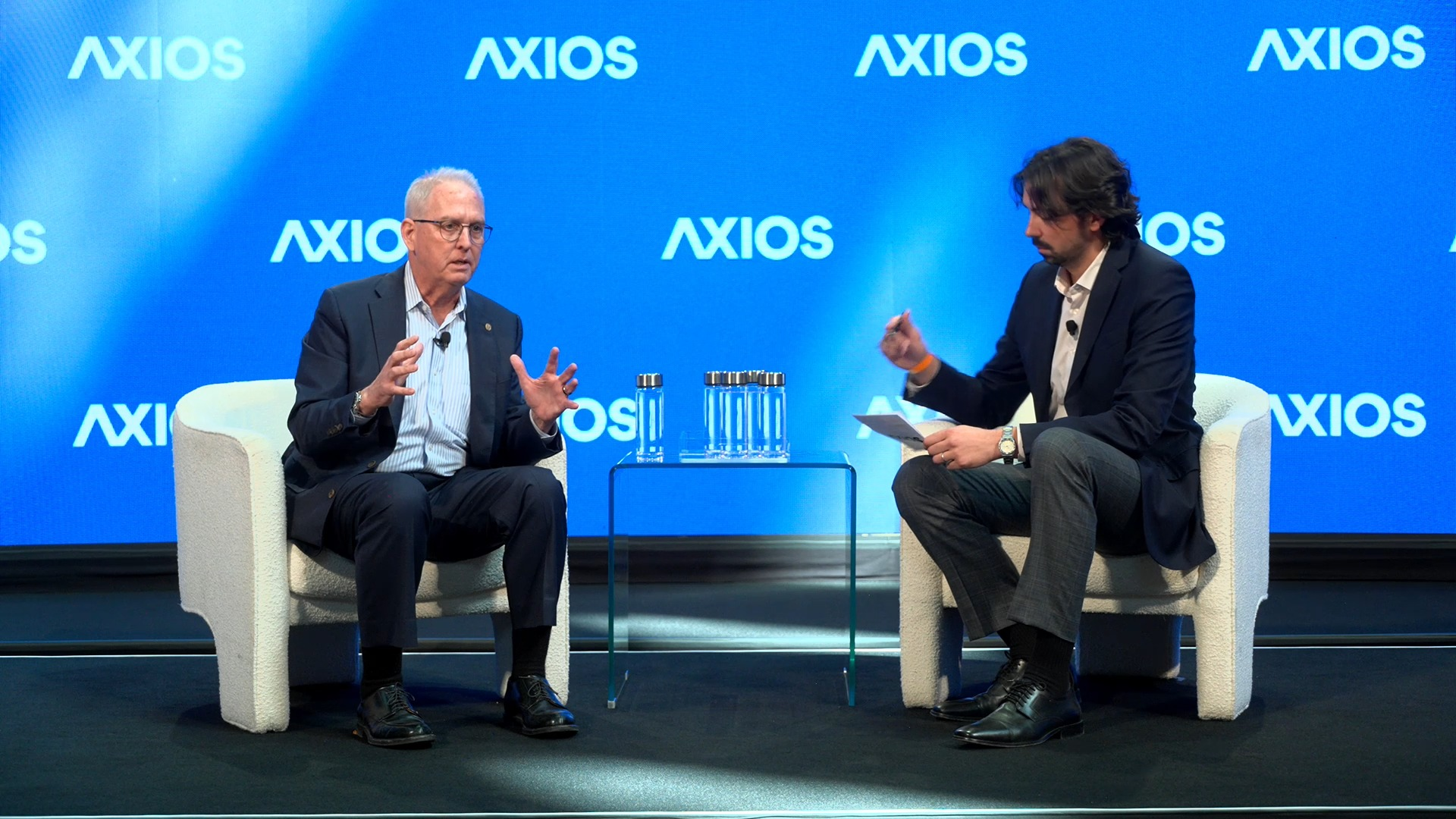
The future of warfare involves humans and machines working together, Lockheed Martin's chief technology officer Craig Martell predicted yesterday at Axios' AI+DC Summit.
Why it matters: As the military expands autonomous weapon use, debates are intensifying over when or whether to trust these systems and who is accountable for mistakes or misfires.
What they're saying: "I want us to really focus on human-machine teaming, because ... I don't believe statistics at scale is going to get us to cognitive machines," Martell said to Axios' Colin Demarest.
- He said it's a human's job to train with the AI system they plan to deploy and to figure out what errors and limitations it has.
- "Then you can make the rational decision if you want to take responsibility, to deploy that device, to deploy that platform."
- "I choose to use it," he said. "And if it gets it wrong, my fault."
Case in point: Martell envisions a pilot flying with a swarm of autonomous aircraft that can help protect the pilot.
Catch up quick: Martell previously served as the Defense Department's first chief digital and AI officer and understands how militaries are implementing AI into their classified systems.
Zoom in: The Army just received its first autonomous Black Hawk helicopter, which can complete missions independently or with remote supervision from a secure offsite location.
- The chopper is undergoing "rigorous" testing, and was developed with a Lockheed Martin subsidiary.
- The delivery reflects a broader push toward autonomous systems as drone warfare and unmanned vehicles become increasingly central to modern combat.
3. OpenAI's business reality shift

OpenAI's decision to shut down Sora — its AI video app — is the biggest signal yet of the company's shift away from splashy consumer plays meant to dazzle the masses and toward a more practical, business-grounded strategy.
Why it matters: Compute resources to power AI are in higher demand than ever, and OpenAI's flashier, energy-hungry, unprofitable offerings were bound to be the first heads to roll ahead of a potential IPO.
Catch up quick: OpenAI announced Tuesday it would shut down Sora, the video-generation app that went viral after its September launch.
- The company also says it won't support video generation in the ChatGPT app.
- OpenAI is retreating on multiple consumer fronts at once — on Tuesday it announced that it's changing its consumer shopping strategy toward product browsing and away from handling purchases.
Zoom in: Fidji Simo, OpenAI's CEO of applications, told employees last week the company is "orienting aggressively" toward high-productivity use cases and pausing all "side quests" to focus on coding and business users, according to CNBC.
- The company is still testing ads that will appear alongside conversations in free and cheap versions of ChatGPT, a move designed to impress potential investors, not the consumer.
Between the lines: The consumer products weren't just power hungry and unprofitable. They were also generating legal and reputational risk.
4. Training data
- Meta and YouTube were found liable and must pay $3 million in compensation to a woman who argued the companies were to blame for her social media addiction. (Axios)
- Apple's deal with Google allows it to run Gemini models in its own data center as well as to distill smaller versions. (The Information)
- Anthropic's deal with the Pentagon could be revived, insiders tell Axios.
- The President named Mark Zuckerberg, Sergey Brin, Jensen Huang, Lisa Su and others to his President's Council of Advisors on Science and Technology. (White House)
5. + This

I did get a chance to see the cherry blossoms in between rehearsal and the AI+ Summit itself. They were beautiful, but I still miss Stumpy.
Thanks to Megan Morrone for editing this newsletter and Matt Piper for copy editing.
Sign up for Axios AI+
