Axios AI+

May 07, 2024


Hi, it's Ryan coming to you from Washington, D.C., where Axios is a media partner at the AI expo of Eric Schmidt's Special Competitive Studies Project. Today's AI+ is 1,071 words, a 4-minute read.
Situational awareness: Digital publishing giant Dotdash Meredith reached an agreement to license its content to OpenAI, joining those publishers who've decided to deal with rather than sue the AI provider, Axios' Sara Fischer reports.
1 big thing: AI-powered marketing without prompts

Automating entire marketing campaigns — from crafting a message to targeting an audience — is the latest feat promised by generative AI, as a startup called Typeface launches a new all-in-one service shared first with Axios.
Why it matters: Marketing has emerged as one of the key early business uses for generative AI, alongside coding and customer support.
Driving the news: Typeface, led by former Adobe chief technology officer Abhay Parasnis, plans to announce Typeface Arc tomorrow.
- The software-as-a-service tool is capable of using a company's existing data, images, brand style and analytics to build marketing campaigns for new and existing products, including email outreach, blogs and social media posts.
- Arc can monitor how its campaigns are performing, offering up suggestions on which messages are landing with which audiences and suggesting tweaks that could be more effective.
The new product isn't cheap, and it isn't for everyone. It is aimed specifically at large businesses that can afford at least several hundred thousand dollars, or even millions of dollars, for a tool to run large campaigns.
Between the lines: The idea behind Arc is that AI tools can do a lot more when they're fed enough custom data and built directly into a specific workflow, instead of always starting with a prompt in a chat window.
- "That gets pretty old pretty quickly," Parasnis tells Axios.
As Parasnis sees it, phase one of the generative AI revolution was about broad tools like ChatGPT that could impressively answer a wide range of queries.
- The next phase will feature tools designed for specific roles and functions. "The second chapter is going to be very deep and narrow," he says.
He also rejects as "absurd" the idea that workers of the future are going to have to be experts at prompt engineering to get chatbots to spit out a desired result. "These AI models should get smart enough to learn how we work," he says.
The big picture: Marketers have flocked to generative AI, in part because the technology is really good at translating content from one format to another.
- Marketers are constantly reworking assets like photos, product specs and promotional text to suit specific media and audiences — and that sort of content transformation is one of generative AI's strengths.
- AI is also good at virtual photo shoots, allowing marketers to present a product against various backgrounds without having to physically create those scenes.
Yes, but: Much of the work is on complicated workflows and systems, Parasnis says, noting that globally companies spend about $35 billion on software for content each year and more than $100 billion for services.
- "That just tells you it is still a little bit in the Dark Ages," he says.
Zoom out: Arc builds on an earlier product, Typeface Hub, that focused on creating personalized marketing assets that combined text and images.
- Typeface's existing customers include one of the world's largest beverage companies, a giant global electronics firm and a large insurer, among other Fortune 500 companies.
- As of last year, the company had raised $165 million, including a $100 million Series B round that valued the company at $1 billion, with a roster of investors that includes companies like Salesforce, Google and Microsoft.
What's next: Parasnis believes the kind of transformation AI is enabling in marketing can occur in other sectors as generative AI tools improve.
- Already, Typeface is looking to expand Arc into other areas including worker training, internal communications and employee recruitment.
2. Musk: SpaceX uses virtually no AI

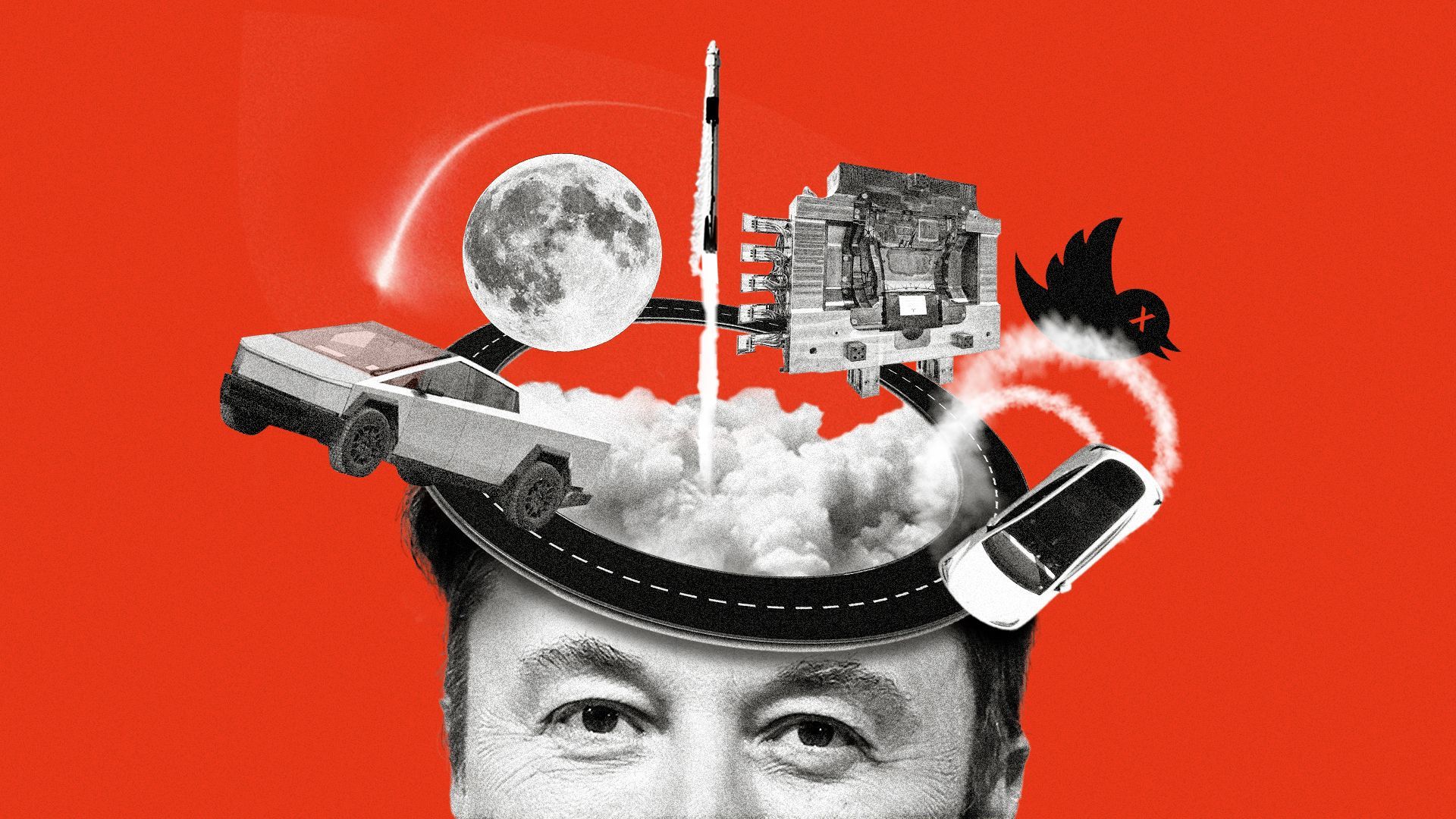
Elon Musk's space company SpaceX uses "basically no AI," he said last night at the Milken Global Conference in Los Angeles.
What they're saying: Though Musk thinks more than 99% of all intelligence will "eventually" be "digital" instead of "biological," current versions of artificial intelligence systems haven't proved useful for SpaceX's needs, Musk told interviewer Michael Milken onstage.
- "I'll ask it questions about the Fermi Paradox, about rocket engine design, about electrochemistry. And so far, the AI has been terrible at all those questions. So there's still a long way to go."
- Even Starlink, the company's internet satellite business and primary driver of SpaceX's valuation, "does not use AI," Musk said.
- "I'm not against using it. Just, we haven't seen a use for it."
The big picture: Since the launch of ChatGPT, companies big and small have rushed to prove they can harness generative AI, and Musk has pushed its deployment both on the X social network and through his new X.ai startup.
- Tesla's autos use more conventional AI extensively in various still-evolving, and controversial, driver assistance features.
- Musk was not asked about Tesla, and he did not bring it up, at last night's event.
One fun thing: When asked to respond to an audience question about what gives him joy, Musk responded: "I probably get the most joy from my kids."
- Asked what keeps him up at night, Musk said, "anything that's a civilizational risk," which includes plummeting birth rates and "anything that undermines the foundations of democracy in America or elsewhere" as well as "anything that's leading us away from a merit-based system."
- "I listen to podcasts about the fall of civilizations to fall asleep," he said.
The intrigue: Musk doesn't know what role humans will play if his theory that digital intelligence will replace biological brains proves correct.
- "I do think it's very important that we build the AI in a way that is beneficial to humanity," he said.
- "The AI should not be taught to lie, it should not be taught to say things that are not true. Even if those things are politically incorrect, it should still say what it believes to be true."
3. Training data
- OpenAI is now a steering committee member on the Coalition for Content Provenance and Authenticity. The ChatGPT maker joins Google, Microsoft, Meta and Adobe in supporting the AI-labeling standard.
- Apple is reportedly designing a range of AI chips for data centers. (Wall Street Journal)
- Microsoft is readying a powerful new AI model, which could be a direct competitor to the most powerful models of OpenAI, its partner — but Microsoft CTO Kevin Scott dismissed any suggestion of rivalry. (The Information, LinkedIn)
- Former President Trump's 2016 campaign manager Brad Parscale has reinvented himself as an evangelist for AI-generated campaign material for conservatives. (AP)
- Fei-Fei Li, known to many as the "godmother of AI," is working on a "spatial intelligence" startup, seeking new ways for AI to achieve advanced reasoning. (Reuters)
4. + This
This music video was made with Sora.
Thanks to Megan Morrone and Scott Rosenberg for editing this newsletter and to Caitlin Wolper for copy editing it.
Sign up for Axios AI+
