Axios AI+

May 08, 2024


Ina here.
Situational awareness: President Biden will travel to Wisconsin today, per administration officials, to unveil a $3.3 billion investment by Microsoft to build a new AI data center — on the same land once intended for a Foxconn plant touted by President Trump, which never materialized.
Today's AI+ is 1,200 words, a 4.5-minute read.
1 big thing: Autodesk's 3D AI play
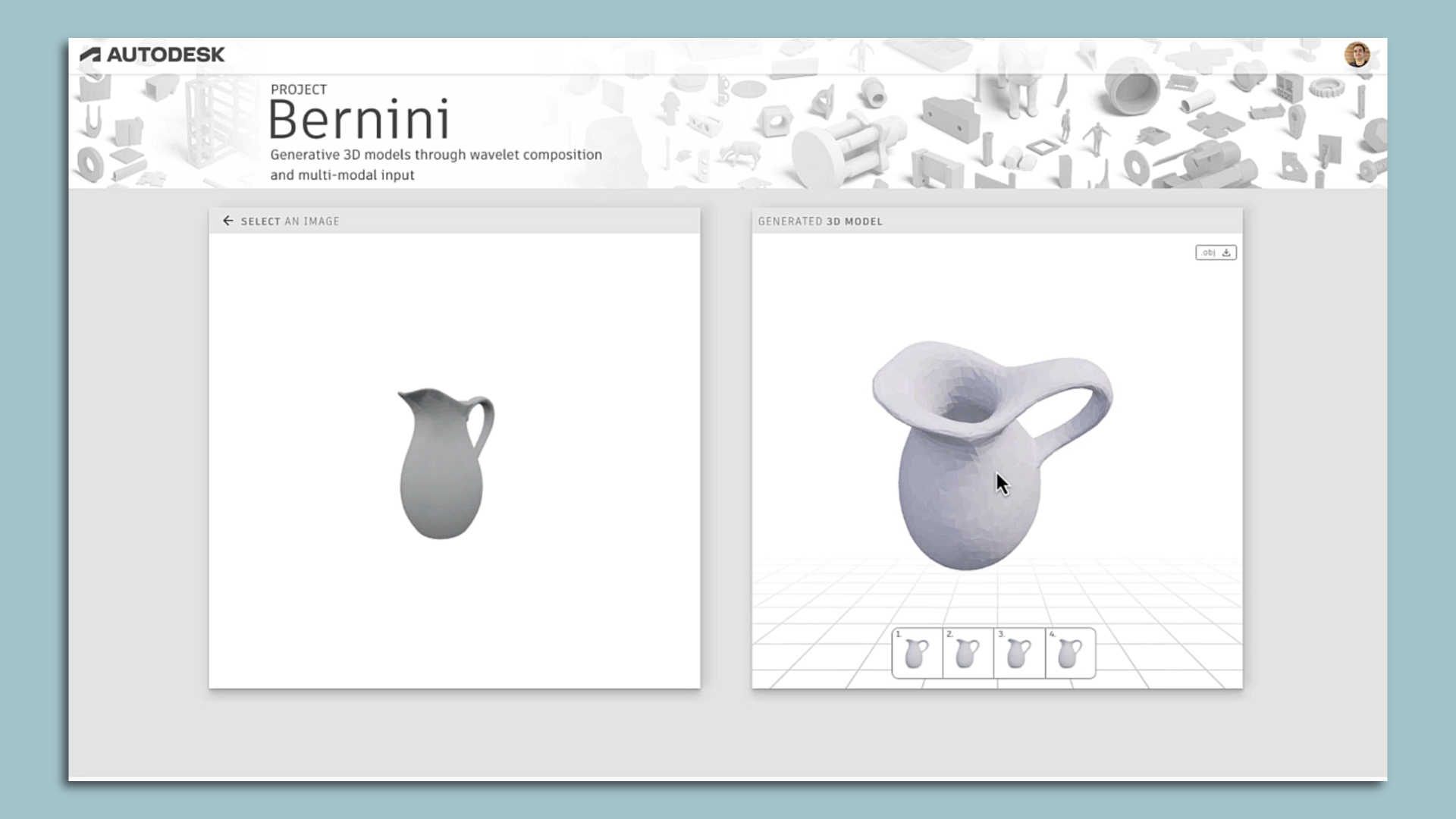
Autodesk, the venerable 3D software company whose tools are used by designers and architects around the globe, is showing off its most ambitious generative AI project to date: a text-to-3D tool called Project Bernini, demonstrated first to Axios.
Why it matters: 3D design and modeling — an essential part of the modern creative process in fields ranging from architecture and product development to drug research and robotics — is one more realm that's about to face the tidal wave of AI disruption.
- For software makers who can harness it effectively, generative AI can both democratize technology that was once limited to a few and improve productivity for professionals.
- By the same token, incumbents who don't get it right risk having their long-held franchises toppled by an upstart.
How it works: Project Bernini can create 3D images from a variety of input types including a text prompt, a single 2D image, multiple images and point clouds.
- The AI model that underlies Project Bernini is designed to have an understanding of how real-world objects tend to exist. For example, it can see an image of a water pitcher and understand that the resulting 3D image should be hollow and water-tight.
- Typing in the word "chair," meanwhile, will bring up a variety of 3D images of chairs. From there, a designer can further refine to reflect what they have in mind, using either text or another image.
- "The main thing is it actually produces good geometry, good shapes, because the designer wants good smooth surfaces, correct topology," Autodesk senior VP and research chief Mike Haley tells Axios.
Yes, but: Autodesk is only previewing the tool, which it says is experimental, and it is not making it publicly available yet.
The big picture: There are other text-to-3D tools out there, but Autodesk is banking that its offering will be the most successful at creating images that can fit into a professional workflow.
- Haley says Autodesk's model is designed to perform even better once companies train it on their own 3D content.
- "The reality is the internet is not populated with tons of great 3D content," Haley says.
- Companies could keep their tuned models to themselves, but Haley says there also could be an opportunity for those with substantial 3D libraries to license some of their content to help train models used by others — akin to what Adobe has done with Firefly.
Between the lines: Autodesk isn't the first to devise a 3D generative model. Nvidia released a tool last year, and startups like Luma and Meshy are already in the space.
- But Autodesk has long owned the 3D corner of the professional design software market, and it's claiming other advantages.
- Haley says one ability that helps Project Bernini stand out from rivals is that it starts by separating texture from the outline of the object itself.
- Many models, he says, get tripped up by mistaking the texture of a 3D object from its contours.
Fun fact: The project name is a reference to Gian Lorenzo Bernini, a 17th-century Italian artist and architect credited with creating the Baroque style of sculpture.
What's next: Haley says Autodesk is still considering different ways to turn the model behind Bernini into something customers can use.
- Among the options is a free web-based experience a la ChatGPT. "We're working through that right now," Haley says.
2. Employees race to bring their own AI to work

Three out of four "knowledge workers" around the world are using generative AI — but many of them are hiding it from their employers, according to a new joint report from LinkedIn and parent company Microsoft.
Why it matters: LinkedIn's data reveals that employees across industries are embracing AI, but simultaneously worry it's coming for their jobs.
The big picture: Because employees are using AI outside of official company strategy and rules, bosses are struggling to measure AI benefits and adjust their AI investments accordingly, per the 2024 Work Trend Index Annual Report from Microsoft and LinkedIn.
- All generations of knowledge workers are bringing their own AI tools to work, ranging from 73% of boomers to 85% of Gen Z, and a slim majority (52%) admit to using it on even their most important tasks.
Zoom in: Of AI users surveyed, 53% said they worry that if their employers know they're using AI to be more productive or creative, it will signal that they're replaceable.
- Of leaders surveyed, 66% said they wouldn't hire someone without AI skills, but only 39% of employees said their organization provides AI training.
- AI "power users" — defined as those who use generative AI at least several times a week and who save 30 minutes a day by doing so — have started to fundamentally reorganize their work days around AI use, they told LinkedIn.
How they did it: The survey that forms the basis of the report included 31,000 people across 31 countries. The results were combined with deep-dive research with Fortune 500 companies, hiring trends from LinkedIn and "trillions" of anonymized Microsoft 365 data points.
The intrigue: While workers are happy to dive into AI use, and told the pollsters they feel the productivity benefits, their bosses are struggling with AI.
- 79% of leaders believe their company needs to adopt AI to stay competitive, but 59% are worried they aren't effectively quantifying productivity gains from AI, and 60% worry their AI plans are insufficient.
What they're saying: "The AI moment is here," and "it's arriving from the bottom up" in workplaces, LinkedIn CEO Ryan Roslansky tells Axios.
- "Ignoring the technology is not an option right now," he says.
- Roslansky says LinkedIn estimates that, on average, 25% of the skills needed to perform a given job have changed since 2015. He's predicting that will rise to 70% by 2030.
He advises his own teenage daughter that "learning how to learn" and "a growth mindset, where you always learn new skills" are the best ways to stay competitive.
Behind the scenes: LinkedIn, owned by Microsoft, operates at an arm's length from its parent — but generative AI is one instance in which Roslansky has eagerly tapped into Microsoft's expertise.
- "This is year three for us integrating generative AI. Now every part of LinkedIn is being GenAI-ified," he says.
3. Training data
- The Department of Energy announced a sweeping new program yesterday that gives it a big, unique role in the federal government's AI research efforts. It's called the Frontiers in Artificial Intelligence for Science, Security and Technology initiative, or FASST. (Axios)
- Apple debuted a more powerful iPad Pro using a next-generation M4 processor yesterday, along with updates to the midrange iPad Air line, including a model with a larger 13-inch screen. (Axios)
- OpenAI is developing a feature for ChatGPT that would allow it to search the web and return results, including citations, sources tell Bloomberg. The move could put the company in greater competition with both Google and Microsoft, OpenAI's key backer and partner. (Bloomberg)
- The U.S. government is further tightening controls on Huawei, revoking licenses for certain chips and other components that had been OK'd for sale to the Chinese tech giant despite sanctions. (Reuters)
4. + This
There's no easy way to learn you've been traded to another team. But learning mid-game — while you are on base — seems particularly rough.
Thanks to Megan Morrone and Scott Rosenberg for editing this newsletter and to Caitlin Wolper for copy editing it.
Sign up for Axios AI+
