Axios AI+
March 20, 2025

For those who still want to get in on the Axios AI+ women's NCAA Tournament bracket contest, you have until 8:30am PT tomorrow to lock in your bracket. Plenty of folks (and bots) have already entered (password: beattherobots). Today's AI+ is 1,207 words, a 4.5-minute read.
1 big thing: White House copyright clash
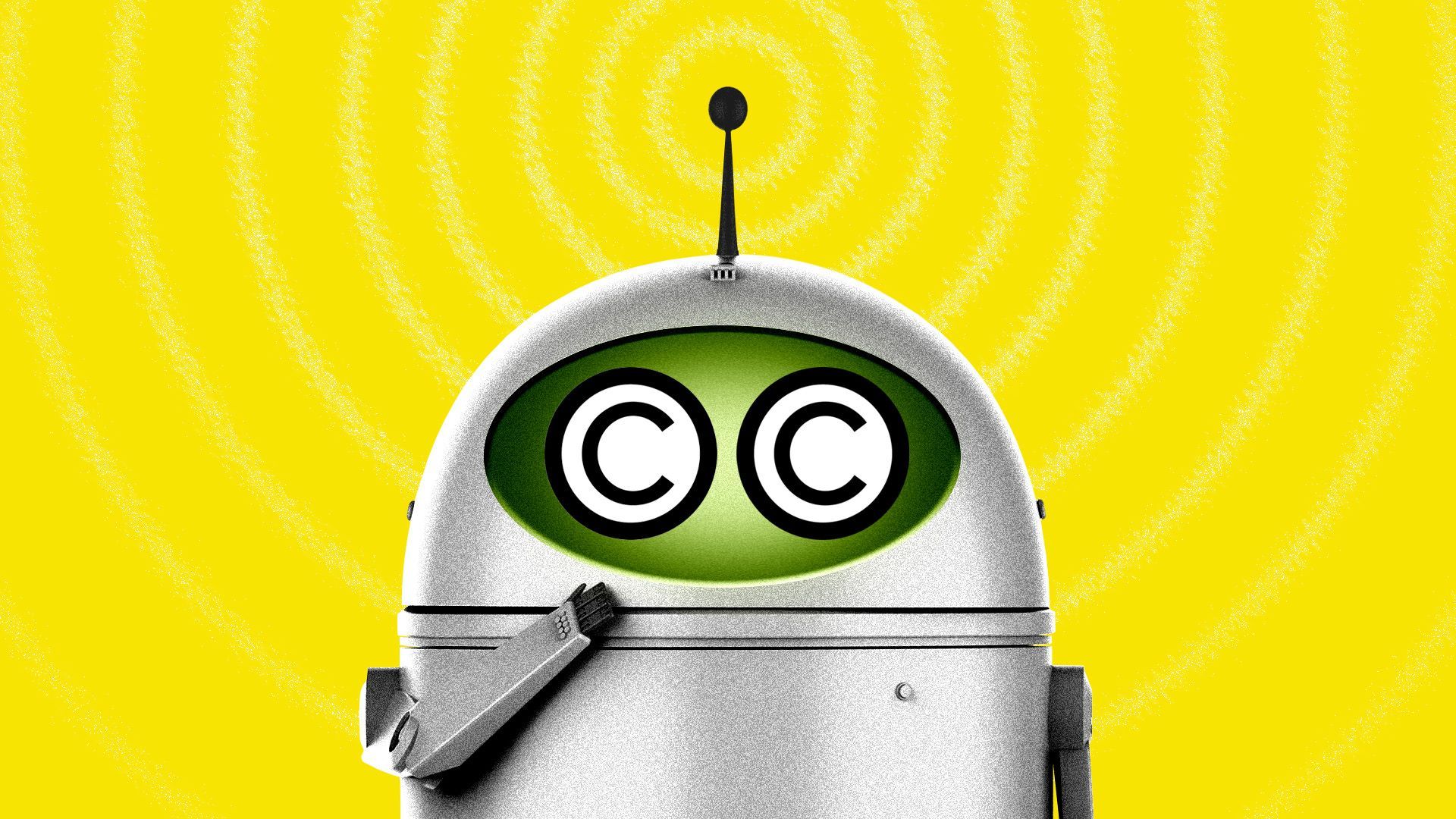
A sharp divide over AI engines' free use of copyrighted material has emerged as a key conflict among the firms and groups that recently flooded the White House with advice on its forthcoming "AI Action Plan."
Why it matters: Copyright infringement claims were among the first legal challenges following ChatGPT's launch, with multiple lawsuits now winding their way through the courts.
Driving the news: In their White House memos, OpenAI and Google argue that their use of copyrighted material for AI is a matter of national security — and if that use is limited, China will gain an unfair edge in the AI race.
- "If the [Chinese] developers have unfettered access to data and American companies are left without fair use access, the race for AI is effectively over," OpenAI said in its proposal.
- The companies make clear they would like to see executive or legislative action that guarantees their ability to train models on copyrighted material.
Yes, but: Fair use does permit limited use of copyrighted material without permission. At issue here is whether fair use principles are broad enough to cover the wholesale consumption of massive datasets in AI training.
The other side: Groups representing actors, filmmakers and publishers (among other creative professionals) used their filings, public statements and editorials to reject those arguments.
- The News/Media Alliance, a trade group that represents newspapers and other publishers, called for strong protection of copyrights.
- "OpenAI's submission to the Trump administration's AI Action Plan would undermine the American economy," N/MA CEO Danielle Coffey said in a statement to Axios. "Loosening standards for everyone else's creative IP might be convenient for them in the short run, but the long-run implications are bad for everyone."
- More than 400 Hollywood entertainers signed a letter warning that "America's global AI leadership must not come at the expense of our essential creative industries."
- The group, which included Paul McCartney, Ben Stiller, Lilly Wachowski, Cynthia Erivo (and dozens of other well-known actors, directors and filmmakers), noted that the U.S. arts and entertainment industry supports over 2.3 million jobs "while providing the foundation for American democratic influence and soft power abroad."
Zoom in: In its filing, startup Vermillio makes its own case for maintaining copyright protection. The company, which focuses on monetizing protected IP, uses OpenAI's ChatGPT to help bolster its case.
- "There are several areas in this document where the proposals seem to overstep bounds and could be seen as trampling on rights guaranteed to Americans," Vermillio quotes ChatGPT as saying.
The big picture: Publishers, writers, artists and others have filed suit against OpenAI, Microsoft, Google and other companies arguing their training and operation of generative AI systems violates intellectual property law.
- In the U.S., lawsuits are dominating the debate, while in the U.K. explicit legal protections for AI training are already on the table.
My thought bubble: There are options beyond not having access to copyright material or having totally free rein.
- The most obvious of these is that AI companies can — and indeed already are — paying to license such content. OpenAI has many such deals, while Microsoft, Google and Meta have also made deals for content they believe is critical to their work.
- And while the threat from China and other adversaries is real, the "if we don't do it, they will" approach could be used to argue for the abandonment of all sorts of protections.
Disclosure: Axios and OpenAI have a licensing and technology agreement that allows OpenAI to access part of Axios' story archives while helping fund the launch of Axios into four local cities and providing some AI tools. Axios has editorial independence.
2. The future of mobility is driven by AI


Gigantic leaps in artificial intelligence and other technologies are enabling a future where cars don't crash or pollute the air, and everyone can go where they want, regardless of their age, abilities or the size of their wallets.
Why it matters: This is the vision I'll be writing about each Wednesday in Axios' newly launched Future of Mobility newsletter.
- Robots will handle most of the driving, while passengers relax (or work) in cabins customized to their personal preferences.
- Cars will learn passengers' routines, tailoring the ride experience to their mood, and automatically suggesting reminders or conveniences.
- Gasoline stations will gradually disappear, replaced by EV charging stations decked out with restaurants, workspaces and other amenities.
- On-demand robotaxis will cruise efficiently about cities, eliminating the need for land-gobbling parking lots.
Yes, but: After years of frustration and slow progress, only one company — Waymo — operates a real commercial robotaxi service today.
- General Motors scrapped its ambitious Cruise robotaxi effort, while Tesla is hoping a robotaxi launch this summer will distract from its plunging EV sales.
Despite these setbacks, AI breakthroughs could be the key to finally making autonomous vehicles mainstream.
The intrigue: Huge leaps in generative AI are enabling a new approach to autonomy using end-to-end, self-learning systems.
- Instead of driving millions of test miles and then manually coding instructions for every edge-case scenario, AV 2.0 systems use advanced AI to train a virtual driver how to reason like a human — even in unfamiliar driving situations.
Stunning stat: U.K.-based Wayve says its AI easily adapted to U.S. roads (including driving on the opposite side of the road!) after just 500 hours of local training.
Meanwhile, Continental has developed a tiny, high-definition projector that beams content onto a vehicle's side windows, visible to people outside the car.
How it works: The mini-projector is embedded in the car's headliner.
- When activated, the AI-enabled system darkens the rear windows to display personalized, context-based information in high resolution.
- Intelligent software co-developed with Banbutsu, an AI digital platform, makes suggestions based on real-time data from the vehicle's sensors, learned preferences and other contextual data.
Why it matters: One way it could be useful is helping to locate your Uber at the airport.
- Instead of trying to read license plates from a distance, you see your name and image projected on the side of an approaching car and know instantly that's your ride.
Yes, but: For the sake of privacy, I wouldn't want an Uber to project my destination on the car's window, as Continental demonstrated.
My thought bubble: It's only a matter of time before cars are using this technology to project advertisements on their windows.
The bottom line: The once-in-a-century transformation of the auto industry has reached an inflection point.
- Carmakers need to do something different, and do it quickly.
- The auto industry is likely to change more in the next five years than it did in the last 100.
3. Training data
- Nvidia CEO Jensen Huang said the chip giant will spend "hundreds of billions" in the U.S. over the next four years to build a domestic supply chain. (Financial Times)
- OpenAI debuted o1-pro, a more powerful and pricier reasoning model available to a select few developers. (TechCrunch)
- SoftBank will acquire server chip startup Ampere for $6.5 billion, betting on its potential to power AI data centers. (New York Times)
- The European Union ordered Apple to make its devices more open to third-party accessories, such as headphones and smartwatches. (Reuters)
4. + This
I'm not sure I need this Atari smartwatch, but I kind of need it. I mean, c'mon, "Centipede" and "Pong" on your wrist?
Thanks to Scott Rosenberg and Megan Morrone for editing this newsletter and Matt Piper for copy editing it.
Sign up for Axios AI+
