Self-driving cars — powered by AI

Add Axios as your preferred source to
see more of our stories on Google.
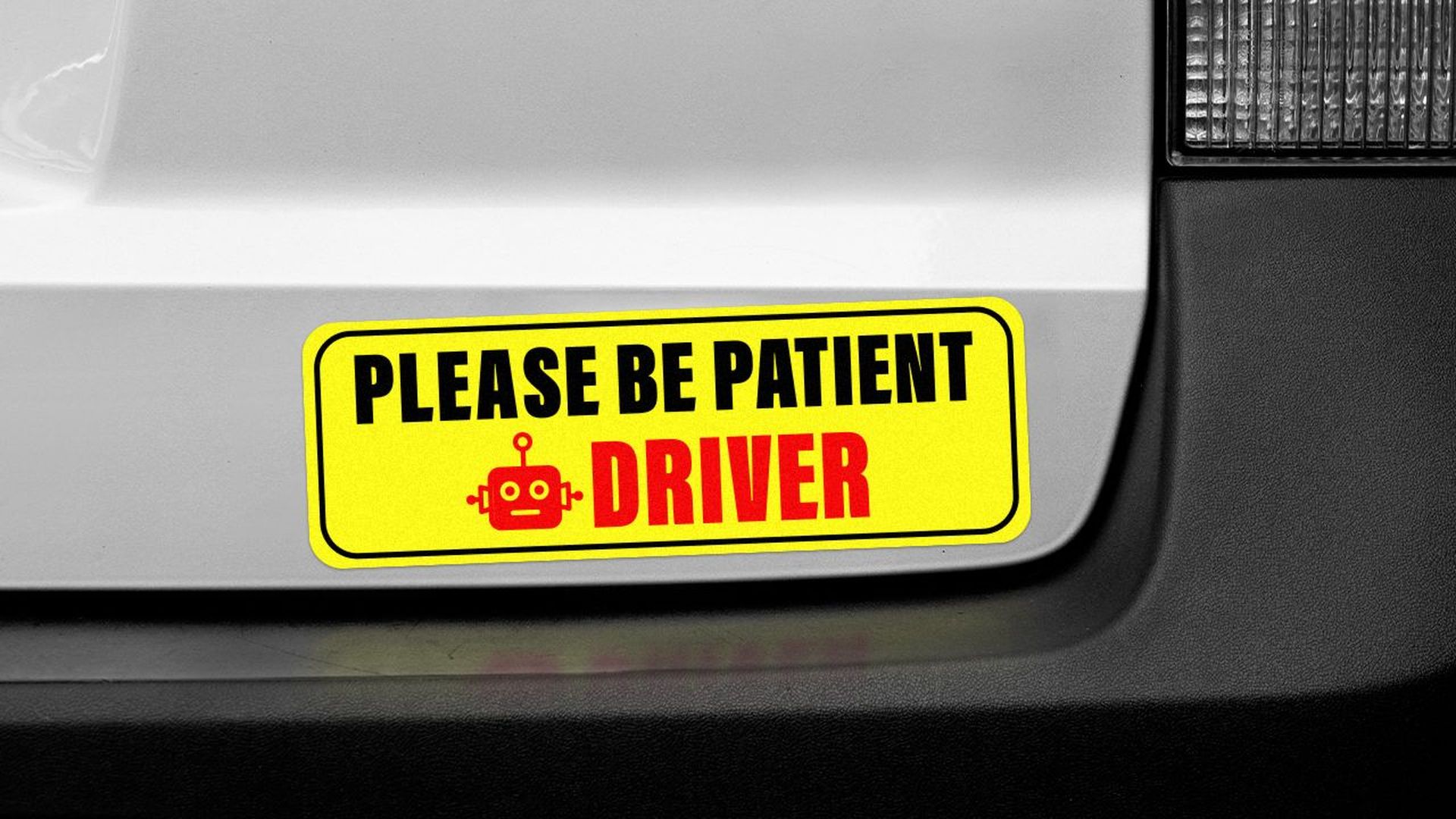
The advancements in artificial intelligence that brought us AI chatbots and image generators are now fueling a fresh approach to self-driving cars.
Why it matters: Autonomous vehicle (AV) development is essentially stuck — it's still too difficult and expensive to scale up the technology into a profitable business.
Driving the news: As AI begins to leap from the digital realm into the physical world, investors are pouring fresh capital into this next phase of AV development — "AV 2.0."
- Driverless truck company Waabi said today it had raised $200 million in an oversubscribed Series B round led by Uber and Khosla Ventures.
- That follows a huge deal last month by Wayve, a U.K.-born startup, which raised $1.05 billion in a Series C round led by SoftBank Group.
- Nvidia, one of the biggest names in AI, participated in both deals.
- SoftBank also invested a reported $1 billion last September in Stack AV, an automated trucking company founded by former Argo AI execs.
The big picture: These AV 2.0 companies are developing self-learning systems for autonomous driving.
- Using AI, their goal is to teach a virtual driver to reason like a human so it can make snap decisions correctly and safely — even in novel situations.
Catch up quick: The original approach to AV development involved racking up millions of miles in test cars, collecting data that could be used to program self-driving algorithms with step-by-step instructions.
- Companies drove around 24/7 hunting for "edge cases" — rare events like the woman in a wheelchair chasing a duck that a Waymo test vehicle encountered in 2018.
- Alternative testing methods such as simulation are useful, though it's still time-consuming and capital-intensive to write an AV instruction manual.
The latest approach, driven by extraordinary leaps in generative AI, is based on intuitive learning, enabling AV companies to accelerate tech development.
- Waabi, for example, was founded in 2021 — well behind industry rivals — but says it has made speedy progress and is aiming to launch fully driverless trucks by 2025, roughly the same timeline as its rivals.
Zoom in: Waabi's Spanish-born founder and CEO, Raquel Urtasun, is an AI pioneer who helped lead Uber's now-defunct autonomy project.
- The Toronto-based startup invented what's called an end-to-end AI system capable of human-like reasoning.
- It requires significantly less training data and compute resources than other approaches — and can be tested in "Waabi World," an advanced virtual simulator.
Yes, but: Waabi still faces the same bar for safety.
- "Learning-based AVs can be taught driving skills more quickly, but the black-box nature of machine learning-based behavior makes it more difficult to validate safety," AV safety expert Philip Koopman, an associate professor at Carnegie Mellon University, tells Axios.
- "Even if you drive a billion miles in simulation, you still need to make sure the simulation wasn't missing edge cases that will cause crashes in the real world."
What they're saying: Waabi's system is "provably safe," Urtasun tells Axios, because its decisions can be interpreted and traced, unlike other "black box" AV systems.
- "The industry needs a big step forward in terms of proving the safety of their systems," says Urtasan, whose claims will be outlined in an upcoming white paper.
- "Incumbents ... will say, 'If I have driven enough miles, I should be safe.' That's not a sign of whether you are safe. It's only a sign of how much cash you spent driving."
Reality check: Generative AI, as fascinating as it is, remains far from perfect, as anyone who has played around with ChatGPT has discovered.
- No one wants a self-driving car to experience the kind of AI hallucination that urges you to put glue on a pizza.
The bottom line: When artificial intelligence comes to the physical world, the stakes become a lot higher.
