Axios AI+

October 17, 2024

I'm wearing purple today for Spirit Day.
Today's AI+ is 950 words, a 3.5-minute read.
1 big thing: The AI manifesto is having a moment

Writing a manifesto predicting a glorious AI-driven future has become a mandatory ritual for AI leaders.
Why it matters: The compulsion to share utopian AI roadmaps might mean that these CEOs and investors see breakthroughs right around the corner in their labs — and they want to make sure the world knows just how close we are to nirvana.
Yes, but: It could instead mean that they know the industry has been slow to deliver on its promises, and an impatient public still isn't fully sold on the value of AI, so they'd better do a happy tap-dance.
Driving the news: Last weekend Dario Amodei, CEO and cofounder of Anthropic, published an essay titled "Machines of Loving Grace."
- "Most people are underestimating just how radical the upside of AI could be," Amodei writes — "just as I think most people are underestimating how bad the risks could be."
- Amodei outlines AI's promise to transform five key areas: "Biology and physical health, neuroscience and mental health, economic development and poverty, peace and governance, and work and meaning."
- He says that what he calls "powerful AI" and what others in the industry dub AGI (for "artificial general intelligence") "could come as early as 2026, though there are also ways it could take much longer."
- In Amodei's best-case scenario, "we alleviate disease, poverty, and inequality...liberal democracy becomes the dominant form of government, and existing liberal democracies become better versions of themselves."
If all this sounds a little giddy, Amodei does provide a raft of scholarly caveats and takes a positively humble tone compared to the predictions in OpenAI CEO Sam Altman's "The AI Age," a similar manifesto posted last month.
- Altman envisions "shared prosperity to a degree that seems unimaginable today; in the future, everyone's lives can be better than anyone's life is now."
But both CEOs' broadsides read like modest musings next to the Nietzschean bluster of Marc Andreessen's "Techno-Optimist Manifesto" from last year.
- "We believe we are poised for an intelligence takeoff that will expand our capabilities to unimagined heights," Andreessen wrote. "We believe Artificial Intelligence is our alchemy, our Philosopher's Stone — we are literally making sand think."
- It doesn't seem to bother Andreessen that alchemy was bunk, and the Philosopher's Stone a myth.
Our thought bubble: The manifesto flood suggests something amiss in the AI world.
- Industries that are selling a technology the public already wants generally don't feel compelled to draft essays explaining its value — they're too busy shipping products and supporting customers.
- When the iPhone took off, no one needed a manifesto to understand what was happening.
- The early era of the internet had its share of grand pamphleteering, but those manifestos were written by visionary authors and thinkers, not startup founders who'd raised billions of dollars.
- And while there have always been startups that launch their companies with a manifesto, it's very unusual for an entire industry that's deep into its development to feel the need to explain itself this way.
The other side: Some leaders are telling us AI is delivering concrete benefits in the present rather than hypothetical ones in the future. Nvidia CEO Jensen Huang made this case on a recent podcast:
- "Go talk to digital biologists, climate tech researchers, material researchers, physical scientists, astrophysicists, quantum chemists," Huang said.
- "You go ask video game designers, manufacturing engineers, roboticists — pick your favorite, whatever industry you want to go pick. And you go deep in there, talk to the people that matter, and you ask them: Has AI revolutionized the way you work?"
- "You take those data points, you come back, and you get to ask yourself how skeptical do you want to be? Because they're not talking about AI as a conceptual benefit someday — they're talking about using AI right now."
2. Amazon's new color Kindles
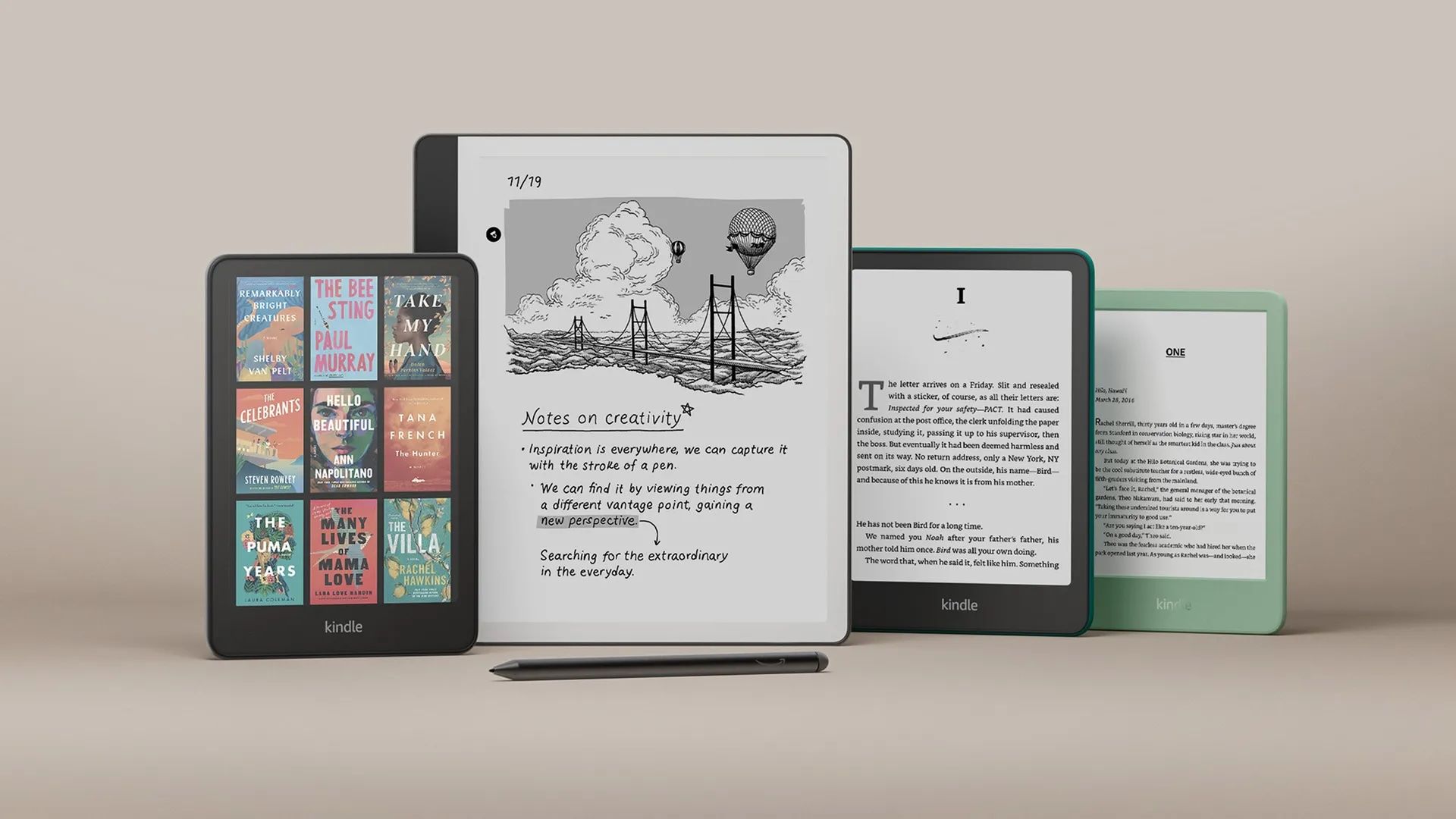
Amazon introduced its first Kindle with a color screen, as well as several other new e-readers, at a New York event yesterday.
Why it matters: So far Amazon has used its pre-holiday hardware launches to focus on incremental hardware advances rather than AI-related software improvements.
Driving the news: Amazon debuted the $279 Kindle Colorsoft Signature Edition, as the color screen e-reader is known. The device is waterproof, supports wireless charging and is slated to begin shipping Oct. 30.
- The company also announced a second generation of its Kindle Scribe, including an AI document summary feature and a redesigned digital pen. While reMarkable recently launched a color screen version of its rival large-screen note taking device, Amazon's remains a black-and-white proposition.
- Amazon also updated its Kindle Paperwhite with a larger display and faster page-turning, and debuted a lighter version of its entry-level Kindle e-reader.
The big picture: Amazon, like others, is trying to update its key consumer hardware ahead of the holiday shopping season.
- Apple on Tuesday debuted an updated iPad mini that maintains most of the same features as its predecessor, but with more memory and a faster processor to support Apple Intelligence.
3. Training data
- An unknown group coordinated an AI bot army of nearly 700 fake profiles to promote Republican candidates on X, per recent research from Clemson University. (NBC News)
- French AI company Mistral released a new generative AI model designed for phones and laptops. (TechCrunch)
- Toyota and Hyundai's Boston Dynamics are working together to develop multitasking AI robots for eventual use in factory assembly lines and elder care. (Bloomberg)
- Hong Kong police said they arrested a group using AI face-swapping tools to lure victims into a $46 million crypto investment romance scam. (The Record)
4. + This
Just wow. With one second to go, Sabrina Ionescu drained this three-pointer from distance to win the game last night and put her New York Liberty one victory away from the franchise's first WNBA championship.
Thanks to Megan Morrone and Scott Rosenberg for editing this newsletter and to Anjelica Tan for copy editing it.
Sign up for Axios AI+
