Axios AI+
September 08, 2026


Ina here. It was a quiet Labor Day weekend in San Francisco, which gave me time to play with Astra and some other new AI tools coming very soon. Check out Axios.com/technology today for the latest, and I will have more to say in tomorrow's newsletter. Today's AI+ is 1,241 words, a 4.5-minute read.
1 big thing: Google's general counsel on AI
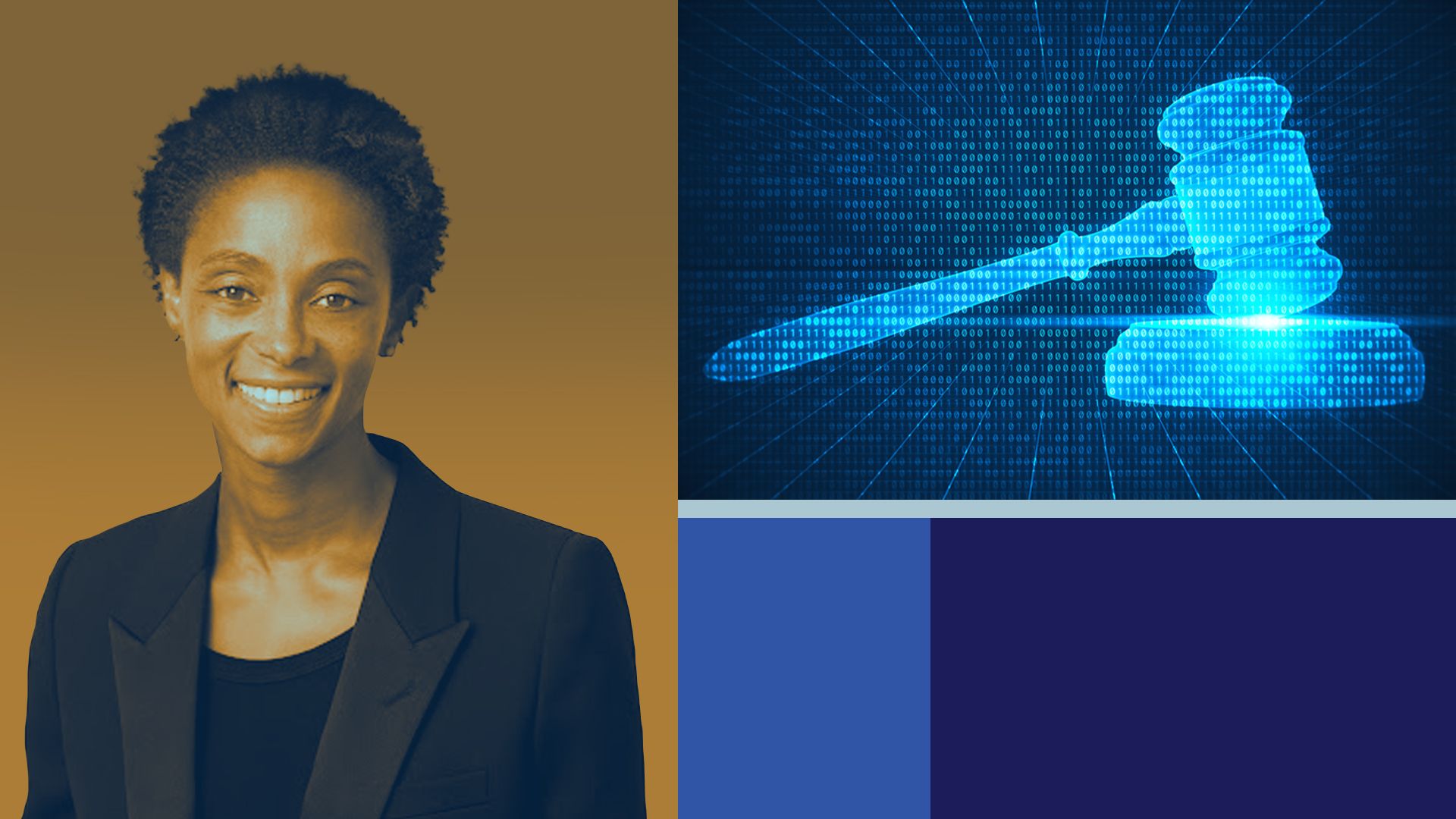
AI could help democratize good legal advice, but should not be seen as a replacement for human lawyers and judges, Google's general counsel tells Axios.
Why it matters: Google, which just entered the legal-specific AI space, is jumping into a fast-growing but crowded segment that already includes Thomson Reuters' CoCounsel and startups such as Harvey.
- "I view it as a complement, not a replacement," Halimah DeLaine Prado said in a wide-ranging interview.
Driving the news: Google last month released Gemini Enterprise for Legal, an AI platform designed for law firms and in-house legal teams. It can help with legal briefs, citation verification, contract management, regulatory monitoring and data discovery.
Between the lines: But the key word there is help.
- "The practice of law will always fundamentally rise and fall on the exercise of good judgment," DeLaine Prado said.
- "You can now access that information in minutes, not days, which gives you more time to think," DeLaine Prado said.
The big picture: DeLaine Prado said Google's legal department is already using AI for contract redlining, regulatory tracking, e-discovery, litigation preparation and retrieving institutional knowledge.
- And she is particularly optimistic about the technology's potential to help smaller firms and legal aid organizations compete with larger practices.
- "The quality of the lawyering should not be contingent on whether or not somebody has a big budget for their tech," she said.
The other side: The news has been rife with examples of lawyers being chastised by judges after filing legal briefs with false case citations and other AI-induced "hallucinations."
- A Georgia Supreme Court ruling this year suspended Clayton County assistant district attorney Deborah Leslie from practicing before the court for six months after she acknowledged using AI to write a filing that included nonexistent cases.
- The federal 9th Circuit Court of Appeals separately sanctioned two lawyers over briefs containing nonexistent cases, misattributed quotations and serious misrepresentations of real cases. The court stressed that it was not punishing them simply for using AI, but for failing to meet their existing duties of competence and candor.
- In all, more than 2,000 cases involving generative AI hallucinations have been identified by legal researcher Damien Charlotin.
Zoom in: There are other concerns, including AI's potential to upend the traditional hourly billing system, the impact on lawyers whose traditional early career tasks are being handled by AI, and the automation of bias.
2. Goldman CIO: Don't rule out open models
Goldman Sachs' chief information officer Marco Argenti says companies shouldn't rule out the use of open-weight models, so long as they follow a set of safeguards he shared exclusively with Axios.
What they're saying: If safeguards are properly followed, businesses, including banks, should have "enough guarantees to essentially run any model, regardless of where they come from," Argenti told Axios.
- "I don't think a priori we should block access to any model," and instead we should ask "under which conditions could I run any model, including the Chinese models," he added.
- Goldman's current open-model usage is "mostly or exclusively" U.S.-based, Argenti said.
Why it matters: The Trump administration has not made its voluntary framework for AI public, but a source tells Axios that it excludes open models.
- Treasury Secretary Scott Bessent and White House Office of Science and Technology Policy director Michael Kratsios have recently posted in support of American open-source AI, Axios' Maria Curi writes.
Argenti's proposed approach borrows two concepts from cybersecurity: "zero trust," or assuming a model could already be compromised, and "defense in depth," or putting several independent layers of protection between the model and a company's systems.
- He breaks that into four layers: model testing and certification, secure inference environments, tightly monitored agent permissions and controlled access to enterprise data.
- Goldman already applies part of that philosophy: Its AI systems don't get direct access to underlying data sources, Argenti said, instead going through the bank's data platform, which enforces access controls.
Zoom out: Argenti's view comes amid a groundswell of support for the open ecosystem, including from Nvidia CEO Jensen Huang. Nvidia just agreed to pay $13 billion for open-source platform Hugging Face.
- The U.S. should measure its AI competitiveness by the strength of its open ecosystem as well as its closed frontier labs, Argenti said, calling the two "equally important."
How it works: Open models can give companies more control and choice because the weights of the model can be adapted.
- They can also be better from an enterprise IP perspective because companies can run them on infrastructure they control.
What we're watching: "We want to be in a position to have choice without adding risk," Argenti said.
- With enough layers of defense, he argues, companies should be able to run "essentially any model" without materially increasing risk.
3. AI is changing math


OpenAI released GPT-6 Astra last week, a model the company says generated new results on long-standing open math problems.
Why it matters: AI's growing ability to tackle complex math could accelerate discoveries in medicine, engineering and other math-dependent fields.
Driving the news: OpenAI says Astra resolved or made "substantial progress" on 10 decades-old math and theoretical computer science problems.
- Astra produced results in high-dimensional geometry, coding theory, group theory, quantum complexity, lattice cryptography and combinatorics.
- OpenAI released papers and reasoning walk-throughs for the results.
State of play: Anthropic and Google have also reported advances in AI-driven mathematics.
- An unreleased research version of Claude made a major improvement on decades-old work related to the Riemann hypothesis, a problem that dates back to 1859 and comes with a $1 million prize for anyone who solves it.
- Earlier systems from Google DeepMind reached medal-level performance on International Mathematical Olympiad problems.
- Anthropic says Claude spent 11 days formalizing an existing proof of Fermat's Last Theorem in Lean, producing what the company calls the first complete computer-checked proof of the famous theorem.
The big picture: AI is starting to find connections that can lead mathematicians and researchers in unexpected directions.
- MIT mathematician Andrew Sutherland said Claude's work showed that AI is "capable of doing interesting mathematical research, as opposed to just solving specific problems that are fed into it."
- Google DeepMind says AlphaEvolve discovered a new matrix-multiplication algorithm that Google deployed inside its own data centers and AI training systems last year.
Between the lines: The way researchers are using these models is surprisingly informal. Anthropic employees asked Claude to "take a real stab" at the Riemann hypothesis and "believe in yourself" after an initial run failed.
4. Training data
- Abu Dhabi-based G42 is weighing whether to give greater ownership to U.S. firms in an effort to ensure continued access to American chips. (Bloomberg)
- Anthropic reportedly walked away from a $6 billion purchase of Decart, a startup that helps reduce the cost of AI training. (Bloomberg)
- Mistral was valued at $24 billion as it positions itself as a European alternative to rivals OpenAI and Anthropic. (CNBC)
- OpenAI expanded its policy team amid a bipartisan effort to regulate AI safely. (Axios)
5. + This
AI companies love to tout their model's trip-planning abilities, but if you are hiking, it's best not to rely only on AI, as this group found out the hard way.
Thanks to Megan Morrone for editing this newsletter and Matt Piper for copy editing.
Sign up for Axios AI+
