Exclusive: Google's general counsel says AI can't replace human judgment

Add Axios as your preferred source to
see more of our stories on Google.
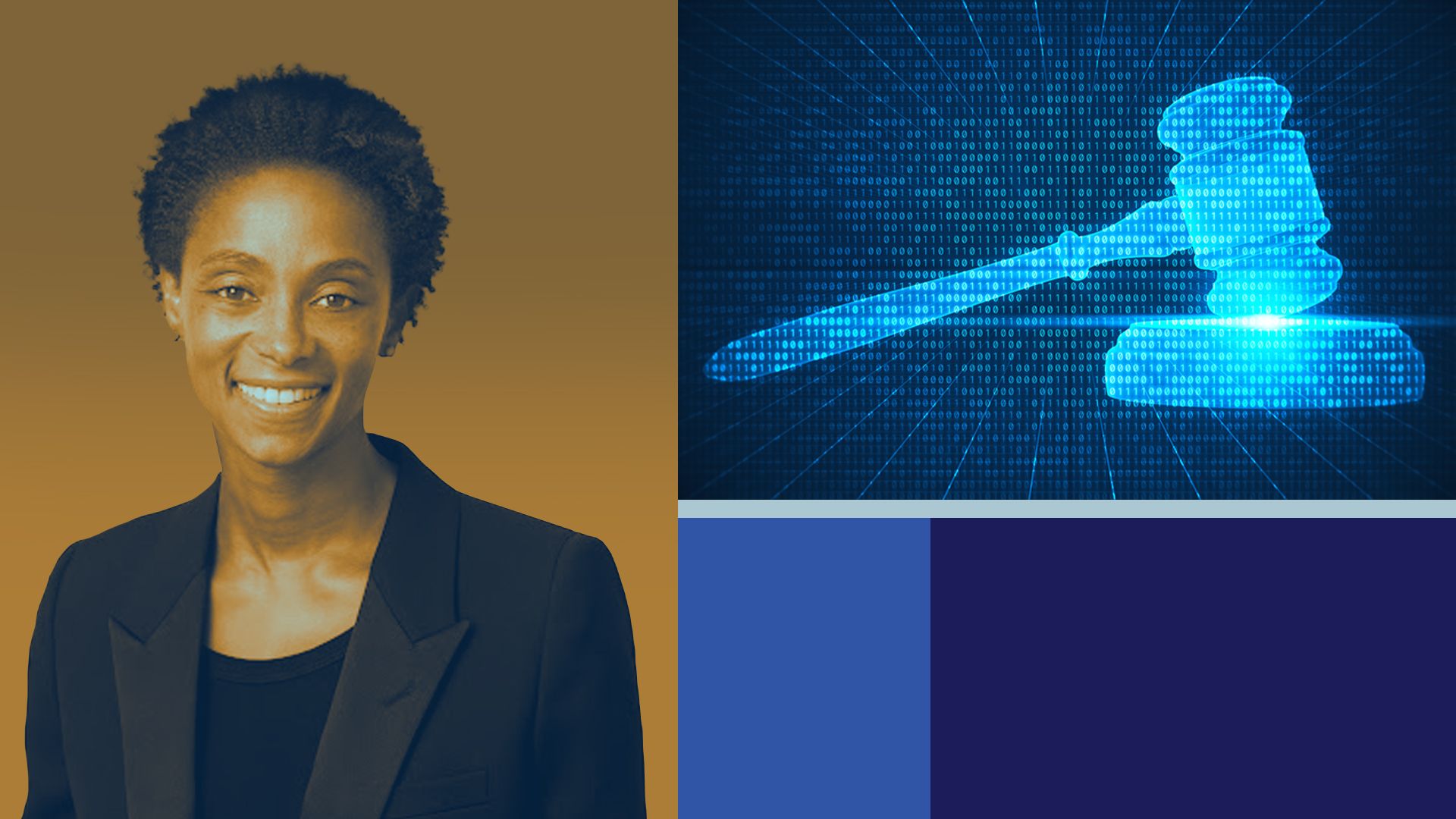
Photo illustration: Axios Visuals. Photo: Courtesy of Google
AI could help democratize good legal advice, but should not be seen as a replacement for human lawyers and judges, Google's general counsel tells Axios.
Why it matters: Google, which just entered the legal-specific AI space, is jumping into a fast-growing but crowded segment that already includes Thomson Reuters' CoCounsel and startups such as Harvey.
- "I view it as a complement, not a replacement," Halimah DeLaine Prado said in a wide-ranging interview.
Driving the news: Google last month released Gemini Enterprise for Legal, an AI platform designed for law firms and in-house legal teams. It can help with legal briefs, citation verification, contract management, regulatory monitoring and data discovery.
Between the lines: But the key word there is help.
- "The practice of law will always fundamentally rise and fall on the exercise of good judgment," DeLaine Prado said.
- AI can gather and synthesize information far faster than lawyers. But it cannot be the final decision-maker, she said.
- "You can now access that information in minutes, not days, which gives you more time to think," DeLaine Prado said.
The big picture: The legal profession has long been viewed as a ripe target for AI assistance because it is expensive, document-heavy and built around enormous bodies of case law, filings and other records.
- DeLaine Prado said Google's legal department is already using AI for contract redlining, regulatory tracking, e-discovery, litigation preparation and retrieving institutional knowledge.
- And she is particularly optimistic about the technology's potential to help smaller firms and legal aid organizations compete with larger practices.
- "The quality of the lawyering should not be contingent on whether or not somebody has a big budget for their tech," she said.
The other side: The news has been rife with examples of lawyers being chastised by judges after filing legal briefs with false case citations and other AI-induced "hallucinations."
- A Georgia Supreme Court ruling this year suspended Clayton County assistant district attorney Deborah Leslie from practicing before the court for six months after she acknowledged using AI to write a filing that included nonexistent cases.
- The federal 9th Circuit Court of Appeals separately sanctioned two lawyers over briefs containing nonexistent cases, misattributed quotations and serious misrepresentations of real cases. The court stressed that it was not punishing them simply for using AI, but for failing to meet their existing duties of competence and candor.
- In all, more than 2,000 cases involving generative AI hallucinations have been identified by legal researcher Damien Charlotin.
Zoom in: There are other concerns, including AI's potential to upend the traditional hourly billing system, the impact on lawyers whose traditional early career tasks are being handled by AI, and the automation of bias.
- If AI allows outside lawyers to complete in minutes work that once took hours, firms may need to be paid differently, DeLaine Prado acknowledged.
- The American Bar Association has said lawyers may bill for time they actually spend using and reviewing AI, but not for time the technology eliminates.
- "That raises the question of how does a firm then get compensated for the judgment that they've been asked, or the opinions they've been asked to share," she said.
Another concern is the degree to which AI will upend the way new lawyers learn the ropes. Junior lawyers traditionally learn through research, document review and drafting — precisely the kinds of tasks AI can now handle.
- Law schools are also trying to juggle teaching students to be AI-aware, without short-circuiting the development of key critical thinking skills.
- UC Berkeley's law school changed its AI policy, effective this summer, prohibiting AI assistance for outlining, drafting, revising or editing work submitted for credit, along with any AI use during exams.
- DeLaine Prado said she is less worried about that concern. "I think it gets resolved the same way it got resolved when I became a lawyer and we were moving from going to a law library to using Westlaw and [Lexis]," she said.
There are also harder-to-measure risks, including confidentiality, privilege and the possibility that automated legal systems could automate and scale existing bias.
What we're watching: DeLaine Prado expects her eventual successor to have AI agents but doesn't expect to hand the reins to an AI bot.
- "We employ agents now," she said. "So I should hope that the next general counsel is also using those same agents."
- Her bet is that AI will give lawyers more time for judgment, strategy and novel arguments. The open question is whether the profession can preserve enough human training — and enough human accountability — to make that bet work.
