Axios AI+

August 19, 2025

In a gut punch to parents everywhere, "skibidi" has been added to the dictionary. Today's AI+ is 1,084 words, a 4-minute read.
1 big thing: Adobe gives PDFs an AI boost
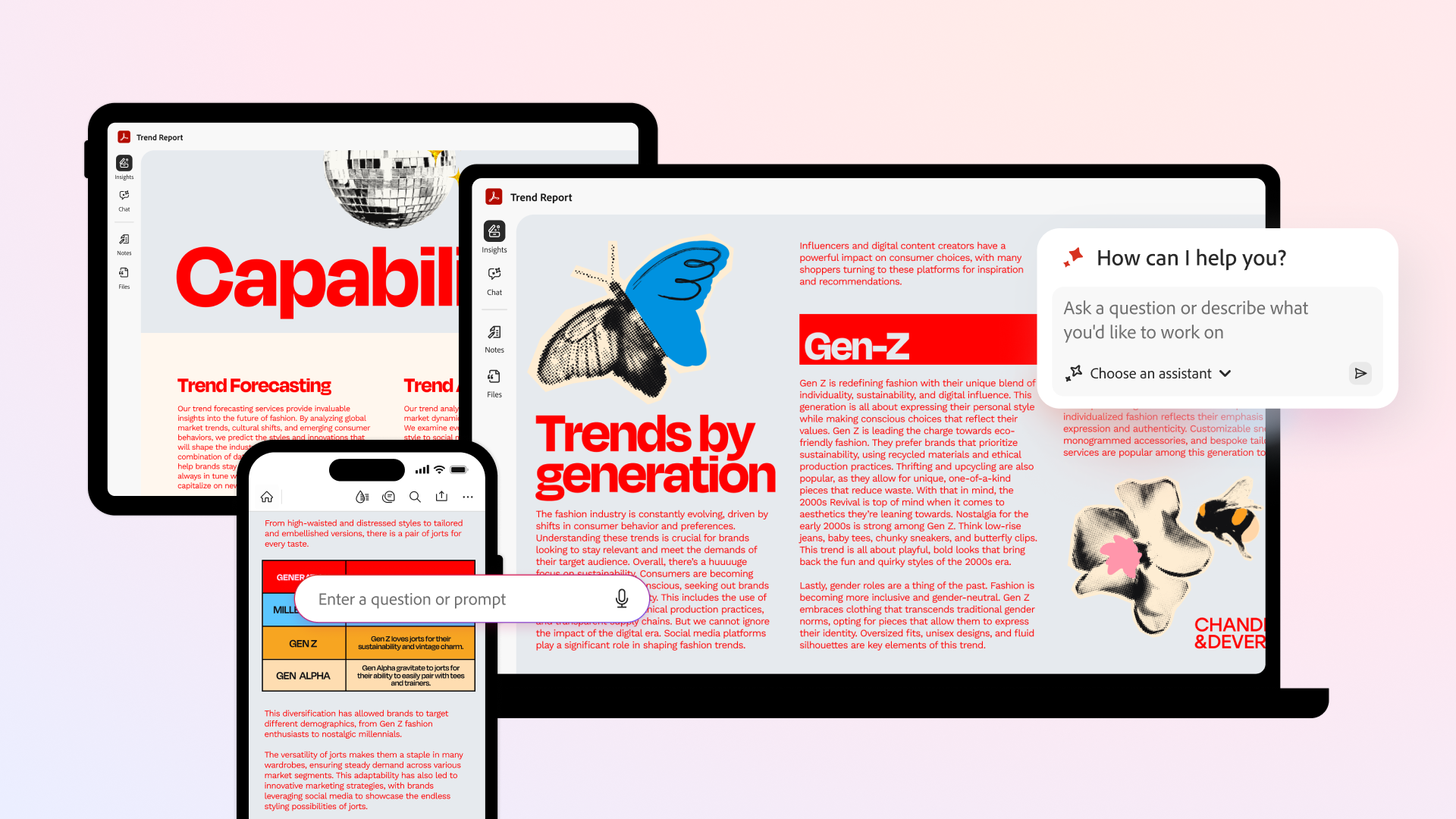
Adobe is adding generative AI to Acrobat, its venerable tool for creating and managing PDF files.
Why it matters: Adobe and its rivals are racing to incorporate AI into their products before chatbots can render traditional software obsolete.
Driving the news: Adobe today launched Acrobat Studio, a subscription service that allows individuals or groups to query a series of documents, generating answers complete with citations.
How it works: Customers can combine up to 100 documents into what Adobe calls "PDF Spaces."
- Acrobat Studio automatically organizes and summarizes the data, and users can ask questions or use the results to create presentations and other documents.
- The service focuses on the types of data found in PDFs, but Acrobat Studio also works with Word documents, PowerPoint, Excel and web pages.
- Available on desktop, web and mobile, Adobe Studio is priced at $29.95 per month for businesses and $25 per month for individuals.
- The subscription also includes the premium version of Adobe Express.
The big picture: Adobe isn't the only software giant infusing AI throughout its product line.
- Salesforce kicked off a big agent push this year and Microsoft has added AI Copilot to nearly all of its key products.
Zoom in: Adobe pitches itself as a creator-friendly alternative to other AI offerings.
- Its Firefly features are safe for commercial use because they're trained only on data that's either licensed by Adobe or in the public domain.
- Adobe also said it won't train its models on customer data.
Our thought bubble: Adobe sent several documents related to the Acrobat Studio launch in a PDF Space. It's pretty nice to just ask questions of a press kit.
- I asked "How much does this cost?" and "Which document types are supported" and got the information almost immediately, rather than the usual process of hunting through various press releases, blog posts and spec sheets.
- It's something I probably could have done myself by importing the documents into ChatGPT or another app, but this was more convenient, and the included citations allowed me to easily double-check that there weren't any hallucinations.
Yes, but: Some say Adobe still isn't moving fast enough.
- "Adobe is off to a slower AI start than we had anticipated," financial analyst Dan Ives said in a research note, removing the company from Wedbush's AI 30 list.
- Ives and colleagues say they have increased concerns that Adobe will see its products disrupted by AI, rather than benefiting from it.
- AI is getting rapidly better at creating software on demand that could eventually be far cheaper than off-the-shelf tools, while also being more personalized to an individual person or business.
Between the lines: Although Adobe created the PDF format, it's now an openly available standard, and plenty of other services on the market allow people to query PDF and other document types.
- Adobe pitched Acrobat Studio as a more capable and secure option, especially for handling long documents and documents with charts, as well as those created by scanning a physical paper document, still a popular use of PDFs.
- "Even though other tools can do some of the capabilities, it's high risk," Adobe VP of product marketing Michi Alexander told Axios.
- In contracts, for example, "you can use another tool for that, but it's not going to help guide you in the same way we would," she said.
2. AI could replace $1 trillion a year in wages

Fully adopting artificial intelligence could save corporate America $920 billion annually, per new Morgan Stanley data — savings that could come from employing a lot fewer people.
Why it matters: As investors worry about lofty valuations, this data backs the bulls: AI could boost productivity and supercharge earnings growth, leading to corporate profits that could justify current multiples.
By the numbers: The $920 billion in annual savings from AI adoption, net of estimated implementation costs, is just the beginning, according to the research.
- That represents over 40% of the annual compensation expenses within the S&P 500.
- Long term, this could result in $13 trillion to $16 trillion in market value creation for index companies.
Between the lines: That 40% number refers to cost savings associated with paying people, which could signal job losses to come.
- "In some cases, adopting AI will result in headcount reductions. … In other cases, employees will be freed up to focus on higher value-added work that can generate incremental revenue and/or reduced company expenses," Stephen Byrd, global head of thematic research and sustainability research at Morgan Stanley, wrote in a statement to Axios.
- The mix between headcount cuts and more free time for workers will vary based on industry and job type.
- The research notes this could manifest through corporates not replacing workers lost to attrition, rather than big sweeps of layoffs.
Zoom out: This research comes as investors are wondering whether all the AI spending will lead to cost savings, with four of the top tech firms set to spend $364 billion on AI for 2025 alone.
- That $364 billion looks measly compared with $920 billion in estimated annual savings.
Zoom in: The cost savings are not linear, and Morgan Stanley estimated different upside for various sectors in the market.
- AI could generate savings worth more than 100% of expected 2026 pretax profits in consumer staples distribution and retail, real estate management and development, and transportation.
- Interestingly, technology hardware and equipment and semiconductors are not among the sectors expected to save as much.
Be smart: If AI delivers nearly $1 trillion in annual savings for corporations, profits could see a major lift — giving today's lofty valuations some real earnings support.
3. Training data
- Softbank is investing $2 billion for a roughly 2% stake in Intel. (CNBC)
- Former Pentagon official and "Unit X" author Christopher Kirchhoff has joined Scale AI as head of applied Al strategy and global security.
- Arm has reportedly hired Rami Sinno, a former Amazon AI chip designer. The move comes as the company is said to be eyeing getting deeper into the business of making chips as opposed to just offering designs for others to customize and manufacture. (Reuters)
4. + This

Skibidi isn't the only dictionary word I've been forced to learn. While struggling to solve the Quartiles game in Apple News+, I learned that a palimpsest is a piece of writing where the original text has been erased with new writing added, sometimes leaving traces of the original.
Thanks to Scott Rosenberg and Megan Morrone for editing this newsletter and Matt Piper for copy editing.
Sign up for Axios AI+
