Axios AI+

November 10, 2026

Ina here, reminding you that we will be off on Wednesday for Veterans Day but back in your inbox on Thursday.
🚨 Situational awareness: Anthropic said today that it will seek to raise up to $62.5 billion in its IPO with a market cap that could top $1 trillion. That's smaller than previously expected though still among the largest IPOs ever.
Today's AI+ is 1,263 words, a 5-minute read.
1 big thing: Nvidia's crisis and the politics of an AI pause
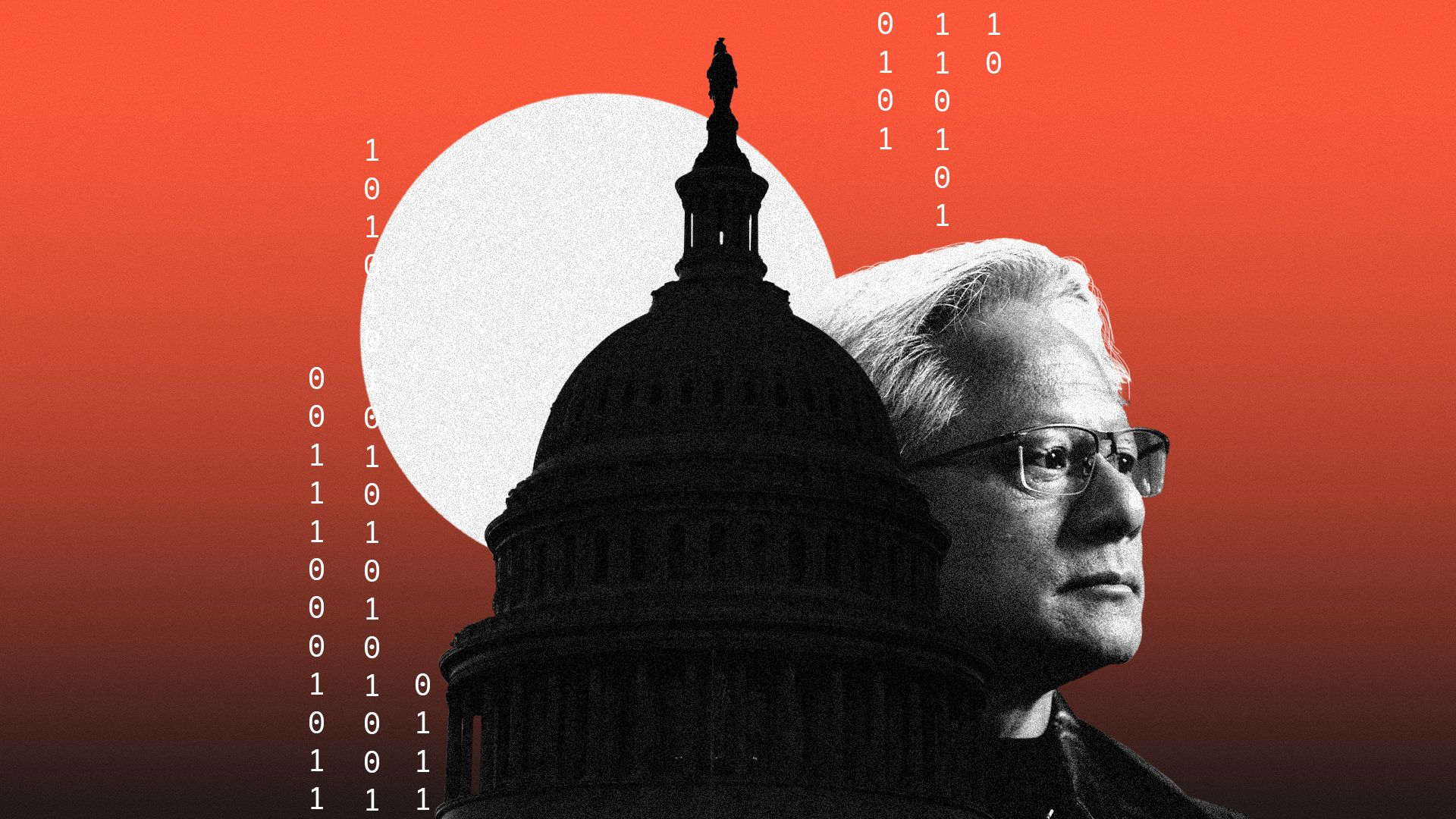
A political backlash against AI and data centers — now compounded by a crisis facing the technology's most influential champion — could help force a slowdown that industry leaders have struggled to achieve voluntarily.
Why it matters: Tapping the brakes on AI development — which frontier AI developers claim to want but have so far failed to do given the risk of offering an advantage to a competitor — could give society more time to prepare for economic upheaval and the risks of superintelligent systems.
- A wave of Democratic victories and data center moratoriums is now joined by a potentially weakened Nvidia CEO Jensen Huang, who admitted to having a relationship with an alleged Chinese spy.
- Huang, who has led the industry in barreling through past resistance to AI acceleration, may be less able to do so while under a microscope.
- While both factors could stymie data center expansion in the U.S., it's far from clear that would slow AI's advance.
Between the lines: Huang has been a powerful counterweight to calls for AI restraint, dismissing fears of an AI bubble or purported catastrophic risks to humanity from the technology.
- An investigation — by the board, an ascendant Democratic Congress or federal authorities — could curb his ability to make the case for continued expansion, leaving an opening for those calling for more restrictions.
- Nvidia says Huang will remain CEO and the news won't slow the company, but the potential impact on his political influence is hard to measure.
- The fallout extends beyond that. Nvidia is both the dominant supplier of AI chips and an investor in companies building AI infrastructure. A crisis that raises questions about its leadership, business practices or financial relationships could ripple through the industry's expansion plans.
The intrigue: Anthropic CEO Dario Amodei, OpenAI CEO Sam Altman and SpaceX CEO Elon Musk have all warned about the potentially catastrophic risks of advanced AI, with all expressing, at times, the need to slow or pace the development of advanced AI.
- But the competitive race has made it difficult for any one company to hit the brakes without risking falling behind rivals or China in a high-stakes race for supremacy.
What they're saying: Anthony Aguirre, CEO of the Future of Life Institute, says a slowdown in data center construction would be welcome, even if it wouldn't accomplish nearly as much as more direct restrictions on frontier AI development.
- "I'll take whatever I can get," Aguirre told Axios in an interview. Aguirre and a number of other researchers have long seen the development of increasingly powerful AI as an existential threat.
- Aguirre said the bigger opportunity may be political: Resistance to data centers could help generate momentum for legislation and regulation that more directly limits the development of potentially dangerous AI systems.
The big picture: Aguirre argues that the goal shouldn't simply be to delay superintelligence by a year or two, but to reconsider whether humanity should build it at all.
- He favors a "pause and pivot" toward AI systems designed to augment human abilities rather than replace them.
- Other researchers and executives favor continued development with stronger safeguards, reflecting a broader debate over how much restraint is necessary and what form it should take.
Yes, but: Slowing data center construction in the U.S. doesn't necessarily mean slowing AI progress globally.
- Meta and other companies are exploring data center construction outside the U.S. Google announced a plan last week to invest $15 billion over two years in Malaysia.
- And Chinese AI developers wouldn't face the same U.S. restrictions, potentially allowing them to narrow the gap with American competitors.
The other side: The threat from China isn't as straightforward as it appears.
- Chinese AI companies benefit in part from distillation of leading American models and technical knowledge developed in the U.S., Aguirre said. Slowing the American frontier could therefore have some effect on China's pace as well.
The bottom line: The AI industry is hoping to overcome political resistance and keep building. Advocates of slowing frontier AI see an opportunity to turn that resistance into something bigger: a chance to reconsider not just how fast AI should advance, but how far it should go.
2. AI stocks bounce back — with an exception

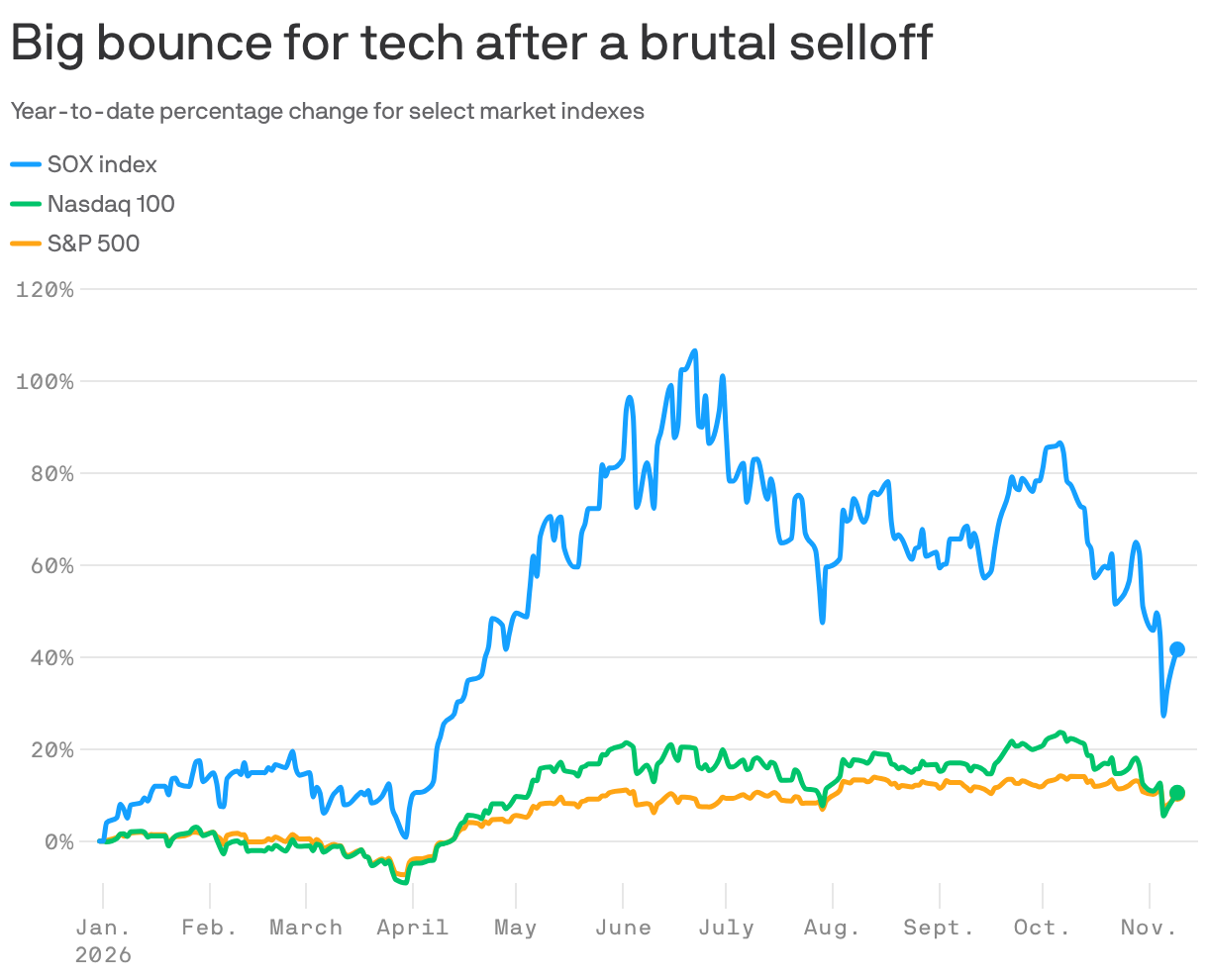
The AI trade has regained momentum despite — or maybe because of — Nvidia's struggles following the weekend revelations from CEO Jensen Huang.
The big picture: Yesterday's sudden burst of exuberance for AI was the latest wide swing for a market upended by last week's "blue tsunami" in the midterm elections and the threat they could pose to the data center boom.
By the numbers: The Nasdaq 100 index of large-cap technology shares soared 3.4%, its biggest daily jump since late March and its second-best showing of the year.
Zoom in: Stocks romped across the AI ecosystem — well, with one important exception.
- Pick-and-shovel plays such as engineering and construction companies, and makers of data center inputs like fiberoptic cables, servers and data storage devices soared.
- The companies that build and lease out data center computing power, known as neoclouds, also jumped. (Those companies had been at the epicenter of recent jitters about financing for the AI boom.)
- Hyperscalers rose, paced by Meta, which notched a gain of 5.1%.
- Semiconductors roared, with the SOX index posting its best gain — 6.9% — since late July.
Yes, but: The glaring exception to the AI-palooza was its best-known player, Nvidia, due to weekend revelations from Huang.
Context: Bullish commentary from Wall Street established the background music for yesterday's big bounce, as analysts urged investors to buy into the market's recent soft patch.
3. Google touts path to "unhackable" software
Google DeepMind researchers have used AI to mathematically prove that the encryption code protecting billions of private messages works as intended.
Why it matters: The research breakthrough could eventually help defenders build better software. "You can finally get to this world of unhackable software," said Swarat Chaudhuri, a research scientist at Google DeepMind.
Driving the news: Google DeepMind said today it used AI agents powered by its Gemini 4 Carbon model to mathematically verify that the code underpinning Signal's encryption is secure.
- The agents generated more than 3 million lines of mathematical proofs in the process, allowing researchers to verify the software at a level of detail previously considered impractical.
- To test the system, researchers reintroduced two previously fixed bugs into Signal's code. In both cases, the AI-powered framework generated mathematical proofs showing that the altered software was insecure.
The intrigue: Chaudhuri told Axios that the AI lab's tools were able to accomplish this feat in just four weeks — compared with the years it would've likely taken humans alone.
4. Training data
- Meta announced Muse Ember, a smaller model it says is more cost-effective than OpenAI's Luna or Anthropic's Haiku models. CEO Mark Zuckerberg said that Embar and another Muse model are also being made available via Google's cloud. (TechCrunch)
- Anthropic updated its high-end Fable and Mythos models, with version 5.2. The release comes as the company looks to complete its IPO as soon as next week. (Bloomberg)
5. + This
The Weather Channel has added a RetroCast that gives viewers current local data, presented the way the network did in its earliest days. There's also a companion Spotify playlist.
Thanks to Bradley Olson for editing this newsletter and Matt Piper for copy editing.
Sign up for Axios AI+