The crisis testing Nvidia's "too big to fail" CEO

Add Axios as your preferred source to
see more of our stories on Google.
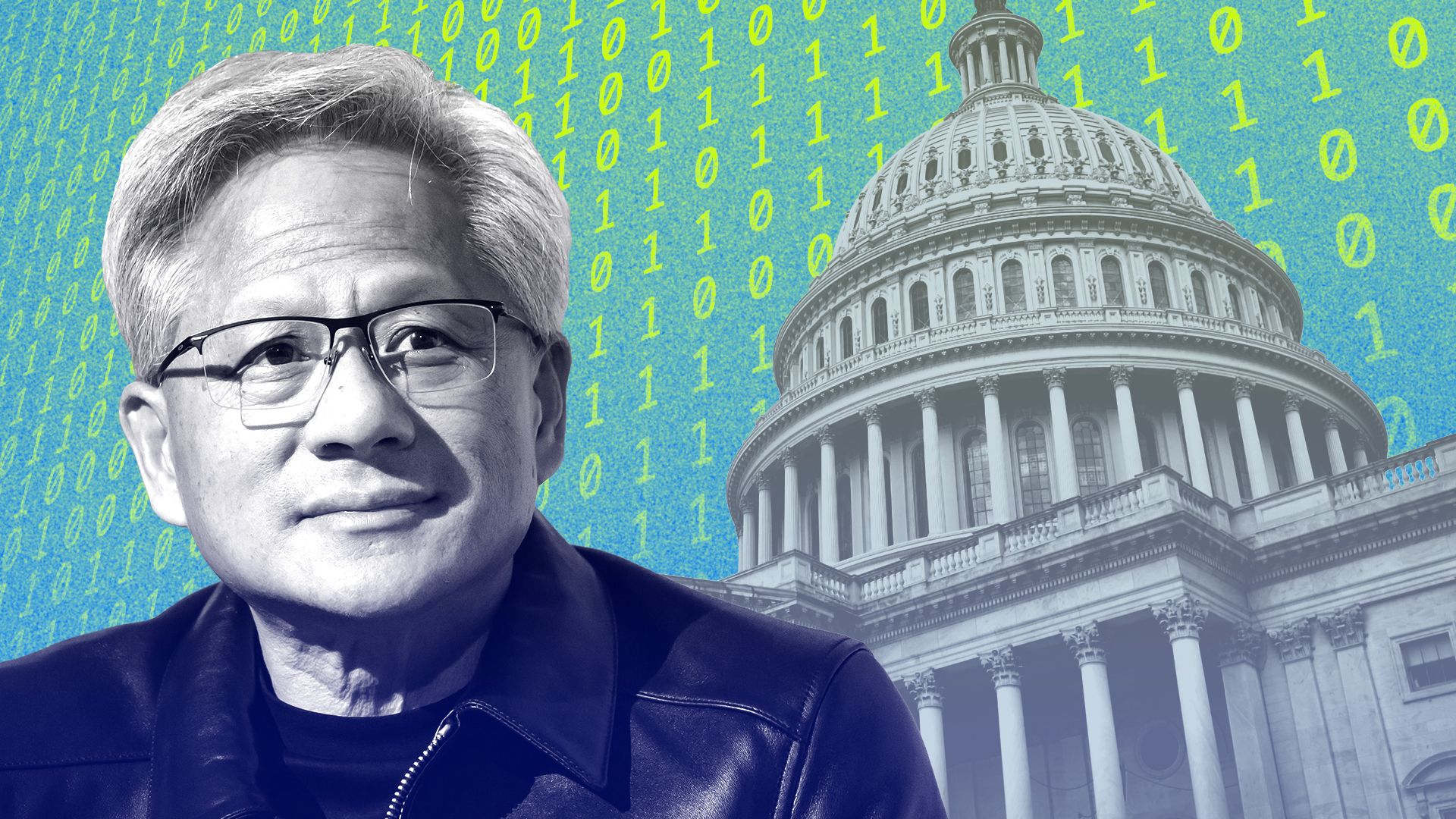
Photo illustration: Brendan Lynch/Axios. Photo: Tomohiro Ohsumi/Getty Images
There is no Nvidia — nor an AI boom as we know it — without Jensen Huang. He has reassured jittery markets with his words, bankrolled a trillion-dollar buildout and put economies on his shoulders.
- Now, the world is wondering if he can save himself.
Why it matters: Global markets must confront a terrifying reality: The AI ecosystem's first "too big to fail" executive is suddenly vulnerable, and there is no backup plan if he is forced to step down.
Catch up quick: Huang apologized Sunday and Nvidia's board launched an independent probe after he admitted to having a relationship with a woman named Alice Huang, an alleged Chinese operative.
- Nvidia's board expressed confidence in his leadership and said it had no reason to believe national security or company secrets were compromised.
- President Trump stood by Huang, calling him "an honorable guy."
The big picture: Keeping his job is one thing. Maintaining the ability to steady markets, finance customers and shape government policy is another.
These are the five questions that now loom over the AI boom:
1. What happens to Nvidia? Forged 33 years ago (initially using a Denny's as an impromptu office), Nvidia is a uniquely founder-driven company, making any potential leadership transition incredibly perilous. Investors have little precedent for valuing the company without him.
- "It's very hard to envision Nvidia run by anybody else," said Dan Gallagher, an analyst with Washington Post Intelligence and long a keen observer of the chip titan.
- Huang has more than 60 direct reports, eschews traditional corporate layers and hasn't been publicly grooming a successor. "I don't know if anyone's going to know how to value Nvidia" without him, Gallagher told Axios.
2. What happens to the market? Huang has repeatedly rescued the AI trade from bearish sentiment.
- On multiple occasions, he has offered backstops to shore up growth plans for companies across the AI landscape, from CoreWeave to OpenAI.
- In July, he argued that cheaper open models would boost demand for Nvidia's chips, pushing back against a market scare.
- Last month, he toured Europe pitching national AI projects as debt investors signaled their appetite for some AI financing was limited.
3. What happens to the companies that depend on him? The risks vary across an industry that relies on Nvidia for chips, capital and credibility.
- The AI giants: Anthropic and OpenAI have options. Anthropic plans to barrel ahead with an IPO this month and already uses chips from Google and Amazon. OpenAI is developing its own chips in-house and with Broadcom. Diversification is underway, but replacing Nvidia is not in the cards near-term
- The "neoclouds": Companies such as CoreWeave and others that rent out computing power have less room to maneuver. CoreWeave suffered a prolonged stock-and-bond selloff last month as investors began to question how it would finance continued growth. Nvidia has provided crucial backstops to many neocloud companies.
- The "neolabs" and AI startups: Nvidia has supplied investment and offered access to computing for AI startups such as Thinking Machines Lab, as well as dozens of other startups providing a variety of services in the AI race.
4. Where does the investigation lead? Southeast Asia's data center boom puts the limits of U.S. chip restrictions in focus.
- The loophole: U.S. restrictions on shipping advanced chips to China generally haven't stopped Chinese companies from accessing them in overseas data centers, the New York Times reported. Nvidia told the Times that remote access is consistent with U.S. export controls because the chips remain outside restricted countries.
- That access is distinct from suspected smuggling. The Times reported that Megaspeed, the Nvidia customer where Alice Huang worked, was under investigation for steering advanced chips to China.
5. What happens to Huang's advocacy? His arguments for selling chips to China and embracing open AI models will face renewed scrutiny, with many of his comments potentially being seen in a new light due to the relationship.
- Huang has repeatedly, and stridently, pushed to loosen restrictions on sales to China, arguing that reliance on American technology serves U.S. interests.
The bottom line: Huang has made himself the AI boom's indispensable man.
- The industry must now reckon with what happens when its fortunes depend so heavily on his.
