Axios AI+

January 18, 2024

Hi, it's Ryan, still in Davos, which is still drowning in AI. Want to see what it's like to interview Sam Altman? Ina recorded her Wednesday interview using Meta Ray-Ban glasses — check it out. Today's AI+ is 1,248 words, a 4.5-minute read.
1 big thing: "AI made us do it" is tech's new layoff rationale

Illustration: Shoshana Gordon/Axios
Big tech companies are pointing to a renewed focus on AI as a justification for layoffs, Axios' Megan Morrone reports.
Why it matters: The new trend in tech company layoffs could be less about replacing workers with AI, and more about replacing workers with a smaller number of workers who are more skilled in AI, for now.
Driving the news: Last week and again this week, Google has laid off hundreds of workers to focus more on AI. Some of those workers were on advertising or hardware teams, but others were working on one of Google's original AI tools, Google Assistant.
- And Google has more cuts to come, per a memo to employees reported by The Verge. Google spokesperson Courtenay Mencini told Axios the changes are about efficiency and focusing on the company's biggest priorities.
- Salesforce, Duolingo, and even AI hardware startup Humane have also announced layoffs or hiring freezes as a part of efforts to focus on AI.
- According to Layoffs.fyi, 58 tech companies have laid off 7,785 employees already in Q1 2024.
- Muddu Sudhakar, co-founder and CEO of generative AI solutions company Aisera, told Axios that he's seeing "a huge displacement of white-collar workers" in basic software developer jobs as well as database administrator roles.
When company layoff announcements come in waves, spokespeople often give the same reasoning for layoffs. Last year the shared refrain was "the macroeconomic climate," and now many tech companies are saying layoffs are a result of a "renewed focus on AI."
- Tigran Sloyan, co-founder and CEO of technical skills assessment platform CodeSignal, told Axios that these announcements could mean that tech companies are "reorienting resources" to spend more on bigger salaries for highly skilled engineers.
- But he said, it could also just be "a nice way to manage the PR element" of layoffs. Or it could mean that the companies are fully automating jobs and replacing workers with AI.
- Contractor cutbacks by language-learning software maker Duolingo this month came as the firm was able to handle more of their work with AI, per Bloomberg.
Between the lines: There are still postings for extremely high-paying AI engineer positions — like the $900,000 one at Netflix last year that went viral — but few workers have the skills required for those jobs.
- Those massive salaries are shaped by limited supply and high demand for Ph.D.-level researchers. "There are very few people who have gone through that much training, that much education, and that much skill building," says Sloyan.
- According to a recent CompTIA report, posting for AI jobs with specialized skills represents more than 10% of all tech job postings.
The intrigue: Sudhakar told Axios that while AI salaries are on the rise, generative AI salaries only capture a small section of the AI market.
- "There is going to be downward pressure on general AI salaries as automation of code generation becomes more prevalent in the enterprise, especially with tools like Github Copilot," says Sudhakar.
- Mark Muro, a senior fellow at Brookings Metro, said there's an immediate need for talent with AI skills. But the number of hires doesn't come near to the size of the past year's layoffs, and the new positions are concentrated in a small number of tech hubs.
The big picture: Large language models pose real risks for software engineering jobs, Muro says.
- He points to forthcoming work from Brookings Metro showing that "'computer' jobs — including software development — face generative AI exposure scores of 90% and more, meaning that 90% of their work tasks could be done in half the time using ChatGPT."
2. Palantir CEO: U.S. is eating world's lunch on AI
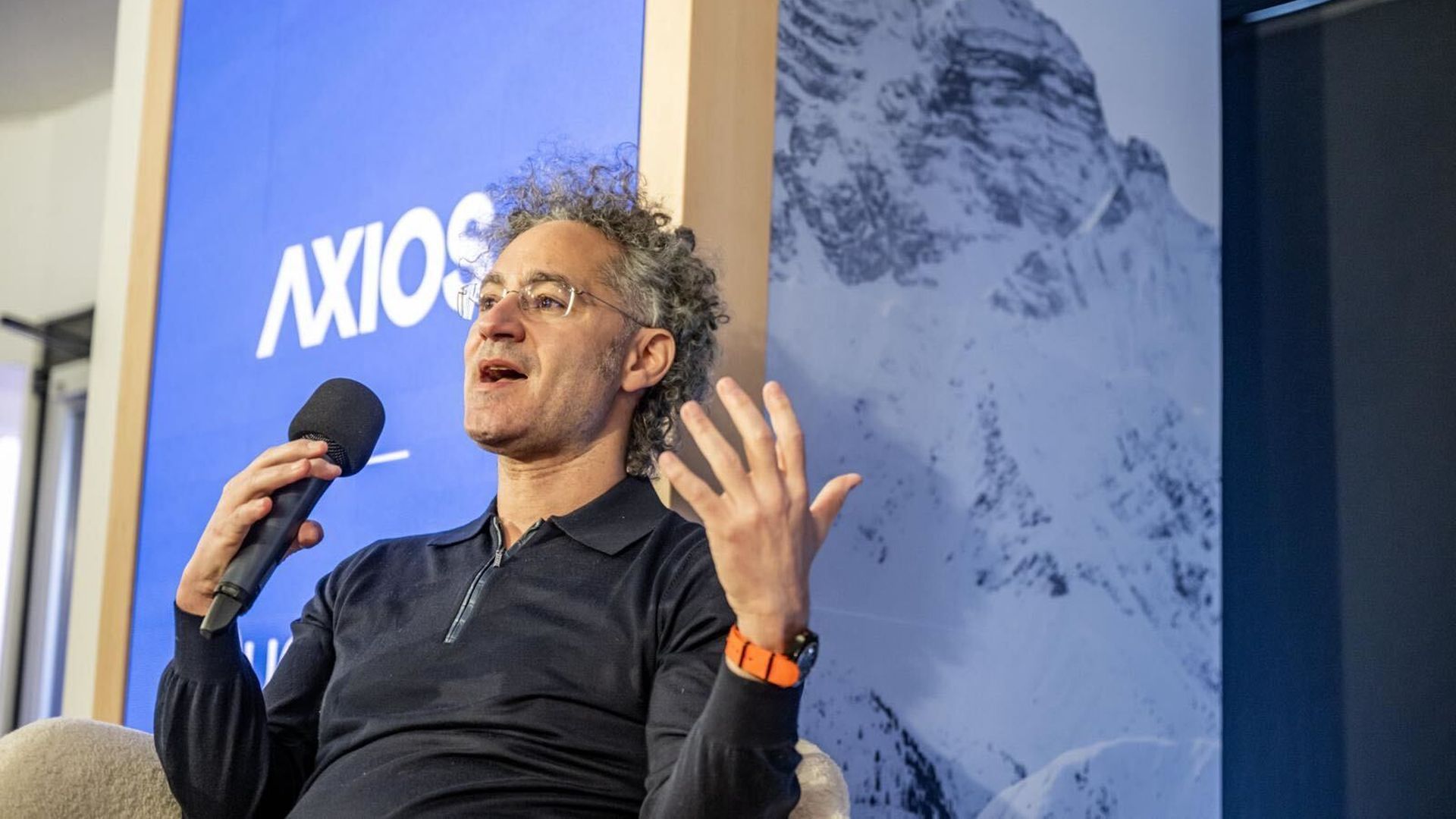
Palantir CEO Alex Karp interviewed by Axios at Davos. Photo: Dani Ammann/Axios
Within 10 years, around 95% of the world's top tech companies will be American thanks to the U.S. lead in AI, Palantir CEO and co-founder Alex Karp, told Axios' Mike Allen at the World Economic Forum in Davos.
Why it matters: Karp predicted that in time AI will deliver very large GDP growth — but that will benefit only a handful of countries and companies, leading to political and social "dislocation."
- A "strong military gets stronger, strong software companies get stronger, people who are in a weaker position get much weaker," he said.
Yes, but: A "crazy political situation and GDP growth? That's much better than [a] nice political situation and no GDP growth," Karp said.
What they're saying: "The startup scene here [in Europe] is anemic," Karp said, noting tech's "real growth and providers are in America."
- "Any one of the products we built would be the number one startup in Germany — and we have five" products, he said.
Driving the news: Karp thinks tech companies face a stark choice about supplying customers in authoritarian countries.
- "You also have to tell some of these tech companies: you cannot work in America and with their adversaries. And if you do, we're gonna screw you," he said.
The intrigue: Karp is not happy about Europe's tech flops. "The purpose of Palantir was to fight for the West. And so I really want Europe to get its act together," he said.
3. Samsung taps Google AI with new Galaxy phones

Photo: Samsung
Samsung on Wednesday debuted its latest smartphone family, the Galaxy S24, which relies in part on Google's AI services, Ina reports.
Why it matters: Samsung just fell below Apple in global smartphone sales and no doubt hopes its AI features will help it both stand out and regain lost ground.
Details: As usual, Samsung is releasing three models of the S24: a base model, a "+" version and a top-of-the-line Ultra model, featuring the largest screen and the most camera lenses as well as a titanium frame.
- The Galaxy S24 Ultra will start at $1,300 (up $100 from last year), while the Galaxy S24+ will start at $1,000 and the base model S24 will start at $800.
- Pre-orders start today, with devices available in stores starting Jan. 31.
The big picture: Market researchers IDC and Canalys this week reported that in 2023, Apple had — for the first time — surpassed Samsung to become the leader in global smartphone shipments.
Between the lines: Some of the Galaxy phones' AI features run on device, while others rely on the cloud and require an internet connection. Some are Samsung's own creation while others were developed with Google.
- The S24 taps AI for a variety of photo editing, live translation and summarization features.
- Samsung and Google also announced a multi-year partnership to bring Google Cloud's generative AI capabilities to Samsung devices, starting with the S24 series which will be able to make use of Google's recently announced Gemini Pro and Imagen 2 models.
- Among the features developed with Google is one that allows people to search by circling something on the device's touch screen. Google also said that Samsung is one of the first customers to test Gemini Ultra, the highest-end version of Google's latest AI model. And for some on-device AI work, the S24 series also makes use of Google's Gemini Nano.
4. Training data
- Google Cloud is rolling out a new combined hardware and software tool for retailers that aims bring their digital and physical offerings under one tech umbrella, with Victoria's Secret as a test case. (Axios Pro)
- Sheryl Sandberg will step down from Meta's board in May. (Axios)
- GLAAD wants Meta CEO Mark Zuckerberg to publicly recommit the firm to fighting anti-transgender hate, in the wake of an Oversight Board ruling that said Facebook erred in leaving up a Polish post advocating trans people to kill themselves.
5. + This

Photo: Ryan Heath/Axios
Consider a scroll invite for your next party — the cool way to attract attention on the Davos Promenade.
Thanks to Scott Rosenberg and Megan Morrone for editing this newsletter, and Bryan McBournie for copy editing this newsletter.
Sign up for Axios AI+

Scoops on the AI revolution and transformative tech, from Ina Fried, Madison Mills, Ashley Gold and Maria Curi.