Axios AI+

June 12, 2025

Happy Loving Day, celebrated on June 12 to commemorate the 1967 U.S. Supreme Court decision Loving v. Virginia, which struck down laws in 16 states that banned interracial marriage. Today's AI+ is 1,211 words, a 4.5-minute read.
1 big thing: Executives love to clone themselves
Workers may fear losing their jobs to AI, but CEOs and other executives are using the tech to "scale" themselves.
Why it matters: Digital doubles can boost productivity and influence, but they can also hallucinate and supercharge inauthenticity.
How it works: Execs use startups like Delphi and Tavus to upload their writings, keynote speeches, interviews and even their meetings to create text and voice chatbots and video avatars trained on their work.
- Otter CEO Sam Liang says he's so inundated with meetings that he ends each day too drained to talk. "I'm double-booked. Triple-booked." So he asked: Could Otter create a Sam Bot to attend the meetings for him?
- "I prefer to call it Sam's Avatar," the human Liang told Axios. "Avatar feels more human."
- Otter's tool, dubbed "Meeting Avatar," is currently only a prototype, but eventually it will be able to answer questions and engage in meeting discussions. It will also record meetings and send notes and summaries.
The big picture: Veteran tech entrepreneur and LinkedIn co-founder Reid Hoffman, Zoom CEO Eric Yuan and Khosla Ventures managing director Keith Rabois have all created AI replicas of themselves.
- Some CEOs are using clones internally. Others make them public. Execs put their digital doppelgangers on investor calls, use them to chat with new employees about company culture, and send them to important video meetings so they don't have to attend themselves.
- Dara Ladjevardian, co-founder and CEO of AI cloning platform Delphi, puts a link to his "digital mind" chatbot in his email signature. I chatted with his clone before getting on the phone with the real thing.
- It was helpful, but not 100% accurate, which is a rough definition of most genAI right now. I asked the bot if Ladjevardian had access to our chat and it said no, it was totally private. But when I asked the human Ladjevardian the same thing, he said he could access the chats. He explained that it was probably a "bug."
State of play: Execs are pushing AI, but slow adoption at the top can cause workplace rifts.
- C-suite engagement with AI is absolutely critical, John Levitt, co-founder and COO of elvex, an enterprise AI orchestration platform, told Axios. "I can absolutely see a difference between customers that have strong engagement and usage from exec leaders versus those that don't."
- The willingness to trust generative AI as a stand-in for their body of knowledge shows that the C-suite believes in the tools they're requiring employees to use.
Yes, but: Workers are increasingly anxious about being replaced by AI, and CEO bots can make that worse.
- "It's sort of widening that gap between executive privilege, technical privilege and the precarity of laborers," says social scientist and AI researcher Julie Carpenter.
Executives who clone their minds say they do it to give customers, clients and workers greater access to them, but experts say digital avatars could do the opposite.
- "It could risk sending messages either to the public or to their employees that there is a lack of accountability at the very top," Carpenter told Axios.
- Digital twins can also hallucinate. Training a chatbot on a smaller set of data, like a single person or company's writing, videos, and podcasts, could mean fewer inaccuracies, but it doesn't mean none.
- "I find it very fascinating," Box CEO Aaron Levie says. "But to be clear, I probably wouldn't do it for myself."
- Instead, Box is working on digital agents that can contain the entire knowledge base of a company to create "a digital memory of infinite scale."
- Levie believes in AI's ability to "blast past the bottlenecks" across organizations, rather than simply giving people more access to the CEO's mind.
2. Behind the Curtain: ChatGPT juggernaut

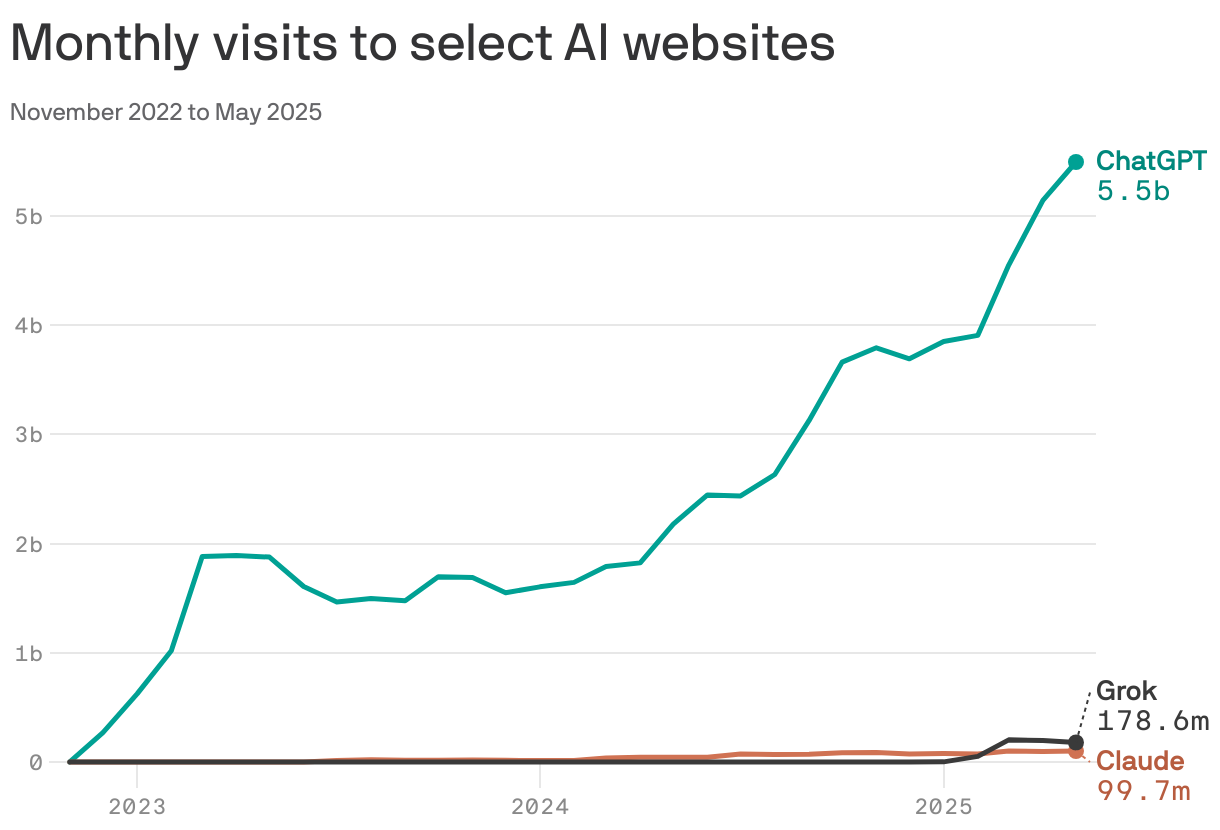
OpenAI's ChatGPT has been the fastest-growing platform in history ever since the chatbot launched 925 days — 2½ years — ago. Now, CEO Sam Altman is moving fast to out-Google Google.
Why it matters: OpenAI aims to replicate the insurmountable lead that Google built beginning in the early 2000s, when it became the world's largest search engine. The dream: Everyone uses it because everyone's using it.
- OpenAI is focusing particularly on young users (under 30) worldwide. The company is using constant product updates — and lots of private and public hype — to cement dominance with AI consumers.
The big picture: This fight is about winning two interrelated wars at once — AI and search dominance. OpenAI and others see Google as the most lethal rival because of its awesome access to data, and research talent, and current dominance in traditional search.
- This is probably the most expensive business war ever. Google, OpenAI, Apple, Amazon, Anthropic, Meta and others are pouring hundreds of billions of investment into AI large language models.
- It's not winner-take-all. But it's seen as winner-take-control of the most powerful and potentially lucrative new technology on the scene.
Altman is selling himself — and OpenAI — as both the AI optimists and early leaders in next-generation search. Anthropic, by comparison, is warning of dangers, and focusing more on business applications.
- Two events — one private, one public — capture Altman's posturing.

3. Disney, NBCU sue Midjourney
Disney and NBCUniversal have teamed up to sue Midjourney, an AI image generator, accusing it of copyright infringement, according to a copy of the complaint obtained by Axios.
Why it matters: It's the first legal action that major Hollywood studios have taken against a generative AI company.
- Hollywood's AI concerns so far have mostly been from actors and writers trying to defend their name, image and likeness from being leveraged by movie studios without a fair value trade. Now, those studios are trying to protect themselves against AI tech giants.
Zoom in: The complaint, filed in a U.S. District Court in central California, accuses Midjourney of both direct and secondary copyright infringement by using the studios' intellectual property to train its large language model and by displaying AI-generated images of their copyrighted characters.
- The filing shows dozens of visual examples that it claims show how Midjourney's image generation tool produces replicas of their copyright-protected characters, such as NBCU's Minions characters, and Disney characters from movies such as "The Lion King" and "Aladdin."
Between the lines: Disney and NBCU claim that they tried to talk to Midjourney about the issue before taking legal action, but unlike other generative AI platforms they say agreed to implement measures to stop the theft of their IP, Midjourney did not take the issue seriously.
What to watch: The lawsuit suggests Hollywood heavyweights will try to focus their copyright fight on platforms that create and distribute replicas of their copyrighted content, rather than the users of those platforms.
4. Training data
- Meta has hired a pair of AI researchers as part of its superintelligence push: Google DeepMind's Jack Rae and Sesame AI's Johan Schalkwyk. (Bloomberg)
- In a further sign of the interdependence of the cloud computing world, CoreWeave stands to benefit from Google's new deal to provide services to OpenAI. (Reuters)
- Meanwhile, another Google DeepMind executive who Meta apparently tried to hire — CTO Koray Kavukcuoglu — is staying at Google with the new title of chief AI architect and will begin reporting directly to CEO Sundar Pichai. (Semafor)
5. + This
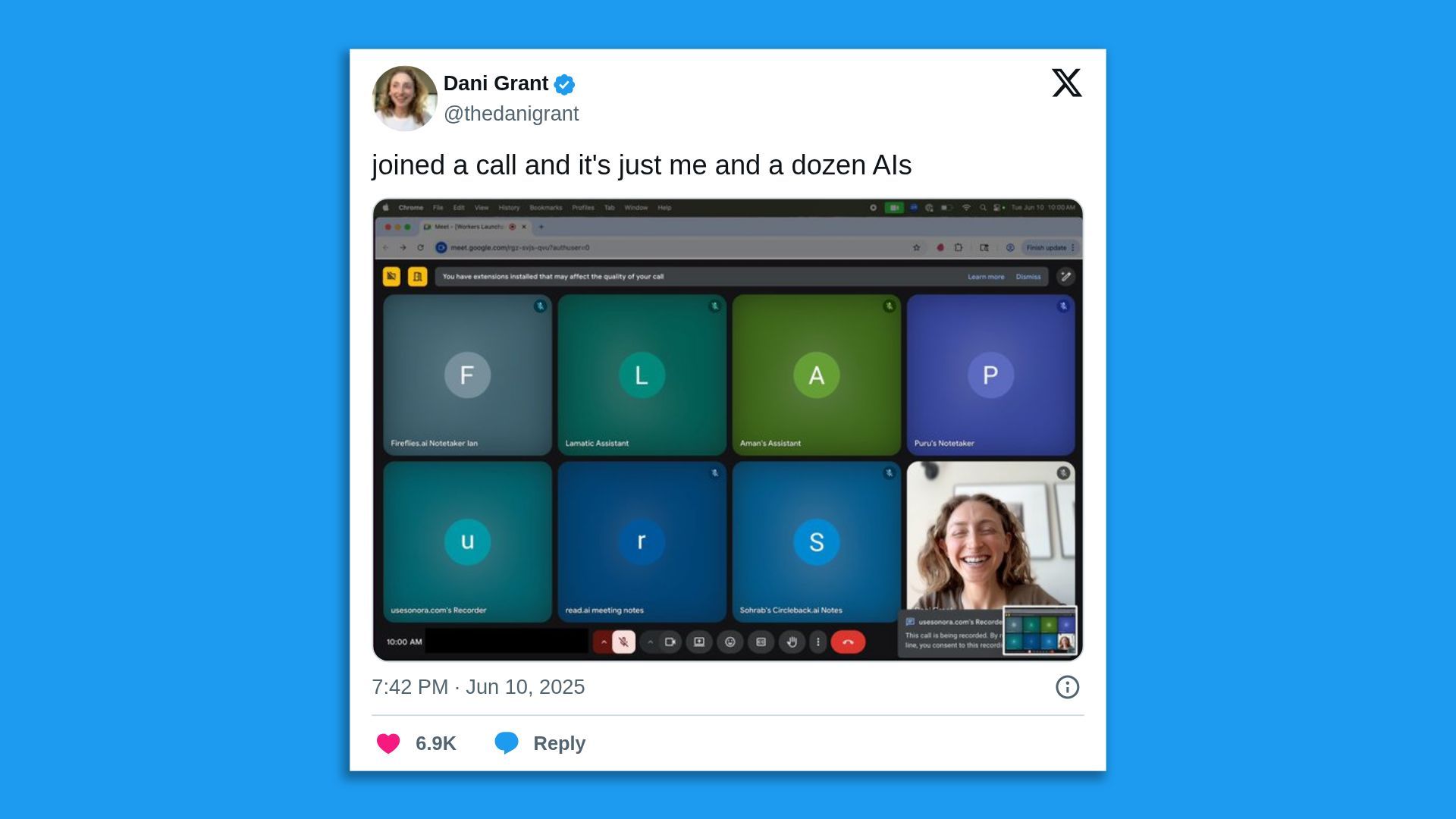
In another sign of our AI future, Jam.dev CEO Dani Grant posted about joining a video call alone with a dozen note-taking bots.
Thanks to Scott Rosenberg and Megan Morrone for editing this newsletter and Matt Piper for copy editing.
Sign up for Axios AI+


/2025/06/06/1749224516693.gif?w=3840)