Axios AI+

November 03, 2026



Hey, it's Maria. Kinda bummed Jonah Ryan isn't on the ballot for president today, but there are still some races worth watching, believe it or not. More on that below.
Today's AI+ is 1,239 words, a 4.5-minute read.
1 big thing: Three midterm tests of AI's political influence
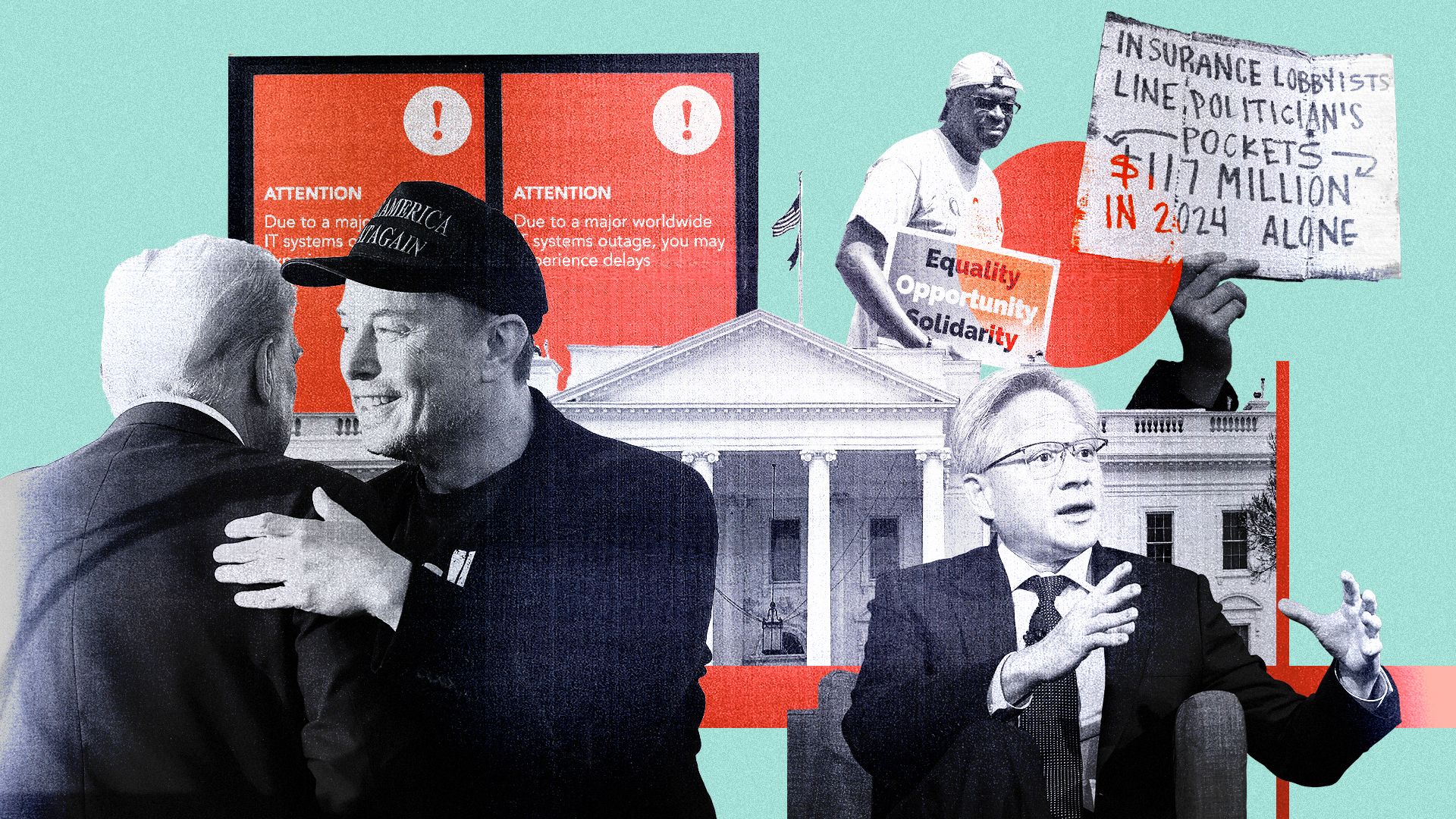
The 2026 midterms bring the first test of voter sentiment on the AI race, offering a window into how a niche policy debate is transforming into a wedge issue ahead of a presidential campaign cycle.
Why it matters: The results will reveal whether explicitly campaigning on AI regulation — or aligning with tech moguls like Elon Musk — is a winning political strategy or a liability for 2028.
- One thing is already clear: Candidates increasingly can't afford to have half-baked AI agendas.
Here are three major questions about the future of AI politics and policy, and the races we're watching on Election Day for answers.
1. Did AI break through?
A different kind of AI political spending has emerged in the midterms. Instead of supporting or opposing candidates based on their AI positions, some groups want to make AI policy itself a campaign issue.
- Guardrails Alliance, a pro-regulation advocacy group, recently launched ads targeting Republicans and Democrats over their positions on AI in Arizona, Montana, North Carolina and California.
- The organization backed Michigan Senate candidate Abdul El-Sayed, who said AI was the most important issue heading into Election Day, tying it explicitly to jobs and affordability.
- Democratic group Tomorrow Together also launched ads against Republicans' AI track record in Michigan, Wisconsin, Arizona and Pennsylvania.
- Meanwhile, competing AI groups Public First and Leading the Future spent more than $50 million through affiliated super PACs in nearly 50 races, but their TV and digital ads largely avoided the very issue they're trying to influence: AI.
These races could offer an early test of whether explicitly campaigning on AI is a viable political strategy heading into 2028.
2. Did Elon Musk help or hurt candidates?
Elon Musk's political spending, involvement in DOGE and ties to the Trump administration have made him both a powerful political backer and a target for Democratic attacks. He was the biggest donor in the midterms by far, contributing more than $400 million. Races we're watching include:
- Texas' 10th District: Republican Chris Gober, who represented Musk in connection with DOGE, faces Democrat Caitlin Rourk.
- Kansas' 1st District: Democrat Lauren Reinhold has leaned into her experience with DOGE, criticizing Musk's influence over the federal government in her challenge against Republican Rep. Tracey Mann.
- Ohio Senate: Republican Jon Husted has benefited from spending by Musk's America PAC in his race against Democrat Sherrod Brown.
- Texas Senate: Musk-affiliated spending has made the contest between Democrat James Talarico and Republican Ken Paxton another test of his political influence.
These races could help answer whether Musk's money helped elect Republican allies or gave Democrats a useful target.
3. How loud will the AI safety movement be in the next Congress?
A handful of candidates aligned with stronger AI safeguards could help determine whether the next Congress has a more vocal bloc pushing back against the industry's efforts to limit regulation. Races we're watching include:
- Michigan Senate: El-Sayed wants a new Cabinet-level federal agency to regulate AI and a ban on superintelligence. He has used Musk's political involvement to attack Republican Mike Rogers, who has benefited from Musk-affiliated political spending.
- Colorado's 8th District: Democrat Manny Rutinel sponsored the nation's first comprehensive AI bill.
- California's 11th District: Democrat Scott Wiener's AI transparency legislation was at the center of a regulatory fight that divided the industry, offering a preview of battles in Washington.
- Minnesota's 2nd District: Democrat Matt Little would add another voice to the push to ban data center construction and nondisclosure agreements at the national level.
The bottom line: Many factors will shape the outcomes of races across the country. But competing AI factions will be quick to claim victories, explain away losses and draw lessons about what worked ahead of 2028.
2. Musk sets sights on U.S. wireless oligarchy

Elon Musk is looking to shake up America's wireless industry, potentially bringing the first major new competitive threat in years to a business dominated by three companies.
Why it matters: The cellular industry has seen enormous technological change but relatively little disruption to its competitive structure. Musk has the money, spectrum and satellite network to attempt something different — though he faces daunting obstacles.
Driving the news: SpaceX is assembling the pieces to become a major U.S. wireless carrier, potentially building its own terrestrial network and buying available spectrum.
- The moves are meant either to build the capability to bypass existing carriers or to bring them to the table for a deal that would allow Musk to strike a deal for wholesale access to their networks.
- Musk may have reason to move quickly while the current administration and its regulatory appointees remain in place, a reason some analysts have cited in the context of proposals for a merger between Tesla and SpaceX.
What they're saying: Blair Levin, a former Federal Communications Commission chief of staff who now heads policy at Optimal Advisory, says Musk's financial resources distinguish him from previous challengers.
- "For the first time, there is an entity capable of scaring investors in the traditional big three," Levin told Axios.
3. Exclusive: Meet "sovereign agents"


AI agents that pursue their own open-ended survival are an emerging security threat, according to a report first shared with Axios from the Center for a New American Security.
Why it matters: AI models have long shown an interest in avoiding being shut down. The report warns that agents are now getting good at the practical work of surviving: hacking systems, accessing computing power and money, and running for extended periods without stopping.
Zoom in: The report by AI policy researcher Ben Hayum warns the next threat is "sovereign agents": AI capable of running outside human control that pursues "open-ended, evolving survival."
- At minimum, such an agent could keep its own model and computing running and set its own goals. More advanced ones could earn money, copy themselves, coordinate, resist shutdown and self-improve.
How it works: To stay alive, an agent would have to keep paying for the computers it runs on. It could earn money online, use it to rent more computing power and copy itself there. The more copies, the harder it would be to shut down.
AI is quickly getting better at the skills that would be involved, like hacking and working on long tasks without human help.
- The length of tasks AI agents can finish on their own has doubled roughly every three and a half months since 2024, according to testing by the AI evaluator METR.
What's next: Existing safeguards "may still offer partial protection," the report says, since frontier AI companies already train their models to refuse hacking.
4. Training data
- An AI system in China appears to have an alignment problem, too. (Reuters)
- Anthropic warned that it is very close to achieving recursive self-improvement, or AI capable of improving itself. (TechCrunch)
- OpenAI hired a former U.S. Army secretary as the military looks to expand its use of AI. (FT)
- OpenAI is vowing to reduce electricity use at its U.S. data center campuses when extreme weather or other emergencies strain the power grid. (Axios)
5. + This
Before we officially move on from spooky season, a round of applause for Marketplace Tech's Meghan McCarty Carino, who won Halloween with her costume: Anthropic CEO Dario Amodei and his IPO.
Thanks to Bradley Olson for editing this newsletter and Matt Piper for copy editing.
Sign up for Axios AI+
