Elon Musk's next target: A major shake-up of America's wireless market

Add Axios as your preferred source to
see more of our stories on Google.
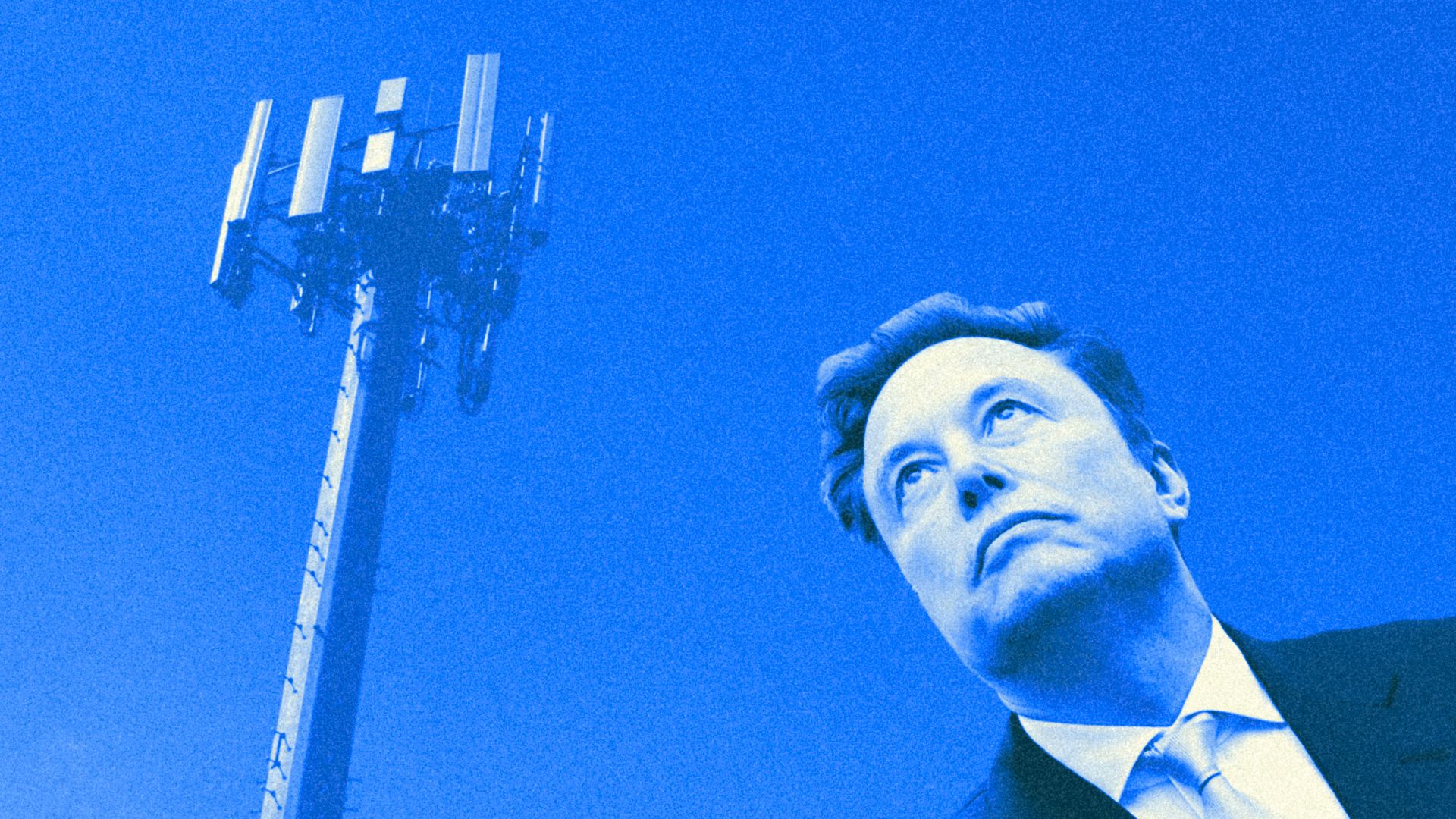
Photo illustration: Brendan Lynch/Axios. Photos: Win McNamee and Eric Thayer/Getty Images
Elon Musk is looking to shake up America's wireless industry, potentially bringing the first major new competitive threat in years to a business dominated by three companies.
Why it matters: The cellular industry has seen enormous technological change, but relatively little disruption to its competitive structure. Musk has the money, spectrum and satellite network to attempt something different — though he faces daunting obstacles.
Driving the news: SpaceX is assembling the pieces to become a major U.S. wireless carrier, potentially building its own terrestrial network and buying available spectrum.
- The moves are meant either to build the capability to bypass existing carriers or to bring them to the table for a deal that would allow Musk to strike a deal for wholesale access to their networks.
- Musk may have reason to move quickly while the current administration and its regulatory appointees remain in place, a reason some analysts have cited in the context of proposals for a merger between Tesla and SpaceX.
What they're saying: Blair Levin, a former FCC chief of staff who now heads policy at Optimal Advisory, says Musk's financial resources distinguish him from previous challengers.
- "For the first time, there is an entity capable of scaring investors in the traditional big three," Levin told Axios.
- Unlike Dish, which faced serious financing constraints, SpaceX can draw on capital markets that have rewarded Musk's ambitious plans.
The latest: SpaceX has held talks with EchoStar about acquiring Boost Mobile or gaining access to its network arrangements, according to a Washington Post report Monday.
- That could provide a quick route to customers and infrastructure, although approval of such a deal is far from a foregone conclusion if Musk's businesses are drawn into a regulator quagmire after the midterm elections.
- The Post reported that Verizon, AT&T and T-Mobile have all rebuffed Musk's efforts to gain access to their networks.
State of play: Musk also has a path to maneuver around them.
- SpaceX has agreed to multibillion-dollar spectrum deals, including a low-band variety useful for reaching customers indoors and supporting a traditional cellular network.
- The company could build its own network using towers and smaller rooftop antennas, though doing so would require substantial investment and time.
The big picture: America's wireless industry has spent much of the past two decades consolidating.
- T-Mobile once played the scrappy challenger, shaking up the industry with aggressive pricing and the elimination of unpopular practices.
- But its 2020 acquisition of Sprint reduced the number of major nationwide carriers from four to three.
- Regulators tried to preserve a fourth competitor by requiring the sale of Boost Mobile to Dish Network, which planned to build a nationwide network.
- That effort never delivered the competitive alternative envisioned, leaving Verizon, AT&T and T-Mobile firmly entrenched.
The intrigue: Musk would be moving from a business where SpaceX enjoys enormous technical and economic advantages to one where the established players have spent decades building infrastructure, acquiring customers and learning how to serve them.
- In terrestrial wireless, the big three carriers have spent decades investing in towers, spectrum, indoor coverage and the countless small improvements that make their networks reliable.
- Building such a network isn't simply a matter of spending billions on infrastructure, Craig Moffett of MoffettNathanson said in a recent podcast interview. It also means catching up on decades of work filling in coverage gaps in stadiums, airports and other difficult locations.
The catch: Even if Musk can assemble the necessary infrastructure, it's far from clear that becoming a nationwide wireless carrier would be a particularly attractive business.
- Moffett questions why SpaceX would want to enter an industry where even the established carriers struggle to earn attractive returns on their investments.
Between the lines: Success will depend on fundamentally lowering the cost of providing service or creating something for which consumers are willing to pay extra.
- SpaceX has floated the idea of using Starlink rooftop equipment as small cellular base stations, potentially reducing some of the costs of building a traditional network.
The political backdrop: Musk's plans come as Washington faces a potentially significant shift following Tuesday's midterm elections.
- While SpaceX is likely to face significant political and regulatory risks due to Musk's ties with Republicans, analysts aren't sure that will translate into opposing a wireless deal that adds competition to the market.
The bottom line: Musk has repeatedly succeeded in industries where established players doubted his ambitions. But this time he's the outsider, trying to overcome the advantages of companies that have spent decades building the networks he wants to challenge.
