Axios AI+
March 22, 2024

Ina here, reminding you that you have only a couple of hours to get in your women's hoops picks to be part of our AI+ bracket challenge.
Today's AI+ is 1,209 words, a 4.5-minute read.
1 big thing: Antitrust suits leave Big Tech unbowed
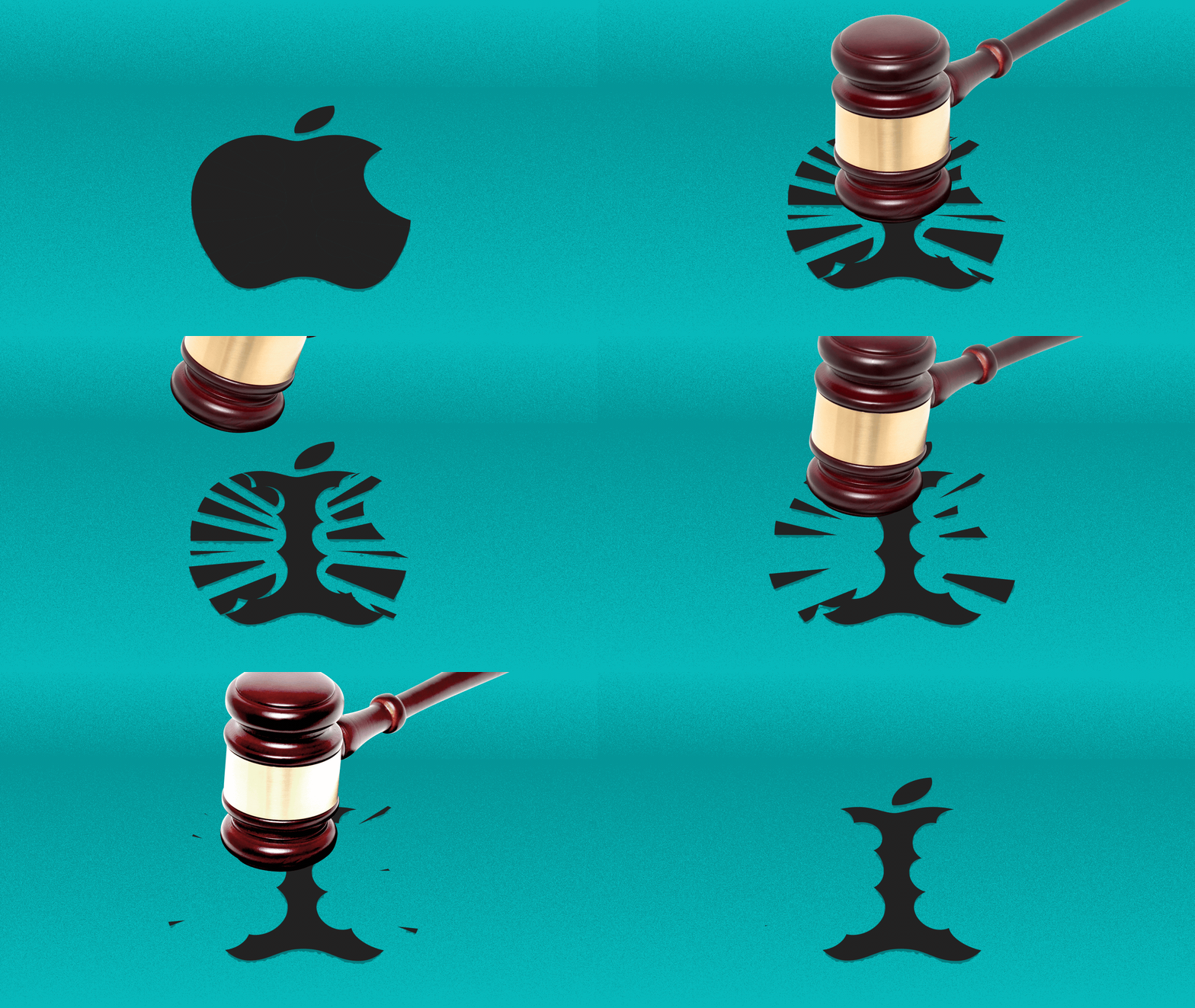
Illustration: Brendan Lynch/Axios
The U.S. government wants to stop Big Tech from parlaying its control of present-day platforms into power over the future — but the giants haven't gotten the message, Scott Rosenberg reports.
The big picture: The Justice Department's major new case against Apple, filed yesterday, completes the Biden administration's quartet of antitrust lawsuits aimed at the companies that have defined the tech industry's last 20 years.
- With another DOJ case against Google and FTC cases against Facebook and Amazon all proceeding in parallel, the Biden antitrust game is now a full-court press.
- These suits are rooted in the competitive battles that shaped the internet, the smartphone and the social media industries. But the officials responsible for bringing them have made clear they're also aimed squarely at the nascent AI future.
"Competition does not just protect the markets and technologies of today, but the innovations of tomorrow," assistant attorney general Jonathan Kanter said yesterday.
- "We bring this case to make sure that Apple competes by innovating rather than by imposing rules and fees that prevent others from innovating and competing too. In so doing, we protect the market for the innovations that we can't yet perceive."
Yes, but: Government lawsuits haven't made tech's trillion-dollar titans any shyer about gobbling up smaller companies in the emergent AI field, though the firms may adjust their tactics.
- Just this week, Microsoft effectively acquired Inflection AI, one of the highest-profile startups developing AI models and chatbots that compete with Microsoft partner OpenAI.
- Instead of purchasing the startup, Microsoft simply hired its leadership and much of its talent, while arranging a $650 million licensing deal that some experts suggest was specifically designed to avoid antitrust regulation.
The tech giants are also tapping one another's AI work — with reports this week of a deal by Apple to license Google's Gemini AI model for the next-generation iPhone.
- These talks don't seem to have been deterred by the proceedings in another federal trial involving Google and Apple, where a judge is now weighing his ruling.
- That case, centering on Google's dominance of the search market, is based in part on the terms of an Apple deal making Google's search an iPhone default.
Zoom out: The new Apple suit catches the company at a moment of unusual vulnerability.
- Sales have plateaued for iPhones, the fate of the new Vision Pro headset is unclear and Apple has so far brought up the rear of the generative AI parade.
The other side: Apple sits on an Everest of cash, and can view even an expensive legal defense — or massive fines like those regularly imposed by the EU — as a bearable cost of doing business.
- The real danger to tech's dominant firms comes in the form of so-called structural remedies — rulings that require companies to substantially change how they do business or to sell off or split up their products and divisions.
Flashback: Structural remedies are rare in the annals of U.S. antitrust.
- Courts broke up Standard Oil a century ago and AT&T 40 years ago, but they've resisted the move in most tech cases since.
- In 2000, Microsoft faced a trial judge's ruling that it must separate its applications and its operating system businesses, but the order was overturned on appeal.
The bottom line: Glacial antitrust trials have done little so far to limit the wealth and power of tech's biggest companies. The newest addition to the litigation onslaught faces similarly long odds.
2. Scoop: U.S. wins China's support on AI vote

Illustration: Allie Carl/Axios
The U.S. has scored a rare diplomatic victory at the United Nations — signing up China as co-sponsor of the first-ever AI resolution voted on by the U.N. General Assembly, Ryan reports.
Why it matters: The race to develop powerful AI has been a source of geopolitical tension, but China's move to co-sponsor American efforts hints at further cooperation on AI safety, and is a win for U.S. diplomats.
- In 2015, all 193 U.N. member countries agreed to work toward 17 Sustainable Development Goals by 2030, but those efforts are far off-track.
- AI offers opportunities to more accurately measure and more quickly achieve progress toward goals including quality education and affordable clean energy.
Between the lines: The resolution, which passed yesterday, makes explicit that the U.N. Charter — which aims to rid the world of war — and the Universal Declaration of Human Rights apply to AI development.
Behind the scenes: Diplomats signed up more than 100 governments as co-sponsors, with U.S. Ambassador Linda Thomas-Greenfield working since December to secure China's support.
- The U.S. accepted comments and tweaks to the text from 120 countries, diplomats told Axios.
- Changes to the text suggested by developing countries include new language recognizing AI threats to jobs, and the necessity of basic infrastructure such as electricity and broadband internet as conditions for fair access to emerging AI technologies.
The big picture: Previous international AI initiatives have been led or limited to the most powerful nations at forums like the G7, G20 and OECD.
- Today's resolution is the first major effort at engaging with Global South countries on the issue.
Yes, but: U.N. General Assembly resolutions are not legally binding, unlike resolutions passed by the U.N. Security Council.
3. 10% of workers could lose jobs to AI, per report

Illustration: Shoshana Gordon/Axios
A new report shared with President Biden finds that roughly 10% of American workers have jobs that are highly vulnerable to being affected and possibly displaced by artificial intelligence, Axios' Ivana Saric reports.
Why it matters: Generative AI comes with a myriad of potential benefits, from boosting the economy to advancing cancer detection, but many U.S. workers remain distrustful of the technology and worried about how it will impact their jobs.
The big picture: Workers in lower-income and less-skilled jobs are the most likely to experience disruption from AI, according to the report, which the Council of Economic Advisers sent to Biden Wednesday.
- The council's findings, which were first reported by CNN, are based on an analysis of 16 work activities that are highly exposed to AI.
- It looked at jobs in which those activities are central and highlighted the gap in performance requirements and income among jobs that could be affected by AI.
Between the lines: Workers in higher-earning jobs that require more complex or difficult work are more insulated, even if their jobs are highly exposed to AI.
- As such, AI could worsen income inequality if it is used to replace workers in lower-income jobs while complementing higher-income ones, the council added.
Caveat: That doesn't mean that the 10% of workers with high AI exposure but low-performance requirement jobs will all end up losing their jobs, the council stressed. Instead, those workers are most likely to see their jobs change as a result of AI.
- "Most jobs remain a collection of tasks of which only a portion can be automated," the council stated.
4. Training data
- Microsoft launched its first Surface devices with a built-in Copilot key. (CNBC)
- Creators of the forthcoming IFC Films feature "Late Night With the Devil" defended their use of generative AI in the film, calling it an experiment. (Variety)
- Mozilla posted an open letter to Meta urging the company to keep its CrowdTangle analytics tool running through the 2024 election year for researchers to track misinformation campaigns. (Engadget)
5. + This

Denise Long and Stephen Curry during a Golden State Warriors practice in 2018. Photo: Michael Macor/San Francisco Chronicle via Getty Images
I had no idea that the Golden State Warriors drafted a female player — Denise Long — back in 1969.
Thanks to Scott Rosenberg and Megan Morrone for editing this newsletter and to Caitlin Wolper for copy editing it.
Sign up for Axios AI+

Scoops on the AI revolution and transformative tech, from Ina Fried, Madison Mills, Ashley Gold and Maria Curi.