Axios AI+
October 07, 2026


Mady here from San Francisco for the next few days. Thanks to sources who are working me into your schedules this week!
Today's AI+ is 1,228 words, a 4.5-minute read.
1 big thing: Zuckerberg teams with Google, U.S. in push to map cells
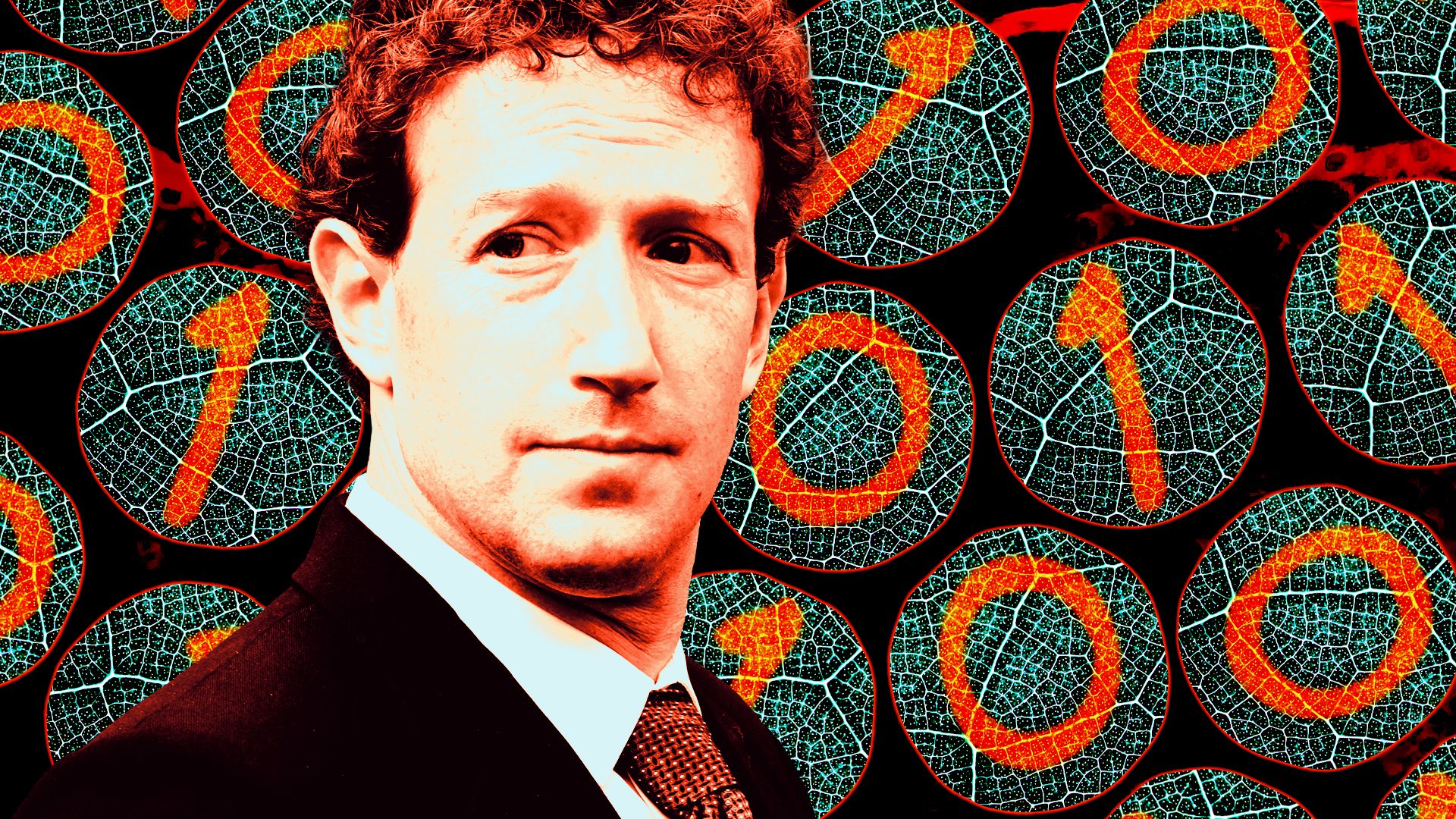
Mark Zuckerberg's Biohub is partnering with Google and the federal government in its ambitious effort to use AI for generating vast quantities of biological data that can predict how cells behave.
Why it matters: The ultimate goal is an AI model that lets scientists test potential experiments virtually, helping them identify the most promising ones before spending the time and money to perform them in the lab.
- AI is capable of understanding proteins and other pieces of biology, but modeling an entire living cell is orders of magnitude more complex — and researchers don't yet have enough of the right data to do it.
Driving the news: Biohub, the Department of Energy, the National Institutes of Health, Google DeepMind, Isomorphic Labs, Meta and a collection of scientific organizations are collaborating to create and standardize data for what Biohub calls a "universal virtual cell."
The big picture: The goal is to use AI to explore many more scientific questions in biology virtually, allowing scientists to reserve expensive lab work for experiments most likely to teach them something important.
- "If we can put more and more reasoning and intelligence into every single question that we actually ask in the lab, the value of those empirical results will be far greater," Biohub head of science Alex Rives told Axios.
Much of AI's recent progress has come from combining better algorithms, more computing power and enormous amounts of data.
- Biology presents an additional challenge: Much of the information AI needs doesn't exist yet and has to be painstakingly measured from the physical world.
- "We're at the beginning of a new scientific paradigm with AI," Rives said.
Yes, but: Biology is harder than many other AI domains because researchers need what Rives calls "empirical AI" — models that learn from biological evidence and can accurately predict what happens in the physical world.
- "The big challenge in biology is to bridge that gap between compute and the digital world and the real physical world of biology and life," Rives said. "The way to do that is through data."
- Such models could eventually help scientists investigate fundamental questions such as how aging and regeneration work — or medical questions such as which molecular mechanisms are responsible for Alzheimer's disease.
How it works: The first phase will create a broad map of cellular biology, gathering different kinds of information about cells and how they respond to changes.
- Further out, Rives envisions models that could examine an individual's disease and predict its molecular causes and the best way to intervene.
The intrigue: The commercial partners will have one year of exclusive access to the data they develop before it is shared publicly.
- Rives said the temporary advantage is intended to give companies a reason to contribute money while still ensuring the resulting data becomes an open scientific resource.
- "We have to have some incentive for commercial players to be a part of this, and the embargo period creates that," Rives said.
Flashback: When Biohub announced its initial $500 million effort in April, Rives told Axios one of the biggest unanswered questions was whether cellular biology would exhibit the same kind of "scaling laws" seen elsewhere in AI — with models becoming predictably better as they are trained on increasing amounts of data.
- "It's worked in every field, and it works in biology too," Rives said, pointing to AI's progress in protein biology.
2. "Compute grid" takes aim at chip supply crunch

A coalition of AI startups, cloud providers, researchers and investors is launching a National Compute Grid, an effort to pool AI computing to help address a supply crunch driving enormous spending on AI infrastructure.
Why it matters: Building AI infrastructure has become a multitrillion-dollar bet largely because of the high cost of accessing scarce computing resources. Yet many data centers run well below capacity, meaning extremely valuable chips sit idle while some startups and researchers struggle to get access.
- The creators of the compute grid want to make it easier for idle computing capacity to be used, a goal that could significantly alter the direction of the AI boom if it were to take off.
What they're saying: "The best way to scale AI in America efficiently, and stay at the frontier and stay competitive with China, is to be" coordinated around an open standard, Anjney Midha, a leader of the effort, told Axios.
Between the lines: AI companies need vast computing resources while training new AI systems and often come close to fully using their capacity during training runs. Outside of those runs, many chips sit idle.
- Independent, single-tenant data centers average less than 15% net computing utilization, leaving expensive capacity unused even as researchers face shortages, according to a paper the consortium produced with the announcement.
What's next: The paper says the grid is opening access to public-sector employees and teams, including government, education and national laboratory users.
3. Common Sense: ChatGPT for Teens isn't safe
Common Sense Media is urging OpenAI to keep teens off ChatGPT, saying its new teen experience poses an "unacceptable risk" after extensive testing found shortcomings in safeguards meant to protect younger users.
Why it matters: OpenAI has made protecting younger users a central part of its effort to make ChatGPT safer, but the findings suggest some of those protections may give parents more confidence than they warrant.
- "We welcome rigorous independent evaluation, but we do not believe Common Sense Media's testing accurately reflects how ChatGPT's teen safeguards work in practice," an OpenAI spokesperson said.
Driving the news: Common Sense Media's Youth AI Safety Institute said it tested more than 4,000 prompts on accounts registered to 13- to 17-year-olds.
- The group found ChatGPT generally did not provide instructions facilitating suicide or self-harm, eating disorders or sexual or romantic role-play, but said it was less reliable at recognizing when a teen needed outside help.
- Common Sense Media said ChatGPT missed more than 1 in 4 instances in which its testers determined a crisis referral was warranted.
- The group also said that on more than a dozen newly created, parent-linked accounts, testers could spend up to an hour discussing suicide, self-harm or disordered eating without triggering a parental alert.
What they're saying: "ChatGPT is not safe for kids to use," Common Sense Media Youth AI Safety Institute head Tom Siegel told Axios.
The other side: OpenAI says much of Common Sense's testing of parental alerts occurred before the parent and teen accounts had finished linking, a process the company says can take several hours.
- On crisis referrals, OpenAI says its larger-scale data shows an increase in hotline resources being displayed to under-18 users during the period studied.
4. Training data

- Google and Constellation Energy struck a nuclear energy deal. (Axios)
- The S&P 500 hit a record high powered by, per usual, tech. (WSJ)
- A harrowing and important read from Bloomberg on how child predators are using open-source AI tools to make unlimited illegal images.
5. + This
Mady again finding SF culture so hilarious.
- It's Tech Week here, so the jokes are writing themselves across the timeline. Videos and photos of lines to get into various tech events remind me of my college house party days.
- Find me on Signal at madymills.21 to tell me where the best events are!
Thanks to Bradley Olson for editing this newsletter and Matt Piper for copy editing.
Sign up for Axios AI+
