Axios AI+
June 24, 2026


Mady here eager to mention that alongside the NBA draft this week was the Jimmy Awards. New York theater kids and Reneé Rapp fans will know what I'm talking about, and the rest of you can email me if you want more tea.
Today's AI+ is 1,169 words, a 4.5-minute read.
1 big thing: OpenAI's first homegrown AI chip

OpenAI says it has begun testing "Jalapeño," the first in a family of homegrown chips, with plans to start using the chips to handle customer queries later this year.
Why it matters: OpenAI is joining other leading AI companies in designing its own silicon as it races to secure more computing capacity, lower costs and reduce its dependence on Nvidia.
Driving the news: This first generation of chips, which are aimed at inference rather than training, were developed with Broadcom.
- OpenAI did the core design, while Broadcom brought specific knowledge in connectivity and other areas.
- OpenAI said its chips are specifically designed for handling current and future models, allowing them to be used more efficiently and deliver better performance per watt of electricity than off-the-shelf options.
Zoom in: OpenAI is using the first sample chips in its labs for tasks similar to answering Codex queries.
- They're delivering even better thermal performance than anticipated, the company says.
- Broadcom said to expect the first chips to be in commercial use at Microsoft and other partners by the end of the year, though OpenAI says the real volume will come next year.
- The company has said it aims to have the custom chips powering 10 gigawatts' worth of compute by 2029.
What they're saying: Broadcom CEO Hock Tan said that the work with OpenAI highlights a message he has been pushing for a while: Companies that want to lead in AI need their own chips.
- "At the end of the day, you cannot, should not rely on some other third-party GPU to do it for you, because it's such a key part," Tan said.
- Richard Ho, who leads OpenAI's chip efforts, said that being able to bring AGI to benefit all of humanity requires the company to deliver compute efficiently and cost-effectively.
- "This gives OpenAI full stack control," Ho said.
The big picture: OpenAI has relied almost exclusively on Nvidia chips for both training and inference, though recently it began also using chips from Cerebras for inference.
- Nvidia remains a key partner, especially for training new models, OpenAI says.
- Google, Amazon, Microsoft and others already have their own AI chips that they use alongside Nvidia's processors.
What we're watching: Whether OpenAI expands its homegrown chip use to training — not just inference. That's something the company said it is considering.
- "We think we have a very efficient architecture and so we will try to maximize our architecture in different dimensions," Ho said.
2. AI job apocalypse hype

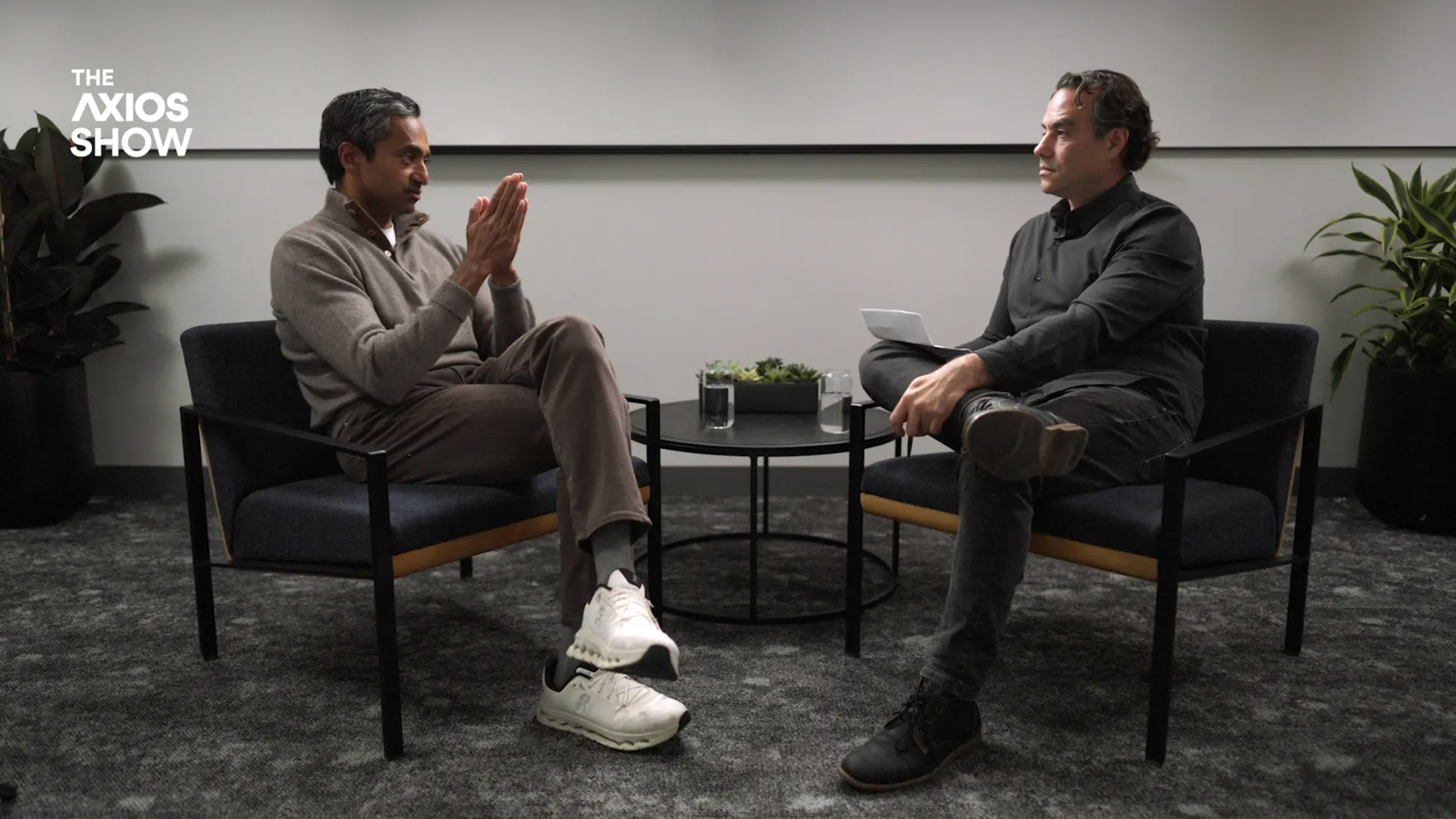
The AI job apocalypse may make for an "incredible headline," AI investor and "All-In" podcast co-host Chamath Palihapitiya said on "The Axios Show" — but he says it ignores history.
Why it matters: The AI boom has turned the future of work into a political fight, an investor thesis and a sales pitch. Palihapitiya's counter: New technology changes what humans do, but it doesn't make them irrelevant.
The big picture: The Social Capital CEO rejected the idea that AI and robotics will wipe out work — even for plumbers. Axios' Dan Primack floated a future where robots could crawl under the cabinet and do the job.
- Palihapitiya pushed back that someone still has to own the plumbing business. Humans will still need shelter, food, clothing and, yes, bathrooms.
"I think it's great to spark a debate," he told Dan in Redwood City, California. But he suggests the argument isn't rooted in "patterns of the past."
- Palihapitiya points to past technological transitions that let humans multiply the number of tasks they do in a day.
- "I suspect if you just trend it, that 35 things now goes to 300 things over the next thousand years," he said. "There's going to be more ways in which we allocate time."
Reality check: Palihapitiya is not alone in challenging the bloodbath theory.
- MIT researchers in an April paper described AI automation as more of a "rising tide" than a "crashing wave."
- In May, OpenAI CEO Sam Altman said he was "wrong" about projections that AI would wipe out entire categories of jobs.
Zoom out: Primack, 50, put the fear in personal terms: He doesn't expect his own work to disappear before retirement, but worries his 15-year-old daughter's generation could face a rockier path to stable employment.
- Palihapitiya pushed back: "Are you saying that you think she's just going to be unemployed and a ward of the state?"
The bottom line: Palihapitiya bets AI won't end work. It will scramble it — and expand what humans do next.
- The full episode of "The Axios Show" interview will be released later this week.
3. Tech stocks slump as AI bubble fears loom



Tech stocks shriveled yesterday as fears about an AI bubble sapped market momentum.
Why it matters: Chatter about a bubble has been prominent in recent months but hasn't yet delivered a long-lasting blow to stocks.
Driving the news: The tech-heavy Nasdaq Composite Index fell 2.5% shortly after the opening bell.
- The broad S&P 500 index was down roughly 1%.
Zoom in: It's a particularly ugly day for chip memory and data storage stocks.
- They suffered some of the worst declines early, after a 10% overnight drop in South Korea's KOSPI index, which is dominated by memory chip makers Samsung Electronics and SK Hynix.
- In the U.S., memory chip maker Micron dove more than 10% in early trading, storage device maker Sandisk plunged more than 12% and hard disk drive makers Seagate Technology and Western Digital were both lower by roughly 8%.
The big picture: Makers of memory chips and data storage devices have been some of the biggest beneficiaries of the AI infrastructure boom, which has created unprecedented demand and soaring prices for products that were long seen as commodity inputs to tech products like laptops and cellphones.
Shares of SpaceX — which went public less than two weeks ago — briefly fell below their opening price of $150 on Tuesday.
- The company — known broadly for rockets — has become an AI play as investors bet on a lucrative future with orbital data centers.
The bottom line: It's too early to tell whether this is a serious shakeout — or just a temporary rebalancing.
4. Training data
- Meta has a team focused on creating a prediction market app, separate from Facebook, that would act like a game and not involve cash wagers. (New York Times)
- Superhuman, formerly Grammarly, is acquiring GPTZero, an AI content detection tool. (The Verge)
5. + This
Mady here. I can't stop thinking about this stat flagged by our Markets correspondent Emily Peck:
- Only 26% of the 204 U.S.-based executives surveyed by KPMG in May said that the operating costs of AI are fully visible to them.
Why it matters: The pendulum has swung quickly from tokenmaxxing to minimizing, but either way, executives seem to be flying blind.
Thanks to Megan Morrone for editing this newsletter and Matt Piper for copy editing.
Sign up for Axios AI+
