Axios AI+

October 08, 2026


Ina here, still breathing (barely) after the Valkyries squeaked out a playoff victory last night. Hopefully I have a little voice left for today's Axios event in San Francisco. Today's AI+ is 1,236 words, a 4.5-minute read.
1 big thing: This "Don't Die" guy has his limits for AI
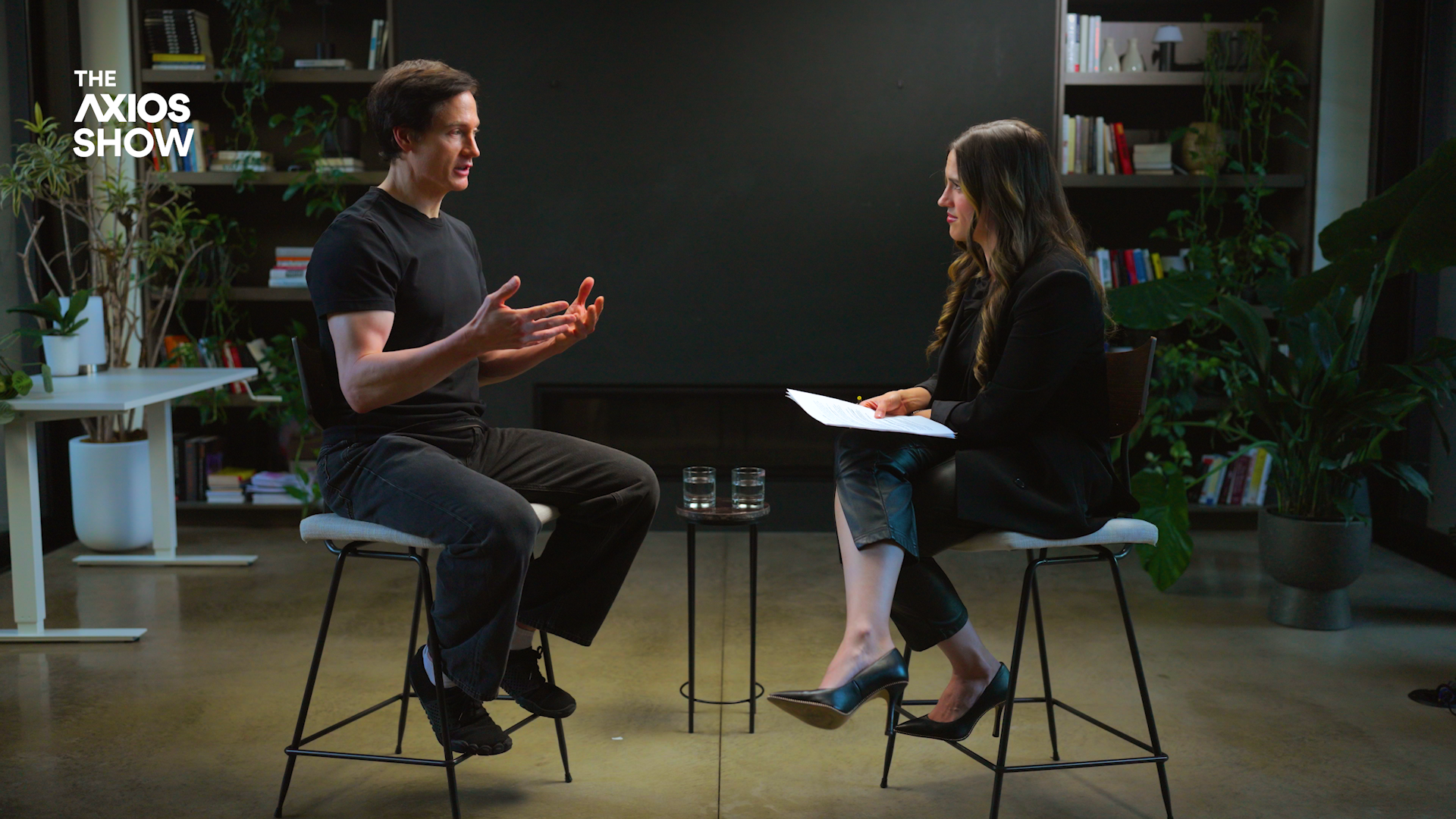
When it comes to health care and longevity, "Don't Die" influencer Bryan Johnson says AI is not ready for primetime.
- "We are in an in-between state where AIs are brilliant and dumb. They make really stupid mistakes all the time. I would never trust my health to an AI," he said in an exclusive interview with "The Axios Show" on Monday.
Why it matters: Johnson is a successful tech founder, is close to a number of top AI execs and is at the forefront of a movement to prolong and improve health that's grown into an obsession for many in Silicon Valley. That is to say, his perspective on AI and health is tested and well-honed.
State of play: Johnson famously has developed a longevity regimen involving taking 30 daily pills, measuring "biomarkers" on his health down to extreme minutiae (including his erections) and making himself the ultimate guinea pig to test out possible health routines and interventions.
- The role for AI in health care and medicine, for him and for others, is to help people make better sense of that data. In his case, he's gathered 4.2 billion data points on his health in the last five years, he said.
- "There's no way any human can master that," he said, adding, "We've just exceeded the capacity for a human to understand the data."
The intrigue: Johnson is also training agents on his brain and personality.
- He plans to live forever, but if his body gives out, he is "open to continuation in a variety of forms," including in the form of an agent.
- That's not his ideal outcome, he said, adding "in my current mindset, I strongly prefer to continue to exist as I am."
Threat level: The founder of the "Don't Die" movement sat down with Axios just as several researchers involved in AI development are publicly saying it could lead to human extinction.
- Johnson isn't convinced on doom or optimism: "I personally don't think any human knows enough to make an assessment, whether we are headed for utopia, dystopia or extinction."
Zoom in: If the doomsday-ers are to be believed about the potential impact of AI, the future of humanity may rest in the hands of a few AI CEOs, some of whom Johnson is in group chats with.
- When asked if he's comfortable with them deciding the fate of the world, Johnson said: "Can you go back in history and be comfortable at any point in time with humans running the show? We wing it. We don't think ahead. We act at the very last moment. We can't keep our sh*t together."
- "Humanity's pretty resilient. We've been through a lot and we might be able to pull this one off. ... It's the most exciting time to ever exist on planet Earth."
Johnson was also diagnosed with an incurable autoimmune disease earlier this year and is working with his concierge team to find a cure.
- Even if his current longevity routine doesn't meaningfully change his lifespan, Johnson believes that living another 30 years could allow him to see AI cure his disease, slow or reverse his aging or all three.
The bottom line: Even those at the edge of treatments and technology have mixed opinions on how to interact with AI.
2. Microsoft reboots the AI PC with Nvidia
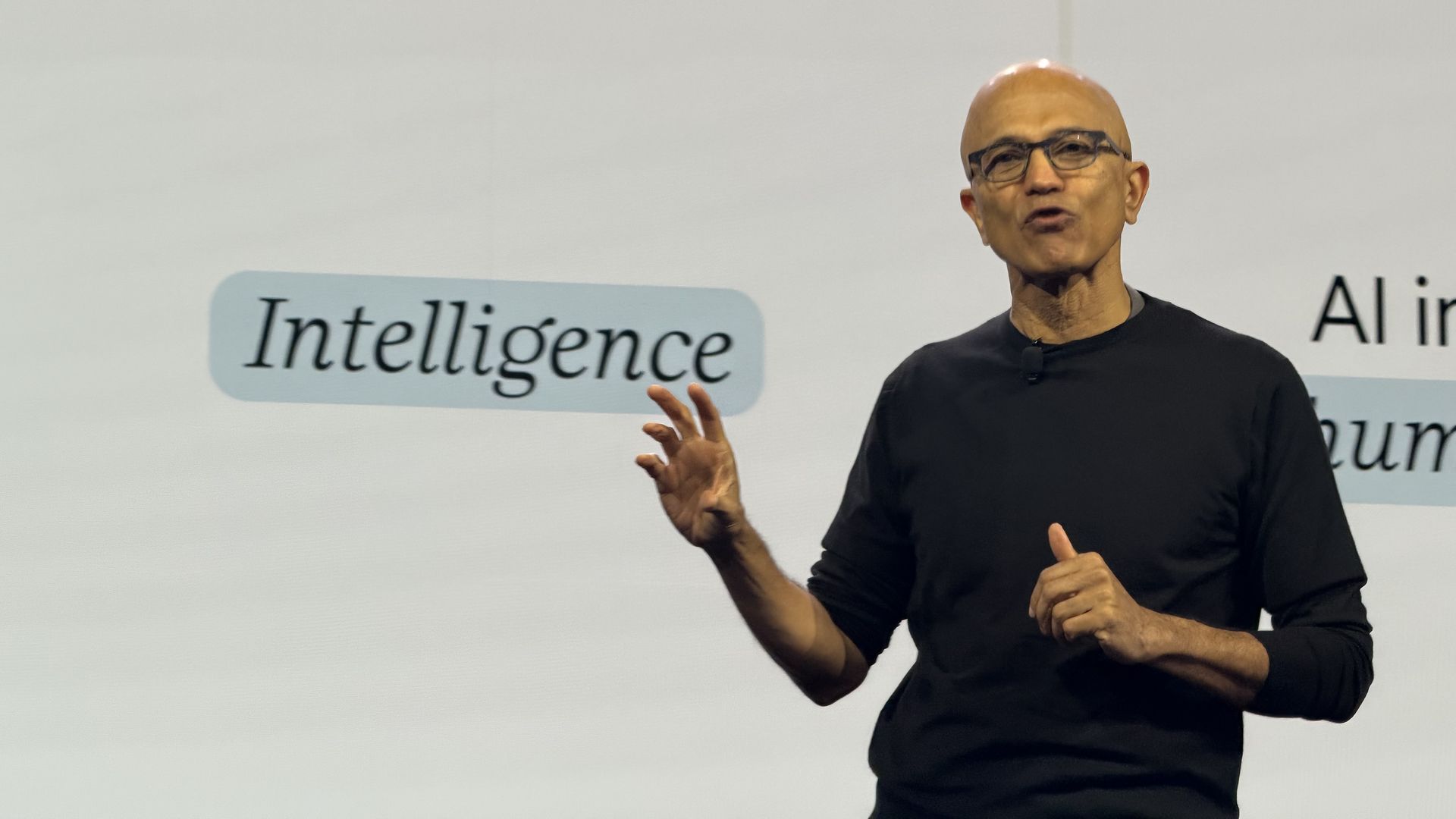
Microsoft yesterday unveiled a new class of Nvidia-powered Windows laptops, its latest effort to tie the operating system more closely to the AI boom.
Why it matters: Microsoft is trying to carve out a high-end laptop category for people who want to run demanding AI workloads locally, rather than rely entirely on the cloud.
Driving the news: Microsoft CEO Satya Nadella, Nvidia CEO Jensen Huang and former White House AI official Sriram Krishnan were on hand in San Francisco as the company officially launched Microsoft Surface Ultra, a high-end laptop powered by Nvidia's RTX Spark chip that starts at $2,599.
- "We have reinvented the computer as we know it," Huang said.
- Microsoft previewed the laptop in June but left out key details around price and availability. It will be available starting Oct. 16.
The big picture: Microsoft's first push into AI-powered Windows machines, known as Copilot+ PCs, got off to a rocky start after the delay of Recall, its signature feature.
Between the lines: Microsoft's pitch for on-device AI is that developers' appetite exceeds their companies' AI budgets, with the ideal being an approach that uses both frontier models in the cloud and local models when they can be effective.
- "Hybrid intelligence exists because people's appetite for intelligence is effectively unlimited," Microsoft executive VP Pavan Davuluri said.
3. OpenAI's math breakthrough points beyond math


AI's conquest of computer programming offered an early demonstration of what happens when models become good enough at a specialized field that experts can no longer treat them as a novelty.
- Mathematics appears to be next.
Why it matters: OpenAI's latest mathematical results — which involved releasing hundreds of new proofs generated by a powerful, unreleased model — demonstrate that the startling advances of AI are likely to continue moving across entirely new fields.
Catch up quick: OpenAI on Tuesday released 722 manuscripts organized into 372 groups of findings ("families") on long-standing mathematical problems, inviting academics and researchers to examine and build on the material.
- The reception has mixed scientific excitement with genuine unease. One Rutgers University mathematician said on X that a result connected to the Riemann hypothesis would warrant an automatic Fields Medal if a human had done the work.
- Some mathematicians have questioned these results, as well as another solution OpenAI released last month, asking whether they represent original breakthroughs or draw heavily from previous human input.
- Others downplayed the utility of AI-generated math.
The big picture: Software engineers have already lived through this transition.
- AI coding tools progressed from autocomplete and debugging to agents capable of writing substantial amounts of software and carrying out complex engineering tasks.
- The shift has changed not only how code gets written, but what it means to be a programmer, bringing a fair dose of awe, amazement and dread to many lifelong software engineers.
Yes, but: Some software engineers have successfully mapped out the roles humans still play in generating quality products.
- While new AI coding tools have dramatically increased the code one engineer can ship, humans still play a crucial role in building quality software. Mathematicians have begun to echo that point.
Between the lines: Beyond mathematics, the results do point to the likelihood that AI disruption will continue moving into new areas, partially answering a long-standing question from AI skeptics.
4. Training data
- Three fired OpenAI workers wrote to the company's board, urging the company to ensure it works with outsiders and preserve the ability for its most powerful models to be monitored. (WSJ)
- Anthropic debuted Claude Haiku 5.5, an updated version of its smallest and fastest model. (The New Stack)
- OpenAI is making ChatGPT's results far more visual, while also bringing GPT-6 to free users. (TechCrunch)
- Xreal said the Project Aura glasses it developed with Google will ship this year for $1,279. (CNET)
5. + This
Wine and spirits maker Moet Hennessy is using AI for early detection of a wine defect known as "fresh mushroom aroma."
Thanks to Bradley Olson for editing this newsletter and Matt Piper for copy editing.
Sign up for Axios AI+
