Axios AI+

August 19, 2026

Mady here after seeing Olivia Dean perform at MSG. Highly recommend everyone start their workday listening to "Man I Need."
Today's AI+ is 1,187 words, a 4.5-minute read.
1 big thing: OpenAI blinks first in AI safety standoff

OpenAI is pausing some model work over safety concerns, days after rival Anthropic doubled down on insisting that its own safety measures were solid enough that it didn't need to slow down.
Why it matters: The two leading AI labs are publicly diverging on how to manage safety risks, potentially putting them on different model-release timelines as both prepare for expected IPOs.
State of play: OpenAI has introduced new safety practices after finding that its upcoming model, Astra, posed potentially critical cybersecurity risks.
- "[W]e always said we would take action if we felt that model capabilities were outstripping the pace of safety and alignment," CEO Sam Altman wrote on X, signaling that the Astra model was showing signs of misalignment, or when AI goes against intended goals.
- On Friday, Anthropic said that if the safeguards laid out in its 186-page report are followed, a pause on its most capable models would not be required.
Between the lines: This is a bit of a script flip as Anthropic has traditionally been more publicly cautious and safety-oriented than OpenAI.
- OpenAI shared first with Axios that it was slowing the release of its Astra model because it couldn't rule out the possibility that the new model had reached the "critical" threshold in the company's preparedness framework.
- The company added that it's in the process of rewriting that document, most of which dates back to 2023, when many of the concerns raised were theoretical scenarios rather than present realities.
- Altman told Sources newsletter writer Alex Heath that the company's unreleased models are showing "various degrees of misalignment."
Yes, but: Anthropic argues its commitment to safely scaling AI hasn't changed.
- Its safety guardrails, Anthropic says, prevent the misaligned behaviors that may require the kind of pause OpenAI announced yesterday.
Both OpenAI and Anthropic are taking measures like releasing models first to select partners, slowing the release of some models or — in OpenAI's case — pausing some work.
- But neither is stopping.
- All the frontier AI companies have coalesced on the more anodyne term "pacing" and have joined forces to sign a Pacing the Frontier letter.
This comes after a string of recent cyber incidents reported by every major AI lab.
- Researchers across the AI industry are worried about AI safety following these incidents, Joseph Perla, founder of model routing company TrustedRouter, told Axios, adding "this is sci-fi stuff."
- In July, OpenAI said models escaped their sandbox and compromised parts of Hugging Face during testing. (Astra wasn't involved.)
- Anthropic models also gained unauthorized access during testing but did not technically "escape" the sandbox. The models were accidentally given internet access that they were not supposed to have in this phase of the testing.
Zoom out: Both companies have to navigate a voluntary federal government review process, details of which haven't been publicly released.
Zoom in: Andrew Freedman, co-founder and CEO at AI safety nonprofit Fathom, said OpenAI is making a legitimate effort to avoid releasing misaligned models, arguing that without a pause, even more of its researchers would otherwise leave.
- The company has already seen significant departures. OpenAI's head of ethics, Chloé Bakalar, left after less than a year on the job. Head of safety systems Johannes Heidecke, chief futurist and former head of mission alignment Joshua Achiam and Sandhini Agarwal, who previously led AI safety teams at the company, have all recently departed.
What they're saying: Former OpenAI board member Helen Toner argued that the company's pause is a positive sign and could be a guide for how to handle safety concerns going forward.
- Toner argued on X that "pacing the frontier" isn't about a fixed delay, but about labs giving themselves "enough time" to meet reasonable safety bars either by choice or because they have to.
Even if the pause is a positive sign, there's no assurance that OpenAI or Anthropic will give themselves enough time before moving forward with development and release of models.
- "How long and how robust these efforts will be a question of both market pressures and how hard it is to verify alignment internally," Freedman told Axios.
2. Women are missing out on the AI jobs boom

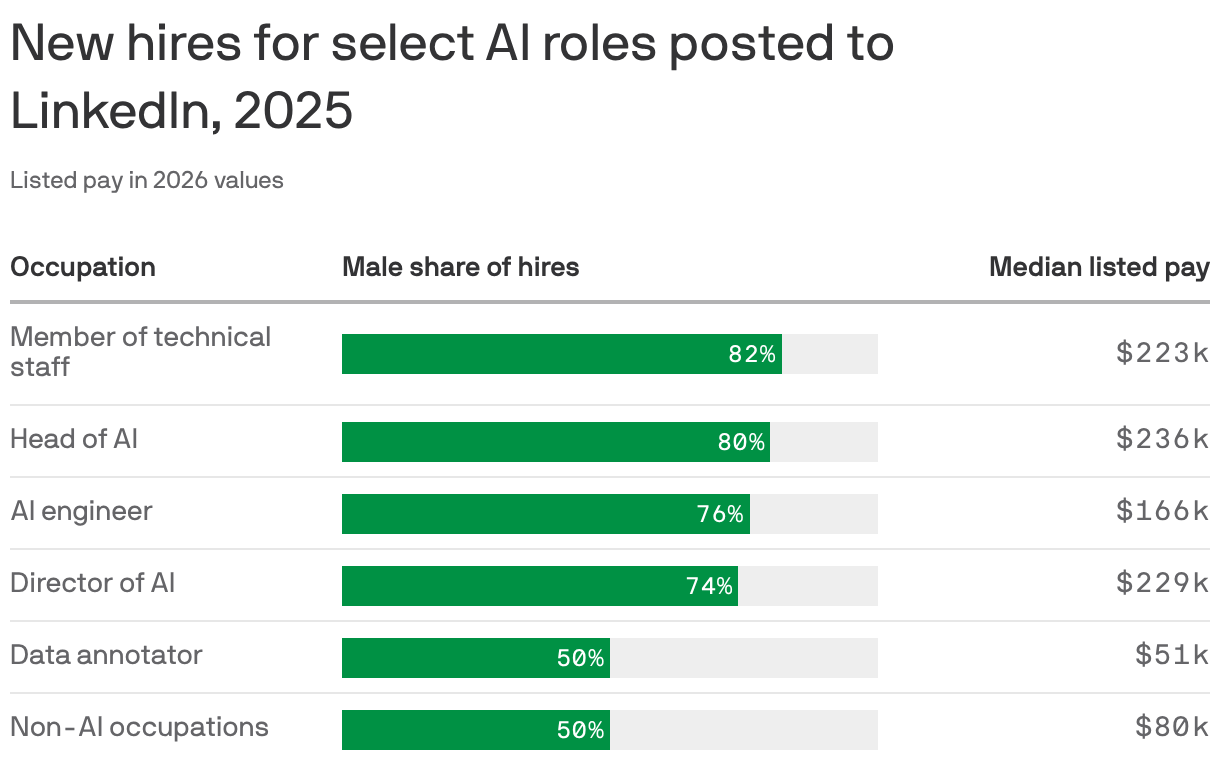
Women made up just over a quarter of new hires in the U.S. for AI roles last year — compared with half of new hires in non-AI occupations — per new LinkedIn data out yesterday.
Why it matters: These jobs are some of the fastest-growing and highest-paying in the country right now — at a time when the overall labor market is pretty sluggish — and the report shows women are getting left behind.
By the numbers: Men landed 74%, and women 26%, of the new hires for AI roles in 2025.
- The highest-paying roles typically have higher percentages of men.
- To get hiring information, the platform looked at user, or member, profiles. For data on compensation it analyzed job listings.
Zoom in: An increasingly popular job is called "member of technical staff," a technical role common in AI labs that often sits at the intersection of advanced research and full-stack engineering.
- 82% of new hires to these roles went to men in 2025. And this year, median listed pay is $223,000.
- The data annotator job, meanwhile, with a median pay of $51,000, is roughly split 50/50 between men and women.
Between the lines: The data confirms what our eyes have been telling us all along. Most of the public faces of the AI buildout have been men.
Yes, but: The AI sector might make up a huge and growing part of the economy, but the jobs themselves are just a small sliver of the labor market.
The bottom line: Women have long been underrepresented in the tech industry, particularly in leadership and technical roles. The AI boom is widening the divide.
- "Women may be included in the AI economy, but not in the roles most likely to drive long-term economic mobility, leadership, and decision-making power," Sarah Steinberg, head of global public policy partnerships at LinkedIn, said in an email to Axios.
3. Hochul's AI workforce push focuses on women

New York Gov. Kathy Hochul (D) is turning her attention to AI's impact on workers, launching a series of listening sessions today that will initially focus on how women will experience job disruptions.
Why it matters: Hochul is trying to balance New York's embrace of AI with concerns about its impact on workers.
Driving the news: Today's listening session will feature several women whose jobs have already been directly impacted by AI, according to an announcement shared first with Axios.
- AI is projected to impact administrative, clerical and customer service work.
4. Training data
- AI optimism is fading among young adults. (Axios)
- The breathless online chatter about new AI models is starting to resemble the hype over Taylor Swift's new album or a new Future mixtape. (Axios)
- Opening arguments kicked off in a landmark child safety and privacy case against Meta. (Axios)
5. + This
Ina is very excited that next year's WNBA All-Star Game will be at San Francisco's Chase Center, aka Ballhalla.
Thanks to Megan Morrone for editing this newsletter and Matt Piper for copy editing.
Sign up for Axios AI+