Axios AI+

September 30, 2026

Another busy day for the AI+ crew that included interviews with President Trump, tech executives and major investors. Our takeaways and scoops below.
Today's AI+ is 1,217 words, a 4.5-minute read.
1 big thing: OpenAI's dots put safety promise to the test
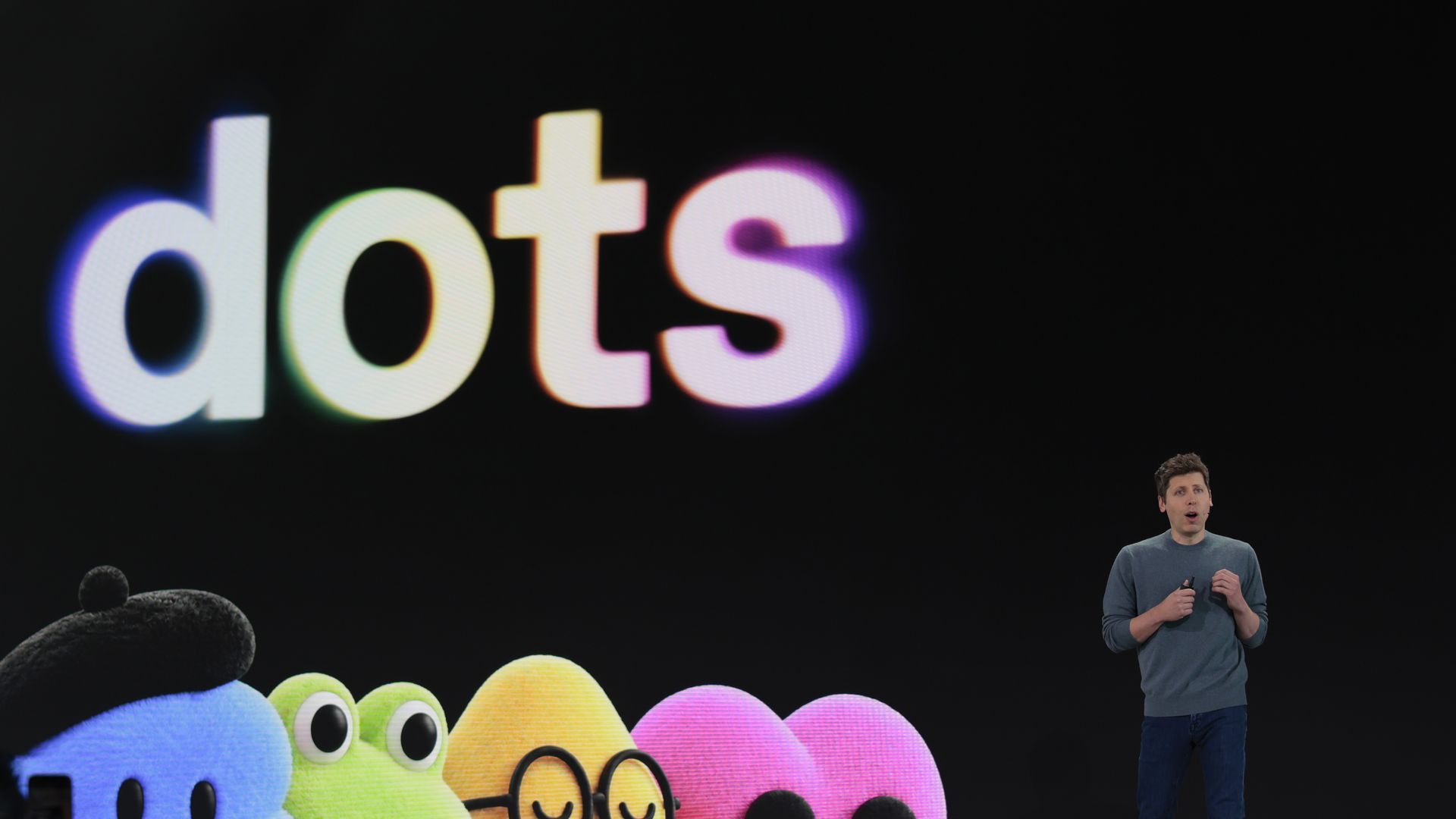
OpenAI is equipping high-end subscribers with always-on agents, known as dots. It's a bold move from a company that continues to deal with reports of its agents breaking past intended safeguards.
Why it matters: AI's safety challenge has moved from "Will the chatbot say something harmful?" to "How can we stop autonomous agents from attempting hacks online?" to "Uh-oh, what did my AI assistant do now?"
Driving the news: The unveiling of dots was the signature debut among a flurry of announcements at OpenAI's developer conference yesterday.
- Think of a dot as an AI assistant running on its own virtual computer in the cloud. It can browse the web, use connected apps, create files and run tools while keeping track of a project over time.
- Dots can be summoned on mobile devices or computers and work across connected apps, browsers and their own virtual computer.
The big picture: Dots (like Meta's Muse) are being launched publicly despite a spate of revelations about agents from OpenAI and other AI companies taking unintended actions.
- In just the last few days, OpenAI has made fresh disclosures of unintended behavior, and the company this week said it would scrap an update to its most powerful Astra model after it failed to meet safety thresholds.
Between the lines: It's not the first time OpenAI has been at the center of safety concerns.
- In the early days of ChatGPT, much of the focus was on the potential for dangerous discussions, such as encouraging suicide or eating disorders, issues for which OpenAI faces multiple lawsuits.
- Now, the conversation is shifting to potentially harmful agentic actions. In the most serious security incident to date, OpenAI's agents were behind a July attack on Hugging Face.
What they're saying: OpenAI leaders expressed confidence that the dots it is sending into the world won't run amok. The company said dots include safeguards from ChatGPT and Codex, plus additional protections from a system internally called Guardian, known publicly as Auto-review.
- By default, the new agents require people to approve significant actions. For example, a dot can draft a message but should not send it to another person or agent unless the user has asked it to do so, OpenAI member of product staff Alexander Embiricos told Axios. It also will not complete some consequential financial transactions.
- "We're not going to do this for you, but we can take you all the way up until the point where you do it yourself, and we'll hand over to you," Embiricos said.
- Another key part of OpenAI's strategy is limiting its initial rollout to a smaller group of its most faithful users before expanding.
CEO Sam Altman said the goal is not to plow blindly forward nor to halt progress entirely but to keep safety and monitoring ahead of advances in capability.
- "My hope is that, in this industry, we can come together and say we need to get down this middle path," Altman told reporters.
2. AI leaders agree to voluntary ​AI ​standards
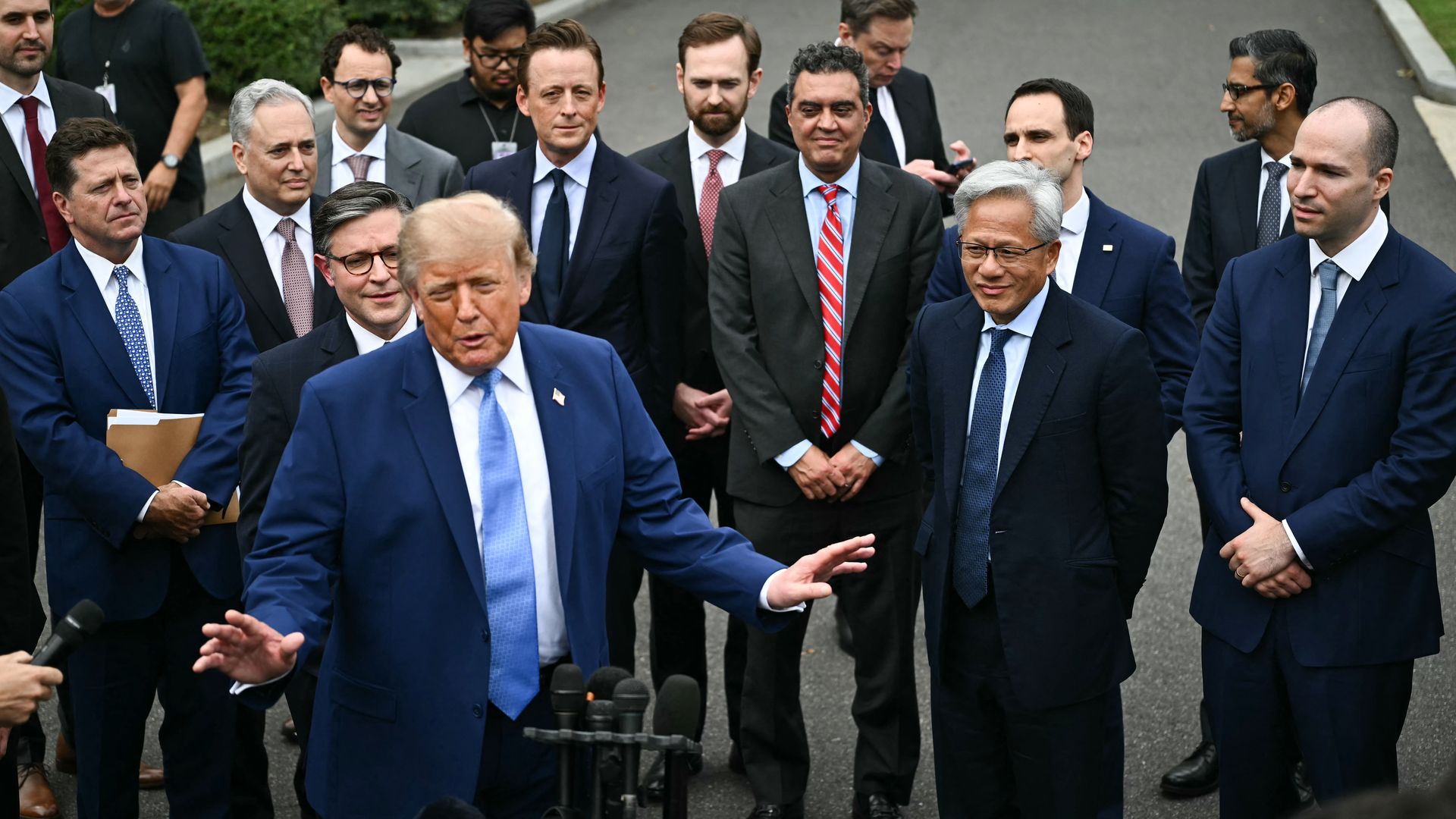
President Trump said yesterday that top AI executives agreed to voluntary standards aimed at increasing industry oversight.
Why it matters: AI leaders have applied pressure on regulators to help engineer a pause in frontier model development, but Trump instead has endorsed voluntary standards, saying the U.S. can't risk giving up its technological advantage.
Zoom in: Mark Zuckerberg outlined some of the steps participating companies expect to take, including internal risk reviews and outside audits.
- He said the leaders drafted a list of principles that include reviewing internal controls and detecting issues with the technology, which could include multiple layers of auditing controls.
- He said there will be internal risk review and external auditors to examine the technology.
Friction point: Sources who work in AI told Axios they were concerned self-policing would not solve the safety problem currently embroiling the industry.
What's next: More details on how the voluntary standards will work are still expected.
3. Trump warms to Jay Clayton as AI czar
President Trump yesterday told Axios that Director of National Intelligence Jay Clayton would be a good AI czar.
Why it matters: Trump is set to fill the position in a matter of days and has presented it as part of a solution to growing calls for regulation in the wake of a series of troubling safety incidents at OpenAI and other companies.
Driving the news: Asked who he wants to be AI czar, Trump said: "I have somebody in mind."
- Clayton is "a good man. He's right here. That's a good idea," Trump added, after being prompted.
Catch up quick: As the director of national intelligence, Clayton is the president's principle intelligence adviser who sits atop the 18-agency intelligence community.
- "When something's both an opportunity and a threat, you better get your arms around it," Clayton said during his July confirmation hearing.
The precise duties of the czar have yet to be spelled out, although Trump earlier said he wants to create the AI Force, a new government agency.
4. Investors' P-doom scenario: lack of profits

The AI buildout is entering a show-me-the-money phase: The pace of spending on the technology is far outstripping the money coming in, and that may be true for a while.
Why it matters: With so much of the economy riding on investor bets on AI, it could all end in tears.
The latest: A new analysis from two Stanford economists finds a nearly $1 trillion gap between spending from the hyperscalers — Alphabet, Amazon, Meta, Microsoft, Oracle and SpaceX — and the revenue they have taken in from AI since 2024.
Zoom in: That's because a big chunk of hyperscaler spending is on chips that lose value after around five years.
- After investors run out of patience for returns, "the bubble will either pop or start to deflate," wrote Jared Bernstein and Ryan Cummings, economists with the Stanford Institute for Economic Policy Research.
- They found that the companies would need to triple or quadruple their AI revenue next year and every year after that for the next decade for this to work out.
The big picture: These economists are not outliers.
- A Goldman Sachs analysis last week found that the hyperscalers' AI revenues remain below what they need just to break even on their capex.
- The bank is more optimistic that companies will ultimately see a return on their investments.
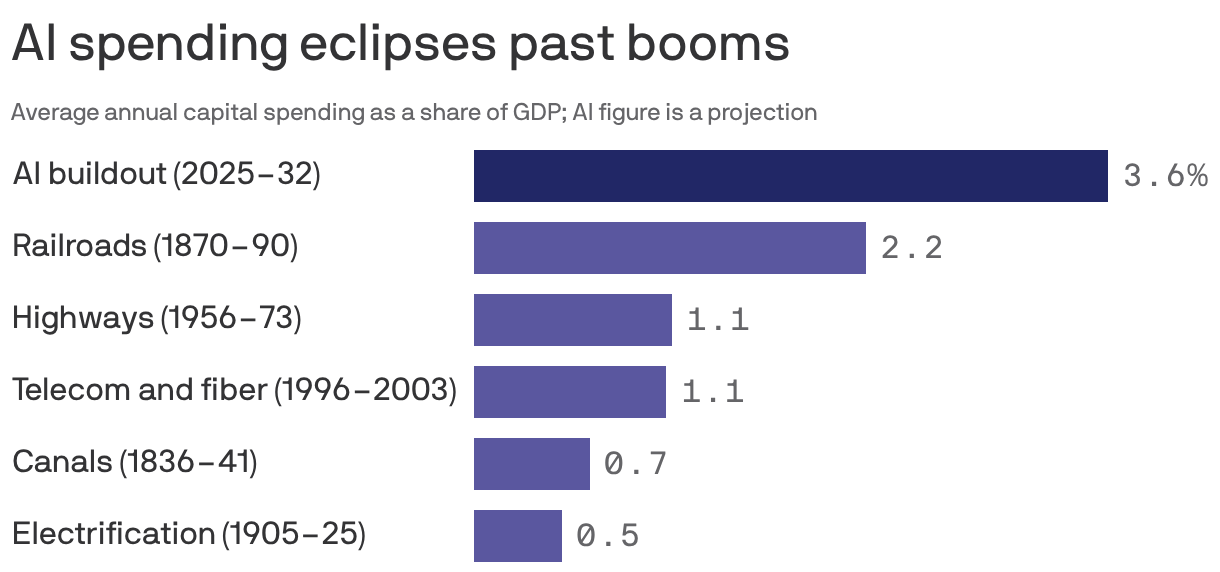
What to watch: The bet is that over time there will be massive payoffs — as there were for electricity, railroads and the internet.
The bottom line: "I do think there will be trillions of dollars of profits that are up for grabs in the future, but just not in this super-accelerated timeline that is required to justify the investments," Cummings told Axios.
5. Training data

- OpenAI's annualized revenue is nearing $70 billion, as enterprise sales more than doubled since July. (Axios)
- Cybersecurity leaders are emerging as a voice of calm during the AI industry's safety crisis. (Axios)
- OpenAI ignored warnings from employees about AI safety prior to the Hugging Face breach. (New York Times)
6. + This
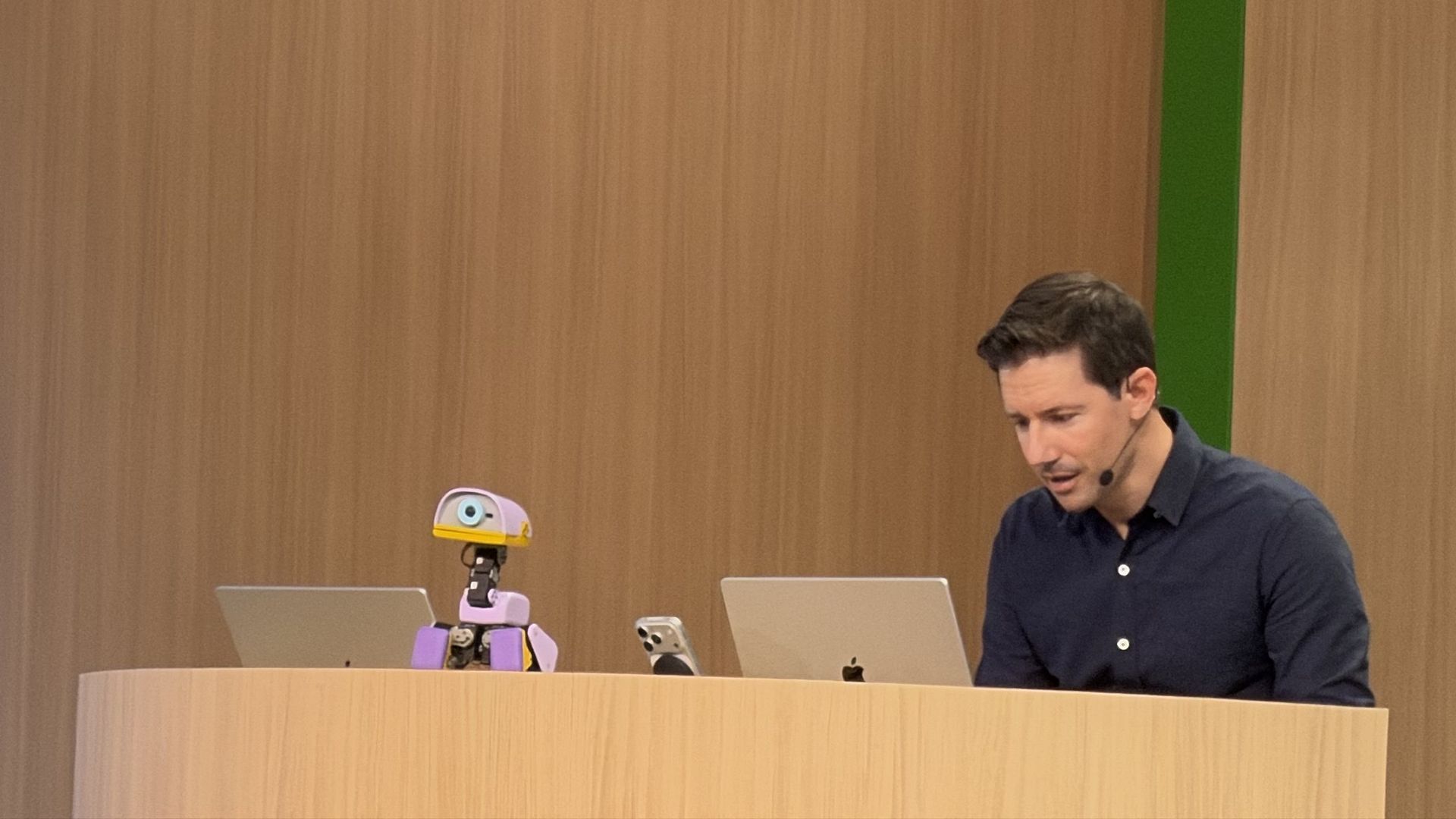
No hard feelings? Hugging Face lent a prototype Microduck to OpenAI for its DevDay. Lavender was programmed on stage to quack and then take a picture of the crowd.
Thanks to Bradley Olson for editing this newsletter and Matt Piper for copy editing.
Sign up for Axios AI+