Axios AI+

June 09, 2025

I'll be in Cupertino today for Apple's big developer conference. (Check out our coverage here.) Today's AI+ is 1,177 words, a 4.5-minute read.
1 big thing: Silicon Valley's not crying for Musk

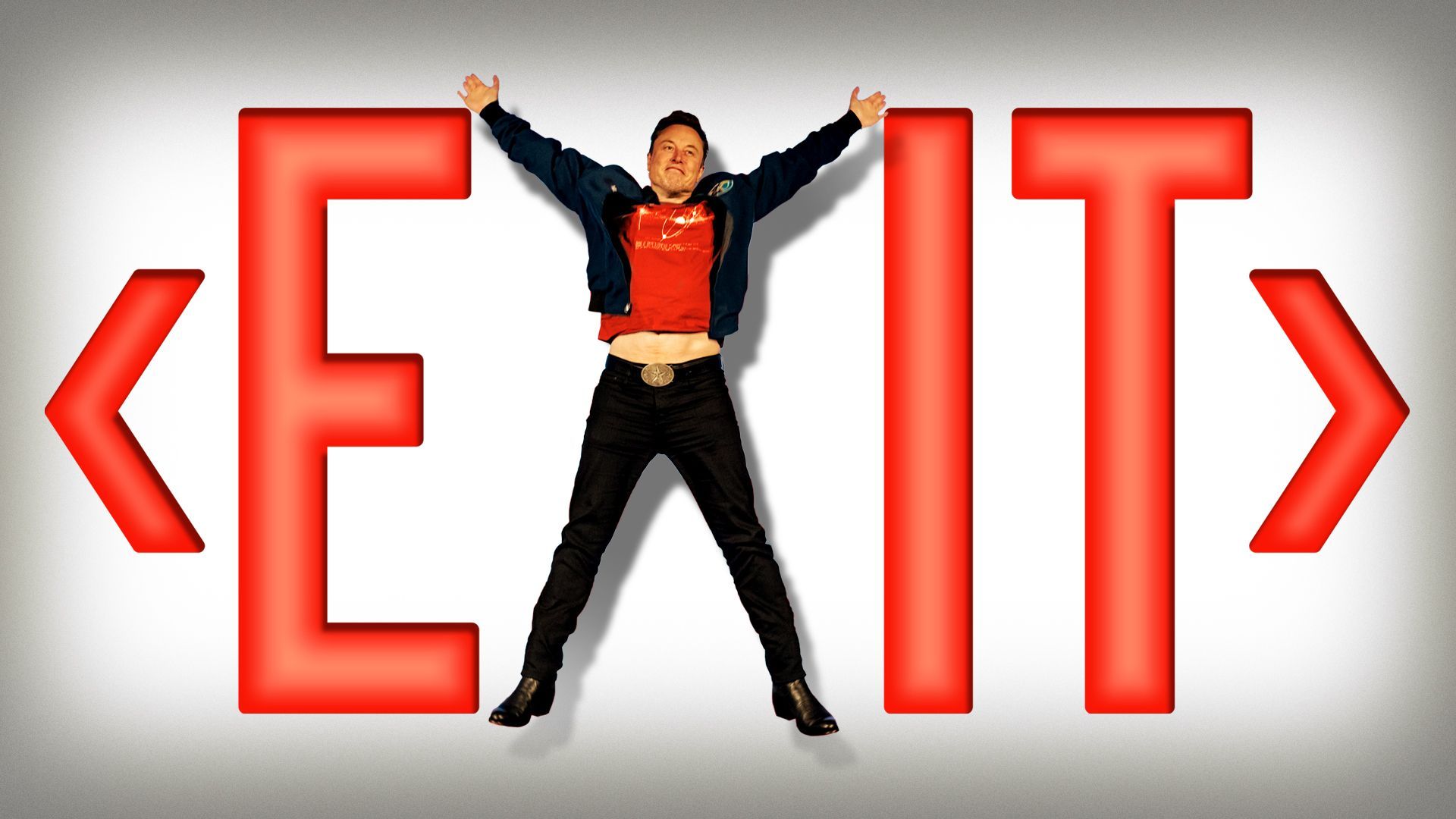
Few tears will be shed in Silicon Valley or at Big Tech firms over Elon Musk's precipitous fall from White House grace.
Why it matters: Musk's brief alliance with President Trump warped the usual dynamics of the relationship between America's most valuable industry and its center of political power.
Between the lines: Musk himself is widely admired in tech's corridors of power for Tesla's and SpaceX's innovations — but also widely disliked for his unfulfillable promises, erratic behavior and social media addiction.
- Now that Musk is suddenly on the outs with Trump, a lot of tech leaders are quietly crossing their fingers that they can get back to dealmaking and policy-setting without worrying about a key competitor whispering in the president's ear.
- Tech giants can't be sure that whoever replaces Musk as Trump's favorite geek will bring stability or regulatory relief — but Musk wasn't delivering on those fronts either.
On the other hand, any follow-through on Trump's threat to strangle the flow of federal dollars to Musk's firms would demonstrate that vendettas are the new normal.
- Such targeting of one person's business empire with the full force of presidential power would send a chill down any CEO's spine, pro- or anti-Trump.
The big picture: Tech leaders see huge opportunities in Washington and government work right now.
- AI is exploding, defense tech is booming, and crypto firms are chomping at the bit.
- Plenty of CEOs resented what they saw as the Biden administration's hostility to deals, dedication to strict regulation and aggressive stance on antitrust.
Yes, but: The long Republican tradition of business-friendly regulatory positions has mutated into a Trumpian realpolitik.
- The Trump administration has been forthright in its intention to help friends and punish enemies.
- Help comes as contracts and preferential treatment by regulators; punishment comes via canceled contracts, fines and even prosecution by the Justice Department.
- The terms of this week's Trump-Musk feud made starkly clear how serious Trump is about these carrot-and-stick moves.
Losers: Musk himself obviously faces not only financial losses but a reputational reckoning.
- He has already alienated his liberal-left fans, who'd once been drawn to his electric vehicles.
- If Trump's MAGA loyalists abandon him too, he might be left with a thinned social media fan base, a pile of sinking shares, and not much else.
Winners: Virtually any tech leader not named Musk can find satisfaction in his misfortune.
- Musk's businesses are all deeply entangled with one another but rarely partner with non-Musk-owned firms.
- His empire is a mostly self-contained Muskiverse, meaning its woes aren't likely to prove contagious.
- There are plenty of MAGA-friendly tech firms — think Palantir and Anduril in defense tech, Meta under a newly MAGA-fied Mark Zuckerberg, or the Andreessen-Horowitz portfolio in startups — ready to step into the Musk void in D.C. if he and the president don't patch things up.
- U.S. leaders may decide it's time to broaden the supply of rockets that can launch satellites and astronauts into space beyond SpaceX — and that could benefit Jeff Bezos and his Blue Origin firm.
One of the biggest winners, even though he has largely stayed mum on the Musk/Trump fireworks, is OpenAI's Sam Altman.
- Musk's role in the Trump administration gave his xAI company an inside track on federal contracts.
- Altman, who wasn't ever known to be close to Trump, surprised Musk by repackaging his giant Stargate data center project as a Trump deal and winning an Oval Office photo op with Trump the day after the new president's inauguration.
- Altman and Musk have their own feud. Both were among the nonprofit's cofounders, and Musk has sued OpenAI, claiming that under Altman it has abandoned its original AI safety mission.
Another winner: Vice President JD Vance, who during Musk's White House days seemed to fade into the woodwork, has a chance to reassert his primacy as the Trump administration's ambassador to tech.
- Still to be seen is where some of the other key tech players in Trumpworld — like White House adviser David Sacks — land when the firestorm subsides.
The intrigue: You won't read expressions of tech leaders' relief at Musk's D.C. exit in their posts or interviews.
- There's nothing to be gained and lots to lose for most executives or investors to take sides in the Trump-Musk war of words.
- That's why the only sound from tech's normally boisterous social-media gallery has been an occasional wan plea of "be nice and make up."
What's next: Trump White House dramas never end, they just go into new seasons.
- When the 2026 campaign heats up and candidates need cash, Musk may find himself an object of GOP courtship again.
- Or he could put his money behind MAGA spoilers.
2. Exclusive: Making machines forget

Hirundo, a "forget-it" pill for AI models, raised $8 million in seed funding led by Maverick Ventures Israel, CEO Ben Luria tells Axios Pro exclusively.
Why it matters: Getting an already trained AI to forget is much harder than you'd think.
Zoom in: Other investors include SuperSeed, Alpha Intelligence Capital, Tachles VC, AI Fund and Plug and Play Tech Center.
How it works: Israel-based Hirundo forces the model to act out, which provides clues of where to find traces of sensitive data or sources of problematic behavior in the "weights" produced through its training.
- It then isolates that information and effectively "de-trains" the model on that info, gradually removing its traces from within those weights.
Stunning stat: As concerns about hallucinations intensify, Hirundo claims it's been able to cut them by 55%.
The big picture: Companies install guardrails that prevent models from cursing or showing pornographic images — but the underlying data still has an influence.
- They also can retrain their models. But that process can take months, with much higher GPU costs. Luria says Hirundo's process can take as little as 45 minutes on one GPU.
The bottom line: The rise of machine unlearning could have much broader implications for the foundational models, as companies sue AI companies over using their data.
- "This is dangerous territory," Peter Triantafillou, a professor of data science at the University of Warwick, says of the foundational model providers. "What if a person or publication sought the deletion of their data from a model, rather than monetary damages?"
If you need smart, quick intel on tech dealmaking for your job, get Axios Pro Deals.
3. Training data
- Axios' Jim VandeHei and Mike Allen explore AI's scariest mystery in their latest column.
- Meta is weighing an investment of potentially billions of dollars into Scale AI, a startup that helps companies test and hone their large language models. (Bloomberg)
- France's Mistral is said to be closing several large deals as companies seek alternatives to the U.S.-based AI giants. (Financial Times)
4. + This
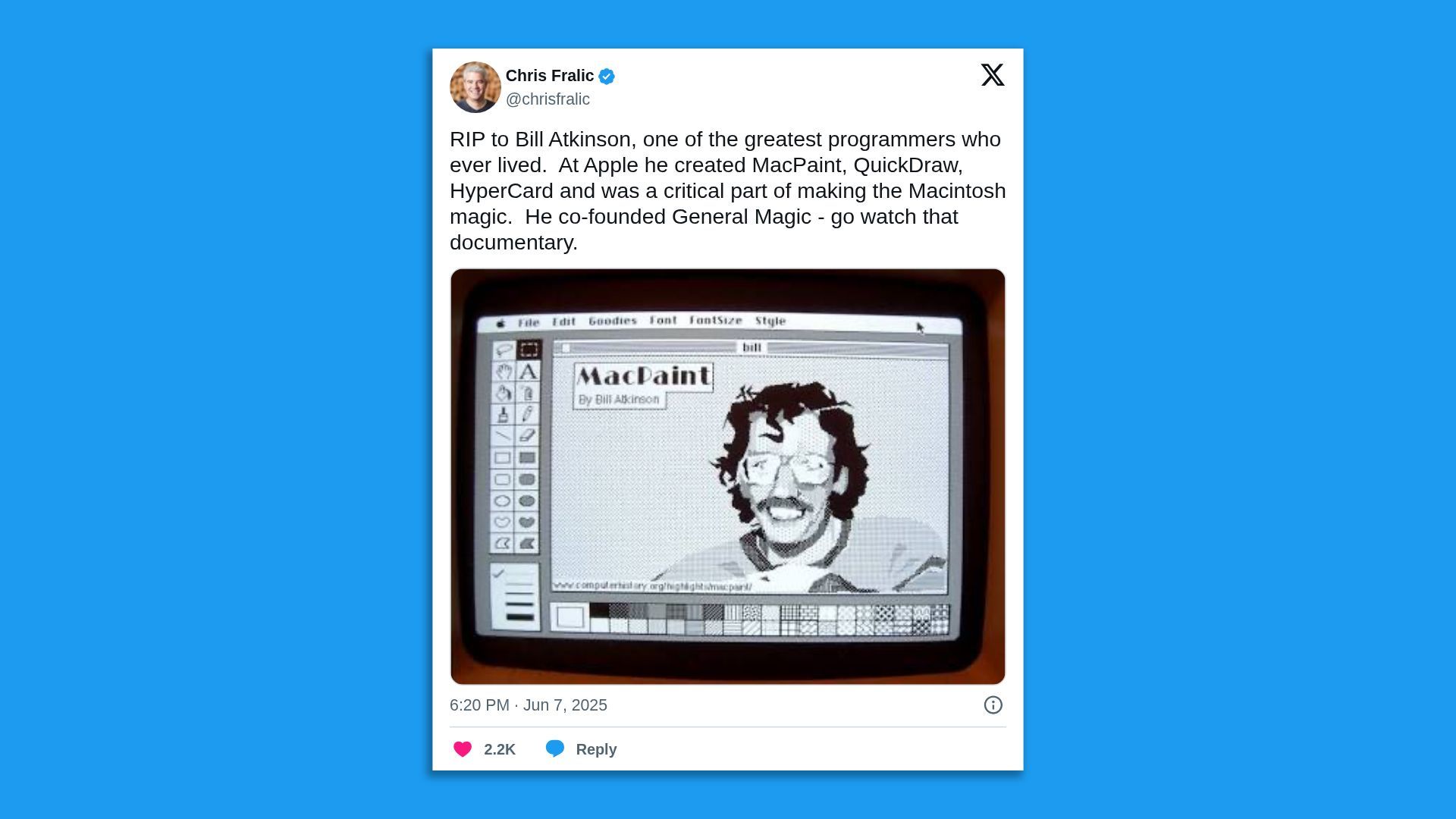
I wanted to take a minute to remember the life and legacy of Bill Atkinson, who was the creative force behind MacPaint, HyperCard and QuickDraw, each of which helped spur generations of tech software. Atkinson, a legendary Apple engineer and co-founder of General Magic, died Thursday at 74.
- For more on Atkinson, check out this tribute from Wired's Steven Levy as well as this 2018 interview.
Thanks to Scott Rosenberg and Megan Morrone for editing this newsletter and Matt Piper for copy editing.
Sign up for Axios AI+
