Tesla's robots and self-driving cars vs. the world

Add Axios as your preferred source to
see more of our stories on Google.
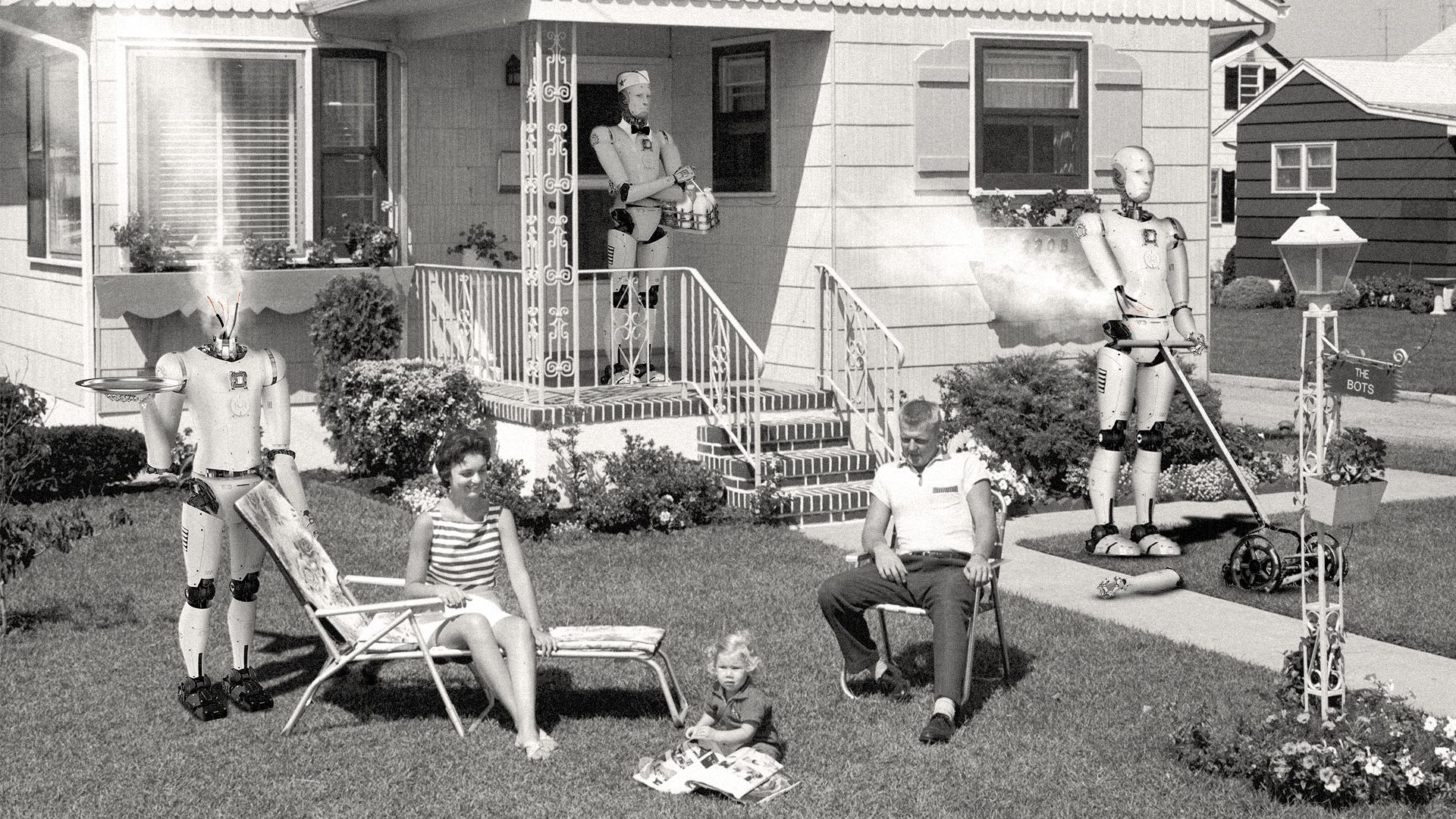
Photo illustration: Aïda Amer/Axios. Photos: Getty Images
As Elon Musk tells it, there are 7 million Tesla robotaxis already on the road today, and humanoid robots will soon do "anything you want" — mow the lawn, buy groceries or walk the dog.
Reality check: Such pronouncements have helped fuel the AI revolution and driven up Tesla's stock price — but in fact, Tesla's cars can't drive themselves, and its Optimus robots, which wowed attendees at a recent event, still need help from human operators.
The big picture: Other companies that are working on similar technologies are giving the world a more realistic roadmap of what to expect from autonomous vehicles and human-form robots.
- In short, while AI-powered robots and robotaxis are becoming more capable, they're not yet smart enough to reliably replace humans for anything other than limited purposes.
Catch up fast: Tesla unveiled its Cybercab at a splashy event earlier this month, saying the two-seater with no steering wheel or pedals would go into production before 2027.
- A week later, during Tesla's quarterly earnings call, Musk and Lars Moravy, Tesla's vice president of vehicle engineering, claimed its cars are already capable of autonomy, which isn't true.
- In fact, U.S. regulators are investigating the safety of Tesla's Autopilot system and its Full Self-Driving (FSD) software after a series of fatal collisions.
- Meanwhile, after reports that the Optimus robots interacting with attendees at the robotaxi event were actually remotely controlled by humans, Tesla sought redemption with a video showing Optimus doing various tasks in a factory.
State of play: It's not all smoke and mirrors. Tesla and a slew of startups are working feverishly to commercialize humanoid robots and self-driving cars, and they're making real progress.
- Extraordinary breakthroughs in AI have introduced new ways to train robots. Instead of having to program every task, developers can teach robots how to behave by example. As the robots get smarter, they can even figure out unfamiliar situations on their own.
- But companies that have been at it longer than Tesla — and arguably are farther ahead — warn against the hype.
- "It's easy to do a demonstration of a single task, or to videotape the one time it works," said Gill Pratt, CEO of Toyota Research Institute, which recently partnered with Boston Dynamics to speed up development of humanoid robots with artificial intelligence.
- That kind of cherrypicking happens across the industry, he said. "We want to offer an unbiased view of where we really are," he added.
Humanoid robots
It'll probably be a decade before humanoid robots are doing useful tasks around the home, says Scott Kuindersma, senior director of robotics research at Boston Dynamics, a pioneer in the field that is now owned by Hyundai Motor Company.
- Boston Dynamics' Atlas robot can do parkour and backflips. But in factories and warehouses, the best robot for the job is a far less sexy version, Stretch, which can lift and move boxes so humans don't have to.
- "There's a long tail of research challenges we have to overcome" before humanoid robots are commercially viable, Kuindersma told Axios.
The problem with humanoid robots, Pratt told Axios, is that people tend to anthropomorphize them and overgeneralize what they can do.
- "Because it looks like a person, it must think like a person. The answer to all those things is no."
Autonomous vehicles
AI breakthroughs are also fueling a fresh approach to self-driving cars.
- Tesla and startups including Waabi and Wayve are using an end-to-end AI system to introduce human-like reasoning to their cars instead of trying to program them with step-by-step instructions.
- But proving such self-learning systems are safe remains a challenge without tons of data.
Meanwhile, Alphabet's robotaxi unit, Waymo, remains the clear leader in self-driving technology, far ahead of Tesla, whose cars still need human supervision.
- Waymo provides more than 150,000 paid rides each week in Phoenix, San Francisco and Los Angeles, and is expanding on Uber's network in Austin and Atlanta.
- Waymo cars still can't go everywhere, but the company just raised $5.6 billion to further scale up its service to new markets.
The bottom line: Tesla talks a big game on robotics and AI, but other players are the ones commercializing it.
