
Axios AI+

May 19, 2025

Just announced: Commerce Secretary Howard Lutnick will join Mike Allen in conversation at Axios' "Building the Future: AI, Trade and the New Rules of Power" event on Wednesday, which also features CIA deputy director Michael Ellis, Sen. Jeanne Shaheen (D-N.H.), Bayer CEO Bill Anderson and more. Click here to learn more.
Today's AI+ is 1,200 words, a 4.5-minute read.
1 big thing: Microsoft's need for AI speed
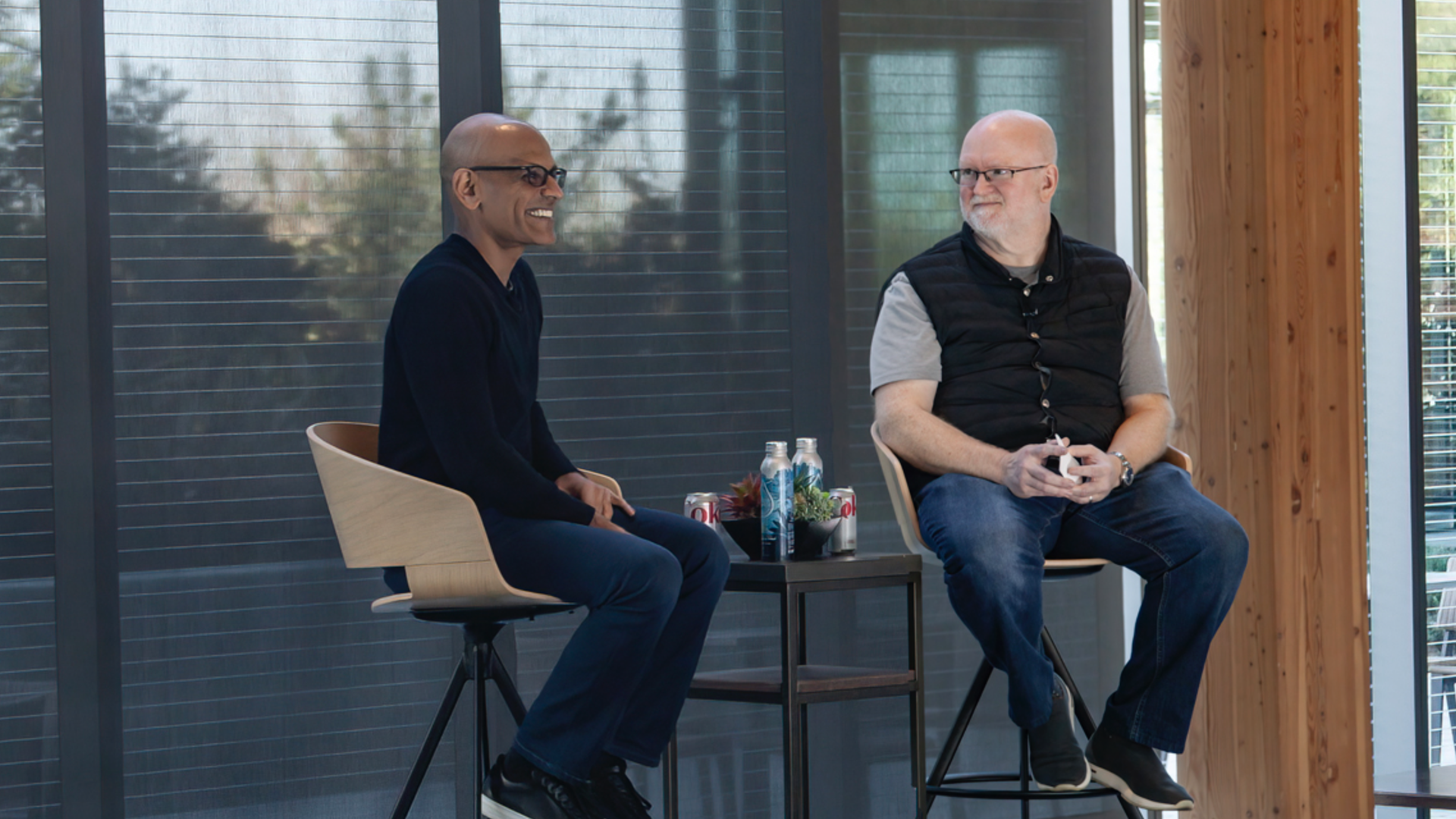
In leading Microsoft's core AI work, Jay Parikh says he has a clear mission: to make sure the company develops, ships and improves products faster than Google and other rivals.
Why it matters: Despite its early partnership with OpenAI, critics say Microsoft hasn't fully seized the AI moment.
"It's all about speed," Parikh told Axios. "The thing for us is just, 'How do we learn faster than any of the other folks out there?'"
- Parikh, a former top engineering executive at Meta, was hired by Satya Nadella last year. But it wasn't until January that Microsoft announced his role, leading a new engineering team responsible for AI work across the company.
- That includes the technology that goes into Microsoft's own consumer and business products as well as the capabilities that get built into Windows and Azure for other software developers to use.
The big picture: The pace of Microsoft's progress versus the competition will be on full display this week.
- The company will be showing its latest AI efforts at its Build developer conference on Monday and Tuesday in Seattle.
- Meanwhile Google, is expected to show new AI models and tools at its I/O developer conference Tuesday and Wednesday in Mountain View.
- In addition, SAP is holding its Sapphire conference in Orlando this week, and Anthropic holds its first-ever developer conference in San Francisco on Thursday.
AI will be the focus of all of these events, with much of the talk this year shifting to how businesses can let AI work as an autonomous colleague rather than always needing supervision by a human.
- In coding, for example, Parikh said the approach is shifting from having the AI just help complete the code that a human programmer is writing to having the AI take on programming tasks on its own.
- "You'll see demos of this as we get into Build, but I can assign it an entire issue or a task and it can just go off and build stuff, fix stuff, secure stuff, triage stuff, coordinate with other agents if it needs to," Parikh said.
- That's a broader shift happening across the industry. Late last week, OpenAI introduced Codex, its own take on a coding agent that can work asynchronously on programming tasks.
Between the lines: Outsiders often struggle when joining Microsoft to figure out how to do what they want in an organization as vast and siloed as Microsoft is.
- With AI being such a focus for Microsoft, Parikh is unlikely to lack for resources.
- But the company has a lot of teams — including all of its various product teams, each of which has its own AI agenda, as well as a consumer AI effort being led by Mustafa Suleyman.
Parikh said he has spent most of his time since joining Microsoft talking to people to learn the company's ways.
- "When you get here and like, working with the Microsoft research team, the other tech teams, etc., it's pretty awesome," Parikh told Axios. "It's confusing, but it's awesome."
- "There's a lot of acronyms, a lot of different technologies, but it is actually amazing how much cool stuff is here, and how many smart people are here," he added.
What's next: Speaking to reporters on Sunday, Parikh said that getting the necessary speed requires changes to both processes and culture at Microsoft.
- "Maybe 25% or 33% is cultural," he said. "The rest is, 'How do you build the tools, the infrastructure that allow your product makers to go fast.' "
- But Parikh said he is encouraged by the progress so far. "We're picking up the pace in lots of places in the company," he said.
2. How AI could end the ETF boom


The number of exchange-traded funds (ETFs) in the U.S. is fast approaching the number of stocks. If anything can put an end to that trend, it's AI.
Why it matters: With AI, it will soon be easier to create your own strategy than it will be to find an ETF designed to follow that strategy.
Driving the news: Online brokerage Public last week released Generated Assets, a tool that allows you to generate a stock portfolio from an idea.
- Instead of paying an expense ratio of 1.03% for an ETF like YOLO (cannabis stocks) or 0.99% for VICE (sin stocks), a simple chat interface allows investors to put together a portfolio along the same lines for free.
- Right now, investors would need to recreate that portfolio manually in their own brokerage account — but later this summer, Public customers will be able to import the strategy and have it periodically rebalance, for a fee that co-CEO Jannick Malling suggests to Axios will be significantly lower.
Between the lines: The small number of massive ETFs investing in major global indices — the ones that account for the vast majority of total ETF assets — have little to worry about here. Their prices are already rock-bottom and they enjoy enormous economies of scale.
- Beyond those funds, however, lies a huge universe of thousands of much more expensive ETFs that are hard to find and even harder to justify as an investment.
Zoom in: The Generated Assets site provides a chart showing how your portfolio would have compared against the S&P 500 over the last 10 years — but that chart isn't really representative, since it treats the portfolio as static.
- Asking Generated Assets to create an ETF that mirrors the S&P 500 itself, for instance, results in a portfolio that has grown by 3,761% over the past 10 years, compared with 248% for the index.
- That's because it gives a successful company like Nvidia a 5.5% weighting — which is correct for its current market cap, but is orders of magnitude larger than anybody seeking to mirror the S&P 500 would have given it 10 years ago.
- Meanwhile, unsuccessful companies that dropped out of the S&P 500 aren't included at all.
- Malling tells Axios that he's working on a tool that backtests strategies rather than portfolios.
Zoom out: It's easy to envisage a future where agentic AIs can dynamically execute any strategy, like for instance "whenever I add new cash to the account, invest it in the stocks where I have the largest capital gains, and then donate the same amount of those stocks to my donor-advised fund, using my lowest-priced tax lots."
- That kind of analysis and execution is much easier for robots than it is for humans.
The bottom line: A lot of financial technologies like index funds are designed to save on the laborious work of, say, buying 500 different stocks in order to put together a diversified portfolio.
- When laborious work becomes free thanks to AI, those technologies will start becoming obsolete.
3. Training data
- Bloomberg's Mark Gurman has a deep dive on Apple's AI struggles, highlighting both the human and technical challenges the company faces as it looks to reboot Siri for the modern era.
- Experts say significant security risks come with the huge deals that American AI and chip firms announced this week with companies in the Middle East. (SemiAnalysis)
- Job applicants now face screenings by AI "interviewers." (Slate)
4. + This
I enjoyed seeing all the "Journalism makes a comeback" headlines this weekend, even if it was referring to the horse who won the Preakness.
Thanks to Scott Rosenberg and Megan Morrone for editing this newsletter and Matt Piper for copy editing.
Sign up for Axios AI+