Axios AI+
October 09, 2024

Congrats to Seattle assistant coach Jessica Campbell, who made history yesterday as the first female full-time coach in the NHL.
Situational awareness: In a second Nobel prize this week for AI-related research, Google DeepMind's Demis Hassabis and John Jumper won for their work developing AlphaFold, which transformed our understanding of the shape of proteins. They shared the prize with University of Washington professor David Baker, who was recognized for his contributions to computational protein design.
Today's AI+ is 1,290 words, a 5-minute read.
1 big thing: Race for the planet

/2024/10/08/1728431802614.gif?w=3840)
Climate change is quickly transforming the world. So is AI — and the planet's future may well hang on which of the two moves faster.
Why it matters: AI could be the climate change story's greatest villain or biggest hero. It could even be both.
- The electricity-hungry technology is tempting us to ramp up energy use at the very moment when experts say we need to aggressively curtail carbon emissions.
- But AI optimists pin their hopes on the technology's capacity to supercharge climate mitigation and alternative energy research and deployment.
Driving the news: Hurricane Milton's threat to Florida is only the latest in a decades-long crescendo of extreme weather events intensified by the impact of a warming climate.
- No individual catastrophe can be specifically blamed on the impact of planetary warming. But today's disaster intensification loop is exactly what climate scientists have long told us our greenhouse gas buildup would cause.
Zoom out: For years, experts have pressed the world to cut carbon emissions by both shifting to non-fossil fuel sources and boosting efficiency — but governments and industry have moved much more slowly, setting and then missing one target after another.
- Now the rise of AI is spiking demand for the sort of predictable "baseload" power that data centers require — and that renewable energy sources like solar and wind aren't always well suited to supply.
Zoom in: AI's energy hunger kicks in during the expensive initial work of training models, and continues with the everyday load of operating them.
- Each time you ask ChatGPT a question, you're using many times the energy it would have taken to make a simple Google query. (And since Google will now automatically append an AI-generated summary to many search queries, you don't even have the "low-energy" option most of the time, anyway.)
The intrigue: Former Google chairman Eric Schmidt caused a stir last week with comments suggesting that efforts to limit carbon emissions were hopeless, and AI was the only solution.
- "My own opinion is that we're not going to hit the climate goals anyway because we're not organized to do it," he said at a conference in Washington.
- Schmidt admitted that even the most optimistic improvements in energy efficiency "will be swamped by the enormous needs of this new technology."
- "The needs in this area will be a problem," he said. "But I'd rather bet on AI solving the problem than constraining it."
Schmidt is a longtime climate hawk and contributor to environmental causes, but here he was speaking for many in Silicon Valley, saying the quiet part out loud.
- In this view, cumbersome U.N. processes and slow-moving global negotiations won't save us, and we'd better pray that technology will.
- Schmidt is betting that we can build AI smart enough to solve the climate crisis, so we shouldn't let fear of worsening that crisis slow us down — even if the AI itself busts our energy budget along the way.
The other side: The danger, of course, is that natural disasters and geopolitical stresses could pile up tragic costs faster than AI can deliver remediating benefits.
- Schmidt's skepticism about emissions targets is understandable, but his wager is a sort of species-wide Hail Mary pass: If it fails, there's no time for a do-over.
2. Exclusive: Google Cloud inks deal with Sequoia
Google is announcing a partnership with Sequoia Capital on Wednesday that will allow the venture firm's portfolio AI companies to gain access to an extended array of cloud credits, enhanced support and other services.
Why it matters: The move could give Google a leg-up on rivals OpenAI and Microsoft while allowing Sequoia-backed startups to save some money on cloud computing.
Driving the news: Under the terms of the deal, which is non-exclusive, Sequoia-backed companies can get up to $500,000 worth of free cloud computing, training and other services. (Google offers up to $350,000 in cloud computing credits and other perks to other AI startups.)
- Companies can also get migration support and up to 45 minutes in daily "white glove" support from Google staffers.
The big picture: Google has partnerships with other VC firms and accelerators, including Y Combinator and 500 Global.
- Microsoft also has a number of programs geared toward AI startups, including partnerships with Y Combinator and other incubators and investors.
What they're saying: James Lee, the general manager of Google Cloud's startups and AI program, said that beyond the cloud credits, Google is able to help startups compare various options, including Google and third-party models. "You don't have to invent every wheel," he said in an interview.
- Sequoia partner Bogomil Balkansky said the deal is particularly helpful for pre-seed stage companies that might only have a few million dollars in funding, a huge chunk of which could be eaten up by cloud costs.
- It also helps ensure portfolio companies can access sufficient computing. "We're still living in an environment of shortage," Balkansky told Axios.
Yes, but: The deal doesn't guarantee Sequoia companies will build on Google's cloud over rivals.
3. OpenAI disrupts AI election misinformation

OpenAI has seen a continued stream of attempts to use AI as part of political misinformation campaigns on social media, but said the effort that spread widest was a hoax that only appeared to use its services.
Why it matters: A new report from the company, released on Wednesday, highlights the continued use of generative AI by foreign adversaries of the U.S. — but shows that, at least for this year's election, the impact appears to be modest.
Driving the news: OpenAI said it saw and disrupted a number of political and election-related influence campaigns in recent months, ranging from one-off efforts typed into ChatGPT to larger, more systematic projects.
- As it has noted in past reports, OpenAI said its tools appear to be used as an intermediate step in broader campaigns rather than in attempts to do end-to-end work. In one case, for example, a Russian influence operation used images generated by Dall-E in an attempt to make its messages more eye-catching.
- "The threat actors look like they're still experimenting with different approaches to AI, but we haven't seen evidence of this leading to meaningful breakthroughs in their ability to build higher audiences," OpenAI principal investigator Ben Nimmo said in a briefing with reporters.
- The company also detected attempts to gain access to the credentials of OpenAI employees, including one by a China-based adversary that aimed to access workers' email accounts.
Yes, but: The AI-related campaign that spread most widely on social media was one that only appeared to use OpenAI's systems.
- "It was a false claim that seemed to show Russian trolls using our model but forgetting to pay for it," Nimmo said. "In fact, that post wasn't generated using our models at all."
The intrigue: OpenAI says it has built additional AI tools in recent months that are helping it more quickly detect and analyze potentially harmful activity.
- "These tools have allowed us to compress some of the analytical steps we take from days down to minutes, and some of the operations that we disrupted in the past couple of months were discovered thanks to our use of AI," Nimmo said.
4. Training data
- Breaking up Google is one of several proposals the Department of Justice is weighing as the remedies phase of the Google search antitrust trial continues. (Axios)
- OpenAI and Hearst forged a deal that allows OpenAI to integrate content from more than 40 of Hearst's local newspapers and magazines, including The San Francisco Chronicle, Esquire and Cosmopolitan. (Axios)
- Sources say OpenAI is shifting away from using Microsoft data centers and making new arrangements with other suppliers. (The Information)
5. + This
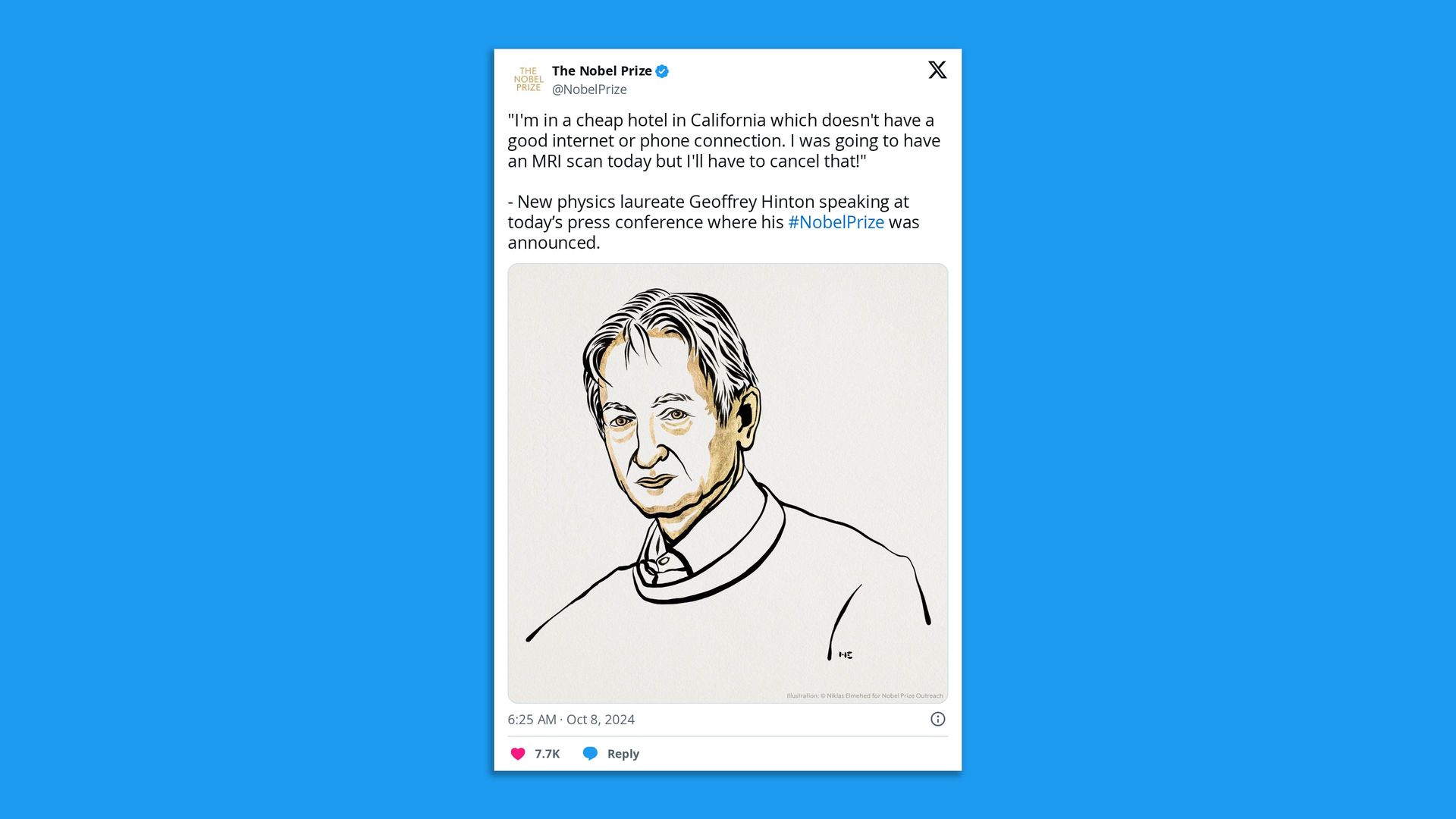
"Godfather of AI" Geoffrey Hinton was in a "cheap hotel" with bad internet and had to cancel an MRI when he learned that he'd just been awarded the Nobel Prize for his work on neural networks.
Thanks to Megan Morrone and Scott Rosenberg for editing this newsletter and to Caitlin Wolper for copy editing it.
Sign up for Axios AI+
