Axios AI+
October 31, 2024

It was exciting to see Stanford women's hoops back in action at Maples Pavilion yesterday, under new head coach Kate Paye.
Today's newsletter is 1,221 words, a 4.5-minute read.
1 big thing: Election's two roads for AI


AI, like everything else in the U.S. on the threshold of a historic election, faces a crossroads Tuesday.
Why it matters: A victory by Vice President Harris is likely to mean new life for the Biden administration's careful approach to AI regulation, which she has overseen. Meanwhile, former President Trump hasn't said much about AI — but if he wins next week, Elon Musk does, too.
A new Harris administration would likely pursue a middle-of-the-road AI agenda in the vein of Biden's 2023 executive order.
- That means a more-carrot-than-stick approach that involves support for chipmakers and some modest oversight requirements for the most advanced AI projects, but no licensing rules or mandatory transparency requirements for training data and other details.
A Harris White House will also face pressure from Silicon Valley giants to back off from the more aggressive regulatory stance of the Biden era.
- Reid Hoffman, a Harris supporter and donor, called on her in July to replace Federal Trade Commission chair Lina Khan.
- But the many antitrust lawsuits pursued over the last four years have a life of their own, and would likely continue under an administration that behaves the way most do.
- Those actions include multiple major cases against Google that have weighed on the search giant's efforts to dominate the AI landscape.
A second Trump term would lay out a much more volatile scenario for AI.
- Trump's relationship with tech firms during his previous presidency was frequently transactional.
- Candidate Trump is taking a similar approach: A Washington Post report this week says he asked Amazon, during an August phone call with CEO Andy Jassy, to fork over a big campaign contribution.
- Trump's pattern of rewarding loyalty, punishing critics and embracing the ideas of the last person that talked to him make it hard to foresee all the twists and turns AI policy would face in a new Trump administration.
We do know one thing — Elon Musk, who is raising billions for his xAI startup, would almost certainly gain additional sway.
- Musk is paying in advance for this influence: He is obsessively promoting Trump on his X platform and has poured over $118 million into a super PAC, as Axios' Zachary Basu reports.
- Musk has massive interests with the federal government — both through contracts and regulatory probes of his companies — and is eyeing a role as head of Trump's proposed "government efficiency commission."
An empowered Musk is almost certainly bad news for OpenAI, a company that he helped found but fell out with soon after, and has tangled with in both the courts and the press.
- A Vice President Vance, with his background in venture capital, could also play a key role in Trump administration tech decisions. But Vance can't count on that — look at how small a role Trump's previous vice president played.
The outcome of the fight to control Congress will also determine the nature of any new laws that might aim to influence AI's growth.
- Speaker Mike Johnson has staked out an anti-regulatory "don't touch AI" position that would likely carry over to a new term if the Republicans retain control of the House.
- If Democrats win power, they could pursue a more active agenda, but the narrow margins in both houses of Congress mean any tech legislation remains a long shot.
What's next: The most active arena for AI rule-making is likely to continue to be the states — particularly California, home to the industry and to some of the highest-profile efforts to regulate it.
- The courts will also play an outsized role over the next few years in setting landmark new rules for copyright and intellectual property in the AI age.
The bottom line: Whoever wins on Tuesday, the companies that are building AI will probably continue to make the most consequential decisions about the nascent industry's future.
2. Microsoft reports earnings with a big boost from AI
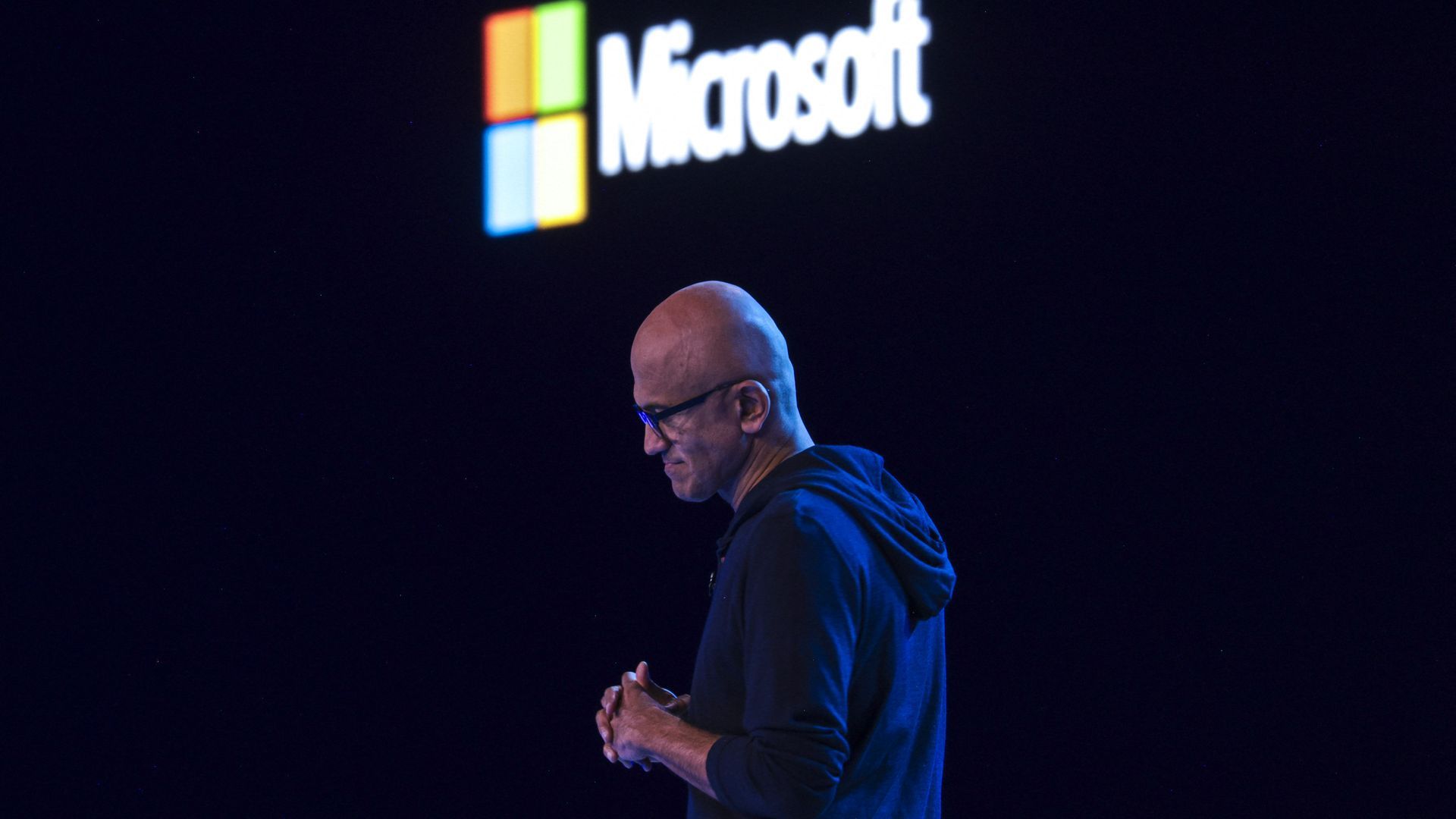
Microsoft CEO Satya Nadella said yesterday that the company's AI business will soon hit a $10 billion annual run rate, the fastest product category to reach that mark.
Why it matters: The newly provided figure shows how Microsoft is seeing additional revenue, largely from its Azure cloud business, but also across other areas including its Microsoft 365 productivity business.
What they're saying: "Our AI business is on track to surpass an annual revenue run rate of $10 billion next quarter, which will make it the fastest business in our history to reach this milestone," Nadella said, kicking off a conference call following the company's quarterly earnings report.
- Axios confirmed with Microsoft that was a reference to the current quarter, Microsoft's fiscal second quarter, which runs through December.
- Microsoft also said that 70% of Fortune 500 companies use Microsoft 365 Copilot for at least some employees.
The big picture: Microsoft is not alone in seeing an AI boost. Google reported Tuesday that its cloud business grew 34% year-over-year, in part from AI-related demand.
3. Exclusive: Global summit blends AI and biotech


The Biden administration this week is hosting a first-of-its-kind international summit about the use of artificial intelligence in the life sciences as governments and private industry increasingly push the boundaries of biotechnology.
Why it matters: The convergence of the life sciences and advanced AI could reveal the underpinnings of diseases, help identify new cures or produce more resistant crops. But there are barriers and bottlenecks — as well as potential risks — to combining the technologies.
- Training today's advanced AI models requires massive amounts of high-quality, standardized scientific data. But there aren't many accessible databases with that information.
Officials hope the AI-Bioscience Collaborative (AIBC) Summit being held today and tomorrow in Washington, D.C., can begin unlocking troves of data that can be used in the life sciences. The gathering has not been publicly announced.
- The summit, hosted under the auspices of the State Department and federal science agencies, will bring together representatives of Brazil, Canada, the EU, France, Germany, Italy, India, Japan, the Netherlands, the Republic of Korea, Singapore, South Africa and the United Kingdom.
- Microsoft, the Chan Zuckerberg Initiative and the National Academies of Science, Engineering, and Medicine are co-hosting the summit. Other companies, universities and foundations are participating.
- "What we have seen is that no country, including the U.S., has all of the domain knowledge to unlock this opportunity," says Seth Center, the State Department's acting special envoy for critical and emerging technology.
Zoom in: Discussions are expected to cover international cooperation and different models for housing and accessing AI models, tools and biological datasets.
- Those datasets need to be curated, accessible and interoperable, Center says.
- "The incentive structures for researchers to put in the time at that level is not always there," he says. "We want to accelerate and compress the time and effort to get curated datasets that can then be used in platforms that are openly accessible to researchers and the private sector."
Between the lines: Everyone is seeking diverse data to fuel AI-driven discoveries and develop products and solutions that can then be widely deployed.
4. Training data
- The Delaware attorney general sent a letter to OpenAI's lawyers earlier this month asking for more information about the nonprofit company's plan to convert to a for-profit entity. (Axios)
5. + This
Nintendo yesterday announced Nintendo Music, a mobile app that plays songs from the company's video games, including Zelda and Animal Crossing. The iOS and Android apps are free for those with a Nintendo Switch Online subscription.
Thanks to Megan Morrone and Scott Rosenberg for editing this newsletter and to Caitlin Wolper for copy editing it.
Sign up for Axios AI+
