Exclusive: Global summit blends AI and biotech

Add Axios as your preferred source to
see more of our stories on Google.
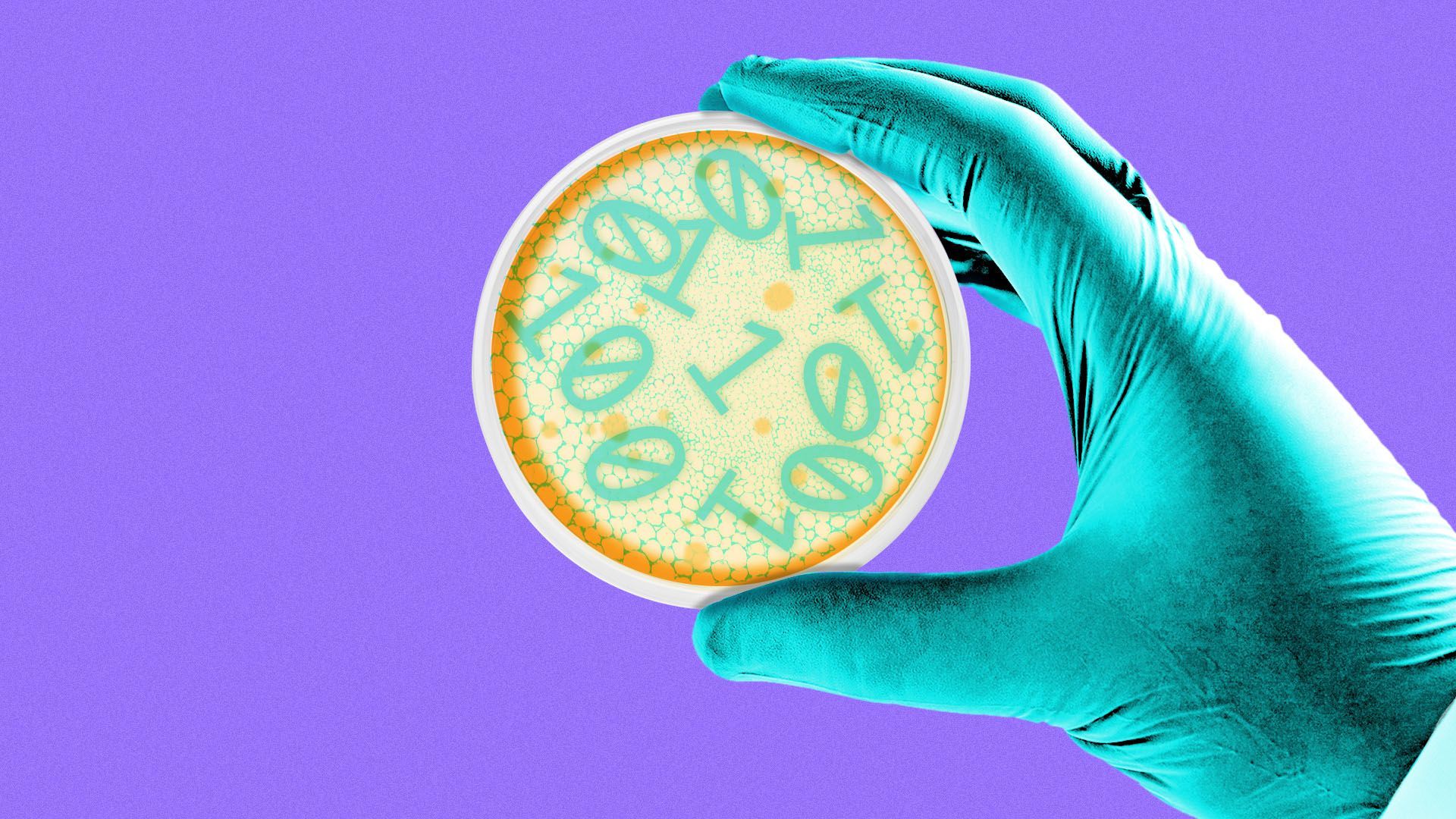
Illustration: Sarah Grillo/Axios
The Biden administration this week is hosting a first-of-its-kind international summit about the use of artificial intelligence in the life sciences as governments and private industry increasingly push the boundaries of biotechnology.
Why it matters: The convergence of the life sciences and advanced AI could reveal the underpinnings of diseases, help identify new cures or produce more resistant crops. But there are barriers and bottlenecks — and potential risks — to combining the technologies.
The catch: Training today's advanced AI models requires massive amounts of high-quality, standardized scientific data. But there aren't many accessible databases with that information.
Officials hope the AI-Bioscience Collaborative (AIBC) Summit being held Thursday and Friday in Washington, D.C., can begin unlocking troves of data that can be used in the life sciences. The gathering has not been publicly announced.
- The summit, hosted under the auspices of the State Department and federal science agencies, will bring together representatives of Brazil, Canada, the EU, France, Germany, Italy, India, Japan, the Netherlands, the Republic of Korea, Singapore, South Africa and the United Kingdom.
- Microsoft, the Chan Zuckerberg Initiative and the National Academies of Science, Engineering, and Medicine are co-hosting the summit. Other companies, universities and foundations are participating.
- "What we have seen is that no country, including the U.S., has all of the domain knowledge to unlock this opportunity," says Seth Center, the State Department's acting special envoy for critical and emerging technology.
Zoom in: Discussions are expected to cover international cooperation and different models for housing and accessing AI models, tools and biological datasets.
- Those datasets need to be curated, accessible and interoperable, Center says.
- "The incentive structures for researchers to put in the time at that level is not always there," he says. "We want to accelerate and compress the time and effort to get curated datasets that can then be used in platforms that are openly accessible to researchers and the private sector."
Between the lines: Everyone is seeking diverse data to fuel AI-driven discoveries and develop products and solutions that can then be widely deployed.
- Some AI tools like large language models churn troves of data, requiring enormous computing capacity. There are efforts to train these models on biological data but some researchers question if bottlenecks will develop, and how far this path can take them.
- Other AI models emphasize data quality. The AlphaFold AI tool that can predict the structure of proteins was trained on a public repository of protein structures started in 1971.
The private sector brings its enormous computing capacity, datasets and skills training to the table. Center says they are hoping to find "relevant datasets held by private sector that they would be willing to unlock."
- Governments have the capacity to convene, set standards and incentivize investments in different technologies.
- "Our hypothesis is that government will play a role but we don't know what it will be. There are pros and cons of a heavy government role in building an open architecture."
The big picture: AI-enabled biological research also raises the risk of someone creating new or enhanced pathogens.
- Some biosecurity experts have called for governments to set up guardrails to try to limit these risks. One challenge is that a lot of work developing AI models for biology is done in the private sector.
- The AIBC summit is focused on data- and expertise-sharing, but research safeguards are expected to be discussed.
What to watch: AI and biotech are two of the biggest arenas for U.S.-China competition as the countries race to attract talent and potential partnerships — both with countries and companies.
- "If this was the year of AI in tech diplomacy, I think next year is the year of biotech," Center says. "This [summit] is a nice transition that brings the two together."
