Axios AI+ Government

October 31, 2025


It's Friday! We've got a packed issue of AI policy news for you. Let's dive in.
Today's newsletter is 1,608 words, a 6-minute read.
1 big thing: White House fields feedback on AI red tape

The White House is now sifting through hundreds of comments on AI regulation from industry and outside groups as it decides how to cut as much red tape as possible.
Why it matters: The Trump administration is touting this effort to cut barriers to AI development and deployment as key to the president's AI action plan.
The big picture: With this request for information from the Office of Science and Technology Policy, the tech and AI industry had a chance to tell the government what not to regulate in a twist on traditional lobbying.
- The industry embraced it fully.
What they're saying: Many industry groups and some think tanks — including the Chamber of Commerce, the R Street Institute and the Consumer Technology Association — pushed for:
- Preempting the patchwork of state AI laws
- Faster permitting for data centers and broadband
- Leveraging existing standards and rules instead of creating new ones
NetChoice called for the removal of the Biden administration's voluntary commitments, once enthusiastically signed by many tech companies, because of "vague and subjective terminology" on policy areas already covered by existing law.
- NetChoice said it's "impossibly vague" to figure out what counts as bias and that the Civil Rights Act, Fair Housing Act, and Americans with Disabilities Act already make it illegal to use AI for discrimination.
- The Chamber of Commerce warned against exporting to competitors "to avoid situations where sensitive technologies" get in the wrong hands and undermine "national security objectives."
- The American Hospital Association specifically wants stronger HIPAA preemption.
Friction point: OSTP says AI can be hampered by "regulatory mismatch" or requirements that are based on "human-centered assumptions" like mandatory human supervision or documentation practices.
- The Center for Democracy and Technology warned against civil rights laws getting caught up in OSTP's definition of a regulatory mismatch.
- CDT said that in addition to reaffirming civil rights law, OSTP should mandate independent audits for high-risk AI systems, such as those used in housing, lending, employment, public benefits and services, or criminal justice.
Groups also disagreed on copyright.
- While the center-right R Street wants the administration to recognize AI training as fair use, the News/Media Alliance called on the administration to promote licensing agreements.
The bottom line: It's not a big mystery where the administration's thinking on AI was at before it got all of these comments — an approach that centers deregulation and a preemptive federal standard is set to come out on top.
2. Using AI: LA ramps up before sporting events

It's all hands on deck for LA's AI adoption as the city gears up to host a string of major sporting events.
Why it matters: LA faces a massive logistical challenge as it prepares to host three global sporting events in three years — and it's turning to AI to help the city cope.
- "The way they describe the Olympics is it's something like seven Super Bowls a day for two weeks. So that's what we're up against," LA chief information officer Ted Ross told Maria.
Driving the news: LA and Google Public Sector on Wednesday announced a partnership to use Gemini and other Google Workspace products to power city operations and try to boost employee productivity.
- The city will welcome millions of visitors for the World Cup in 2026, the Super Bowl in 2027, and the Olympics and Paralympics in 2028.
Ross said the partnership with Google will help the city meet the moment by:
- Analyzing traffic patterns and helping people avoid jams in and out of stadiums and sports arenas.
- Coordinating law enforcement agencies and analyzing data to prevent potential security issues.
- Creating multilingual press releases, podcasts and videos to quickly share information about events and manage public communications in a city where hundreds of languages spoken.
The city employs more than 45,000 people, with 27,500 being trained on responsible AI usage and data security, according to Ross, who added he's not making it mandatory to adopt the technology.
- "There's a set of people who do not want to use AI. And you know what? I'm not going to force you because it's a personal choice," Ross said.
- "They have tremendous fears and concerns, real or perceived. I need to be very sensitive."
- Ross said he believes that eventually certain types of government workers, such as analysts, will "find themselves ineffective" if they don't embrace the technology.
The bottom line: LA is striving to be a "smart city" by 2028, meaning everything from its airport LAX to public transportation will be highly digitized and connected.
- Adopting the tech could help on issues beyond sporting events, such as for emergency management as the city deals with natural disasters, Ross said.
In our recurring feature "Using AI," we note use cases ranging from light to serious on how governments and bureaucrats are putting artificial intelligence to work.
3. IBM CEO Arvind Krishna on AI policy
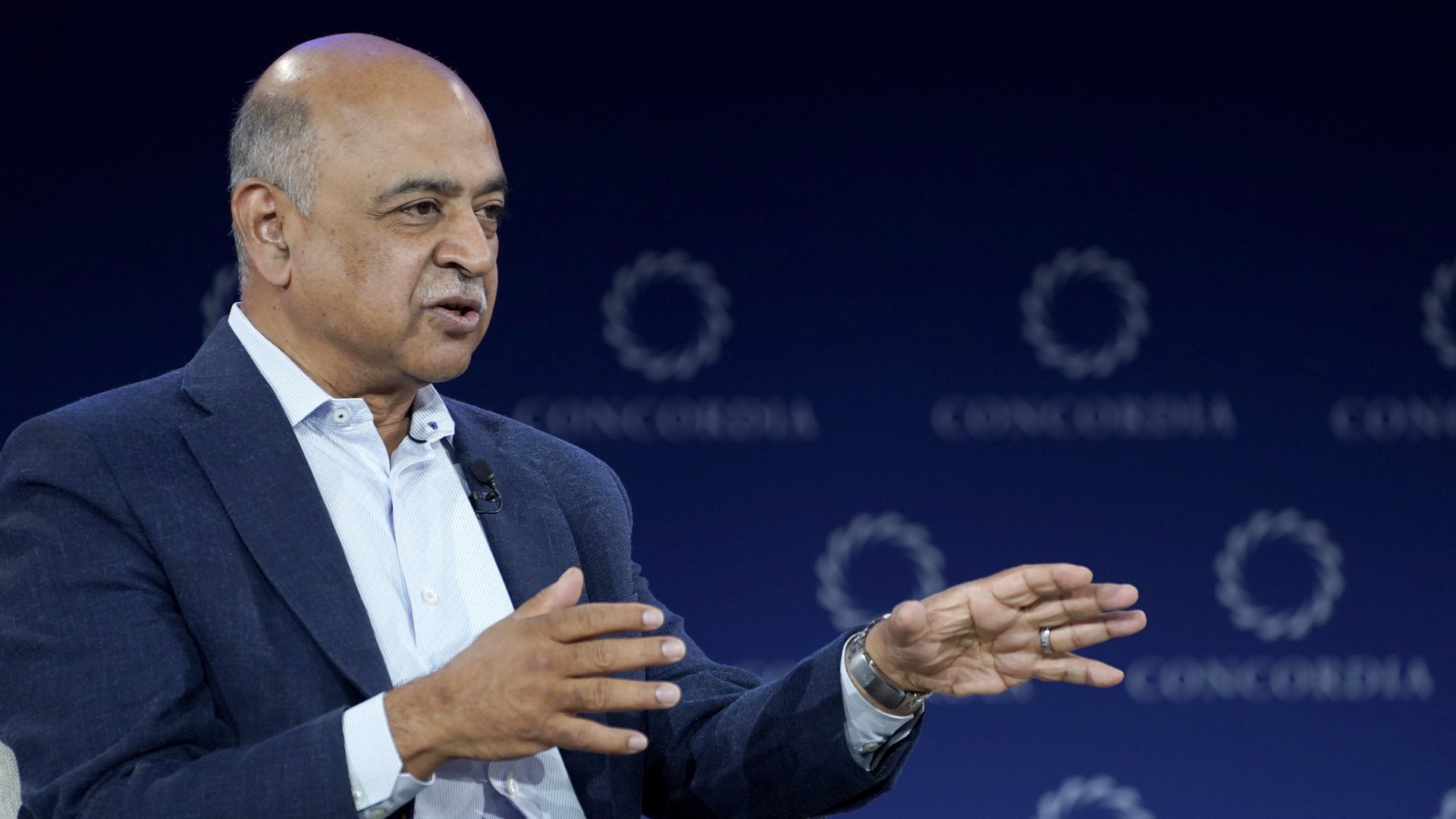
Axios reporters sat down with IBM CEO Arvind Krishna this week in Washington and talked about everything from quantum computing to taking risks during economic upheaval.
Why it matters: Krishna has led a turnaround at the legacy tech giant as AI reshapes the industry — and he says he's confident the technology's impact on jobs and productivity at IBM will be a net positive.
Driving the news: IBM under Krishna has seen high stock prices, driven by strategic acquisitions and a focus on cloud, enterprise AI and quantum computing.
- Krishna also has a right-hand man in former Trump National Economic Council director Gary Cohn, IBM's vice chairman, who he has lengthy phone calls with almost daily.
- Krishna said he always wants Cohn in the room with him while making important decisions.
This interview has been edited and condensed for clarity.
What are your priorities for AI policy in this administration?
We have been advocates that there there ought to be federal legislation. So I'm actually sorry that it [Sen. Ted Cruz's effort to get a state-level AI bill moratorium passed] got stomped on.
What AI regulations should the federal government impose for AI?
There are so many protections already built in for consumers that if anybody tries to purposefully misuse AI, you can catch them on the current laws like mail fraud laws, laws around consumer abuse that are already there, consumer financial protection laws.
- So there's so many areas where you can say complete misuse can be stopped.
- I think there's a lot of laws on the books that would kind of come in the way.
Do you think the Trump administration has been doing enough on funding key research and development for AI and quantum?
I think that they're investing a fair amount in R&D.
4. CBP taps Altana's AI for trade enforcement


U.S. Customs and Border Protection is expanding its work with supply chain management firm Altana, signing a two-year federal contract to use its AI platform to monitor global supply chains, the company told Axios exclusively.
The big picture: The partnership is part of the administration's focus on federal AI procurement — a central pillar of President Trump's AI action plan.
- The move comes as private firms and federal agencies alike are looking for ways to navigate the supply-chain uncertainty stemming from Trump's unpredictable approach to trade policy.
Driving the news: CBP has inked a formal two-year contract with Altana to test its AI platform, per the company.
- CBP staff will use it for real-time trade enforcement, forced labor and counternarcotics risk detection, and customs clearance modernization.
- The initial phase of the pilot program will screen "hundreds of millions of transaction line items of current and historical audit data," per a press release.
Altana will provide AI-enabled compliance screening that it touts as "critical" for enforcing Section 232 national security tariffs on steel, aluminum and other products.
- That means evaluating "agentic AI systems trained on the Altana product network to predict and flag potential issues" like incorrect tariff codes or a misdeclared country of origin, the release notes.
- CBP will also use Altana's platform to try to expedite customs clearance, with importers able to pre-verify their supply chains, and to establish a small package screening enforcement program.
Flashback: In 2023, CBP awarded a contract to Altana to give its staff access to its product Atlas to identify and block goods linked to forced labor.
5. First look: Perplexity's AI patent directory

Perplexity yesterday launched Perplexity Patents, an AI patent research agent, per an announcement shared first with Ashley.
Why it matters: The AI-powered web browser wants to make it easier for people to look up patents so engineers, researchers and consumers can quickly find prior inventions.
- Perplexity Patents launched in beta on Thursday, and this version is free.
What they're saying: Perplexity vice president of policy and global affairs Jerry Ma told Axios that the product will make searching for patents and prior inventions as easy as entering any question into its AI-powered search engine.
- Perplexity's AI agent will use "official documents straight from the government. That leads to a more trustworthy and richer experience," Ma said.
- "Most of the information about advances in technology really only exist in the patent domain, because that's where companies disclose the full details of how they built products and furthered innovation."
How it works: When a user asks Perplexity Patents a question, it will go beyond exact keywords and phrases to serve up all possible related answers to a patent-related query.
- It will search not just patent databases, but also academic papers and blogs.
What's next: Perplexity will keep a free version for all users going forward and refine it with user feedback, per the company, and future Perplexity Pro members will have expanded access.
Thanks to Mackenzie Weinger and David Nather for editing and Matt Piper for copy editing.