Why the quiet D.C. Bar race has Washington talking

Add Axios as your preferred source to
see more of our stories on Google.
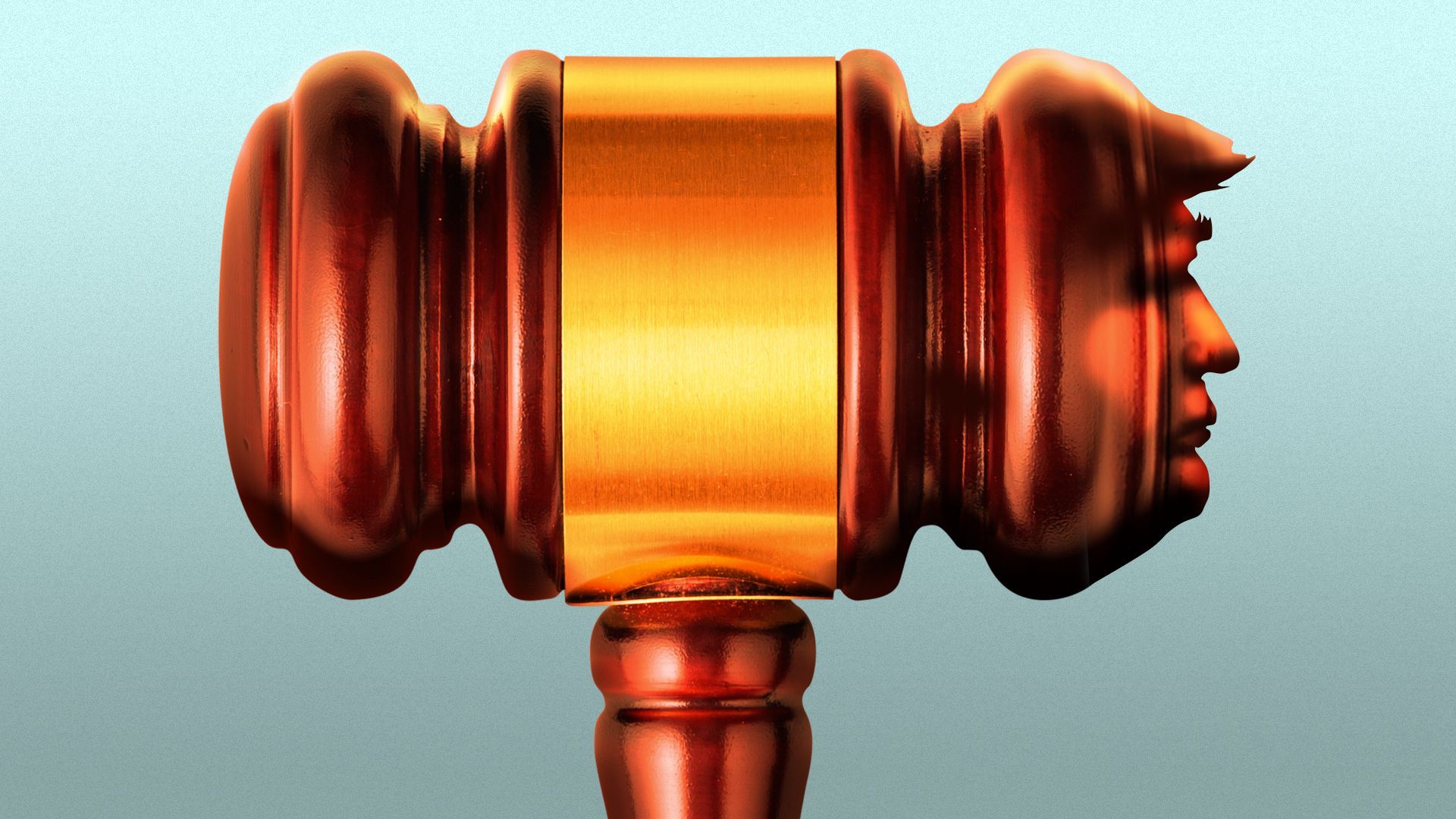
Illustration: Sarah Grillo/Axios
Everyone's buzzing about the D.C. Bar election — typically the least-buzzed-about race in Washington.
State of play: Al Sharpton is talking about it on MSNBC. George Conway is sounding alarms on Instagram. Local lawyers are penning op-eds and getting out the vote on social media. For one reason: Brad Bondi, the brother of Trump's U.S. Attorney General Pam Bondi, is running for D.C. Bar president.
Why it matters: Local Washington is on high alert amid the Trump administration's unprecedented meddling in local and legal affairs.
The big picture: The D.C. Bar is the largest mandatory bar in the country: It regulates over 120,000 lawyers, and counts five sitting Supreme Court justices among its highly influential members.
- As such, it's historically apolitical, and leaders are prohibited from expressing partisan views when speaking for the organization.
Yes, but: Critics fear that Bondi's appointment would politicize and weaponize the organization, despite his assurances otherwise.
- Some worry it could lead to an ethical free-for-all, with pressure from the top to bring retribution against those who oppose the administration's agenda, and turn a blind eye to sympathizers who cross legal lines.
Meanwhile, another attorney with ties to Trump World is running for a top role. Alicia Long, a top DOJ deputy to Ed Martin, Trump's former pick for U.S. Attorney for D.C., is running for treasurer.
- Martin's nomination was yanked last week after concerns over misconduct complaints for Russian state media appearances and his leniency toward Jan. 6 rioters. Trump said he'll take on another role in the DOJ.
Reality check: The DC Bar presidency isn't as high-stakes and influential as many are making it, former president Bob Spagnoletti tells Axios. The D.C. Bar's CEO of eight years, he says he's "confident that either [candidate] will lead the bar in an appropriate apolitical way."
- The president and treasurer have "no impact or control over the disciplinary system," Spagnoletti says. "It operates utterly and completely independently of the D.C. Bar."
- Complaints are investigated and adjudicated by independent bodies affiliated with the Bar and the DC Court of Appeals (equivalent to a state supreme court).
- That's true for low and high-profile cases, like when Rudy Giuliani was disbarred for spreading misinformation about the 2020 election.
"We have no visibility in the cases that they bring. We have no knowledge of the complaints that are filed. We have no role in their resolution," says Spagnoletti.
- "So even if your goal was to somehow 'gain leadership of the bar' to affect this place, it's not going to happen. It's impossible."
Between the lines: Though some portray Bondi and Long as parachuting into the D.C. Bar on the winds of the Trump administration, they've both held bar positions.
- Bondi, who runs the global white collar defense practice at Paul Hastings, was an elected steering committee member as recently as 2019.
- Long, who's currently on the Board of Governors, is running for re-election as treasurer.
Friction point: Opponents say these are extraordinary times, where the legally impossible is now a reality. The Trump administration has brought Big Law to heel, defied court orders, exacted revenge on perceived enemies, and, some say, violated the Constitution — all within 100 days.
- Pam Bondi, others allege, is transforming the Department of Justice into Trump's personal law firm.
But Brad Bondi wants "to set the record straight."
- "This idea of a shadowy plot is fabricated," he tells Axios via email. "I've never discussed my candidacy with any public officials … and I'm running to keep the Bar nonpartisan and prevent it from getting dragged into political fights."
- "In Washington, we have countless venues for activism, but the Bar isn't one of them."
Zoom in: Bondi, who tells Axios he decided to run last spring, is campaigning on a platform of "unity and inclusion."
- He promises to promote greater pro bono participation and make the bar's ethics hotline more accessible, "so every member feels supported in tough moments, fostering a sense of fairness and inclusion," he tells Axios.
He's facing Diane Seltzer, an active Bar member of over a decade who currently sits on the Board of Governors. She founded her law firm specializing in employment law and litigation.
- Seltzer tells Axios she planned to run on a different platform that addressed generational differences in the industry, but that Trump's attacks on the legal profession changed everything.
- "I quickly realized my priorities as a lawyer, and as a future leader of the Bar, had to be the rule of law. And knowing that lawyers are being supported by the Bar during this time of governmental chaos," Seltzer tells Axios.
- "If lawyers don't feel safe in who they can represent, and judges don't feel safe in how they rule, then the guardrails are off. That's exactly not what I want to see happen."
Stunning stat: Typically, fewer than 9% of active Bar members vote in a given election, even with an easy online ballot system that's open for a month-and-a-half.
- Weeks into this election, over 30,000 members have voted, representing nearly 34% of the eligible base.
What we're watching: The votes are open through June 4. The president-elect and other roles will be announced June 9, and transition into office in July of next year.