How judges can hold Trump admin accountable for defying court orders

Add Axios as your preferred source to
see more of our stories on Google.
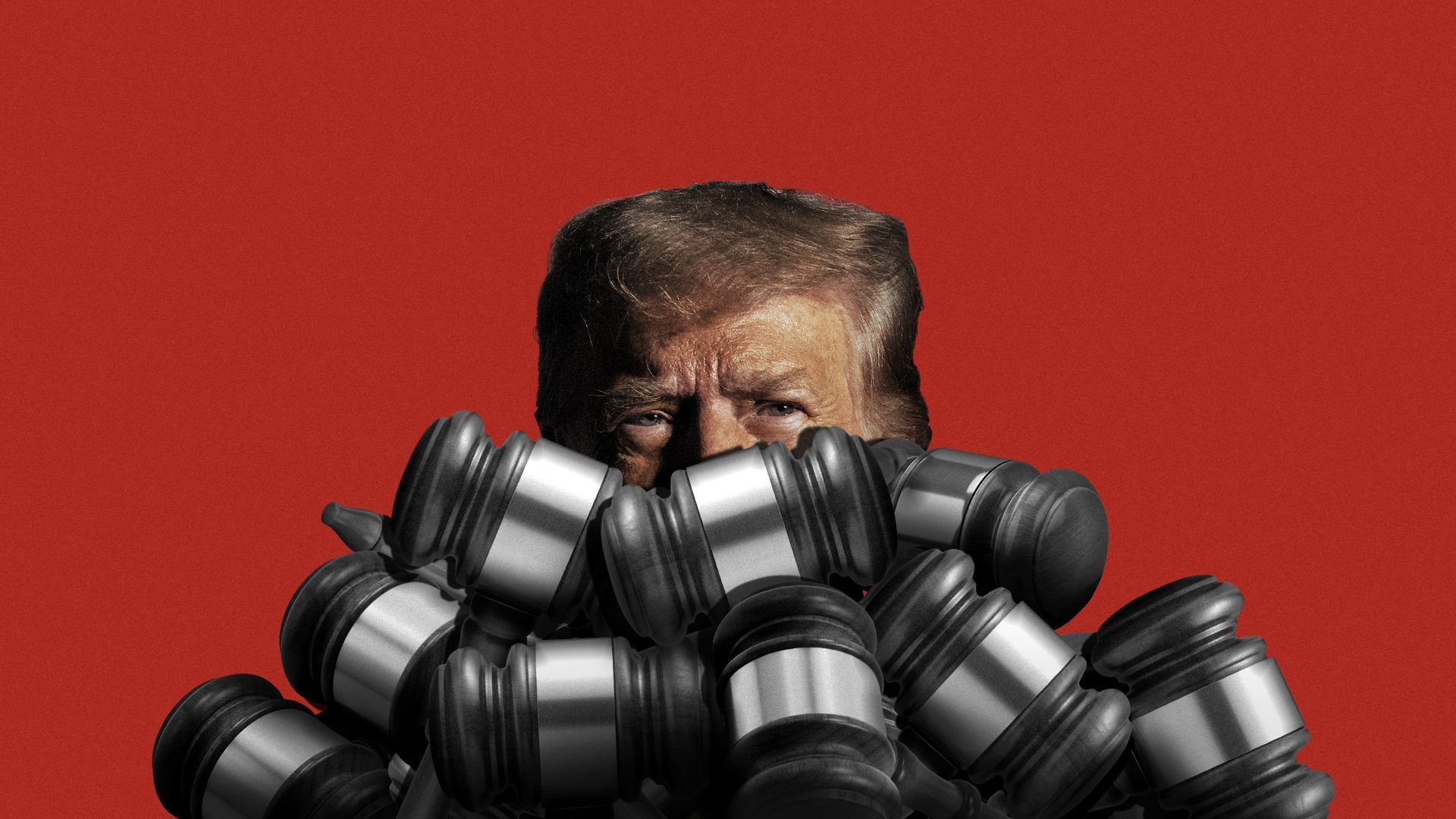
Photo illustration: Lindsey Bailey/Axios. Photo: Jeff Swenson/Getty Images
Some legal scholars are warning that Trump administration's reluctance — or outright refusal — to comply with court orders is setting the stage for a full-blown constitutional crisis.
Why it matters: In several instances, federal judges have said that the Trump administration is not taking sufficient steps to adhere to rulings. Courts aren't powerless. They can punish the executive branch in an effort to force compliance, experts say.
Case in point: The Supreme Court ruled that the Trump administration must facilitate the return of Kilmar Armando Abrego Garcia, a Maryland man erroneously deported to El Salvador. Officials have contended that doesn't mean they have to return him, even after losing several appeals.
- "The argument that they're in compliance with the Supreme Court's order and the district court's subsequent orders is ridiculous," said, David Noll, a law professor at Rutgers Law School.
- "They're essentially thumbing their nose at the court," Noll said.
The latest: The Trump administration is now facing the possibility of a contempt ruling in Abrego Garcia's case and a separate immigration case.
- U.S. District Judge James Boasberg said Wednesday he had found probable cause to hold the Trump administration in contempt for defying his order to halt deportation flights of alleged Venezuelan gang members to El Salvador.
- The administration has defended the deportations, arguing the planes were already over international waters and that his order didn't apply.
- And U.S. District Judge Paula Xinis threatened the administration Tuesday with contempt proceedings for resisting her order to return Abrego Garcia to the U.S.
The other side: White House spokesperson Harrison Fields said in a statement to Axios earlier this week that "The Administration remains fully compliant with Supreme Court rulings. The Court's decision was clear to any impartial observer: U.S. courts lack the authority to compel the President to force a foreign nation to return an MS-13 terrorist alien."
- He added, "As seen publicly yesterday, President Trump discussed the matter with President Bukele, who firmly stated that El Salvador will not return the individual. The issue is resolved."
Here's what to know about the steps judges can take when they determine an order hasn't been followed:
Could a judge hold Trump admin in contempt?
Federal courts have broad discretion to determine whether a party is in contempt of court, according to the Brennan Center, a nonpartisan law and policy institute.
- The process would start with a judge issuing an order to show cause, Noll said, which would essentially direct the government to explain why they appear to not be complying with an order.
- In Abrego Garcia's case, he said, the court would likely have to first take steps to develop a record about who is making the decisions.
Context: There are two kinds of contempt proceedings: Civil and criminal.
- Civil contempt, which is outside of the president's pardon power, seeks to force a party to comply, Noll explained. Trump is familiar with the concept.
- Criminal contempt, on the other hand, is more about "punishing disrespect" of court authority — but it is subject to a presidential pardon. Trump has experience with this, too.
Zoom out: The federal government's compliance with court orders is often "imperfect and fraught," according to a 2018 Harvard Law Review article by law professor Nicholas R. Parrillo.
- But the federal judiciary is willing to issue contempt findings against agencies and officials, he wrote.
- Even when higher courts have intervened "to rescue an agency from incurring a budget-straining fine," contempt findings have a "shaming effect" with substantial deterrent power.
But, but, but: "We don't have a lot of precedent of what happens when ... the power of shame breaks down," Noll said, referencing Parrillo's findings.
Who enforces court orders?
In civil contempt proceedings, Noll said, the court has "really wide discretion" to choose remedies, which could include setting fines, freezing assets and, ultimately, ordering an arrest.
- Arrests would typically only occur when other remedies have been tried but failed.
Friction point: "Although civil contempt can involve being jailed until the person complies with the court order, that is enforced by the United States Marshals, who are part of the Department of Justice and thus under the president's control," wrote Erwin Chemerinsky, the dean of the UC Berkeley School of Law in a New York Times op-ed.
- Retired federal judge Nancy Gertner expressed a similar sentiment to NPR's "Morning Edition," saying, "if Trump wanted to fully not comply, he could direct the Department of Justice not to comply. At that point, you have a full-on constitutional crisis."
- Such a directive, Noll told Axios, would be "completely unlawful."
What we're watching: If an improper effort to block the Marshals from conducting their duty occurs, there is a rarely used authority that allows a court to deputize different law enforcement offers to carry out their orders.
- But he noted, "You have to really sort of go back to the wild west" or the early 20th century "to find cases where private parties or law enforcement officers other than the Marshals were being used to enforce federal court orders."
Go deeper: Trump's GOP allies bombard judges with impeachment threats
Editor's note: This story was updated with additional developments.
