Home EV chargers are hot commodities in D.C.


Add Axios as your preferred source to
see more of our stories on Google.
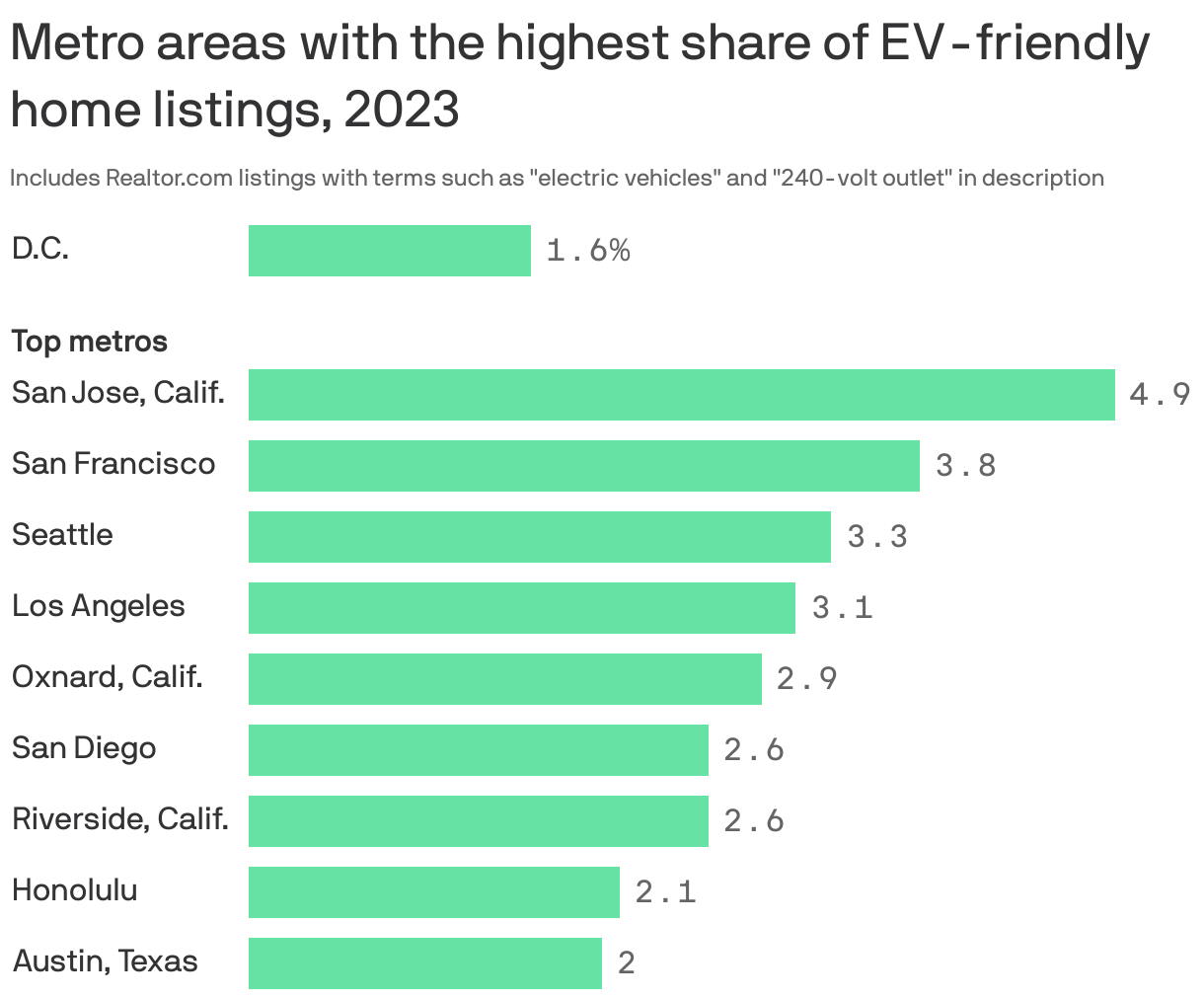
Homes with electric vehicle chargers could hold greater resale value in D.C. as more car buyers make the switch, Realtor.com chief economist Danielle Hale says.
Why it matters: Access to at-home EV charging is a rare and increasingly desirable amenity.
Between the lines: Home chargers are often more convenient than public ones, and faster than charging cables that come with most EVs.
State of play: The District offers up to $1,000 in tax credits to help cover the cost of installation, which can cost upwards of $2,00–$3,000. It can be paired with the federal tax credit.
- Using your at-home charger during off-peak hours can save Pepco customers a little cash, too.
What they're saying: Christopher Magaha, who lives in Columbia, Maryland, says being able to leave home on a full charge is one of the biggest perks to charging at home.
- Charles Williams II installed a charger at his Congress Heights home back in 2022. He's only had to use a public charger twice since then.
- Gavin Wright in Oak Hill is a recent EV owner and says if he was unable to install an at-home charge, he never would have made the switch.
The intrigue: Some Washingtonians are buying homes together and sharing an at-home charging station. Arlington residents Greg and Jackie Smith head to their son's house about once a week to charge up. The setup serves multiple cars, Greg tells us.
Yes, but: You've got time to install that charger. EV adoption hasn't been swift, Axios' Joann Muller reports.
The big picture: A small but growing share (0.9%) of U.S. homes listed on Realtor.com in 2023 were described as EV-friendly, up from 0.1% five years earlier, according to the company's and Cox Automotive's report.
- Areas with higher EV ownership rates saw higher shares.
Note: Cox Automotive's parent company, Cox Enterprises, also owns Axios.