Unusually hot summer forecast for D.C.

Add Axios as your preferred source to
see more of our stories on Google.
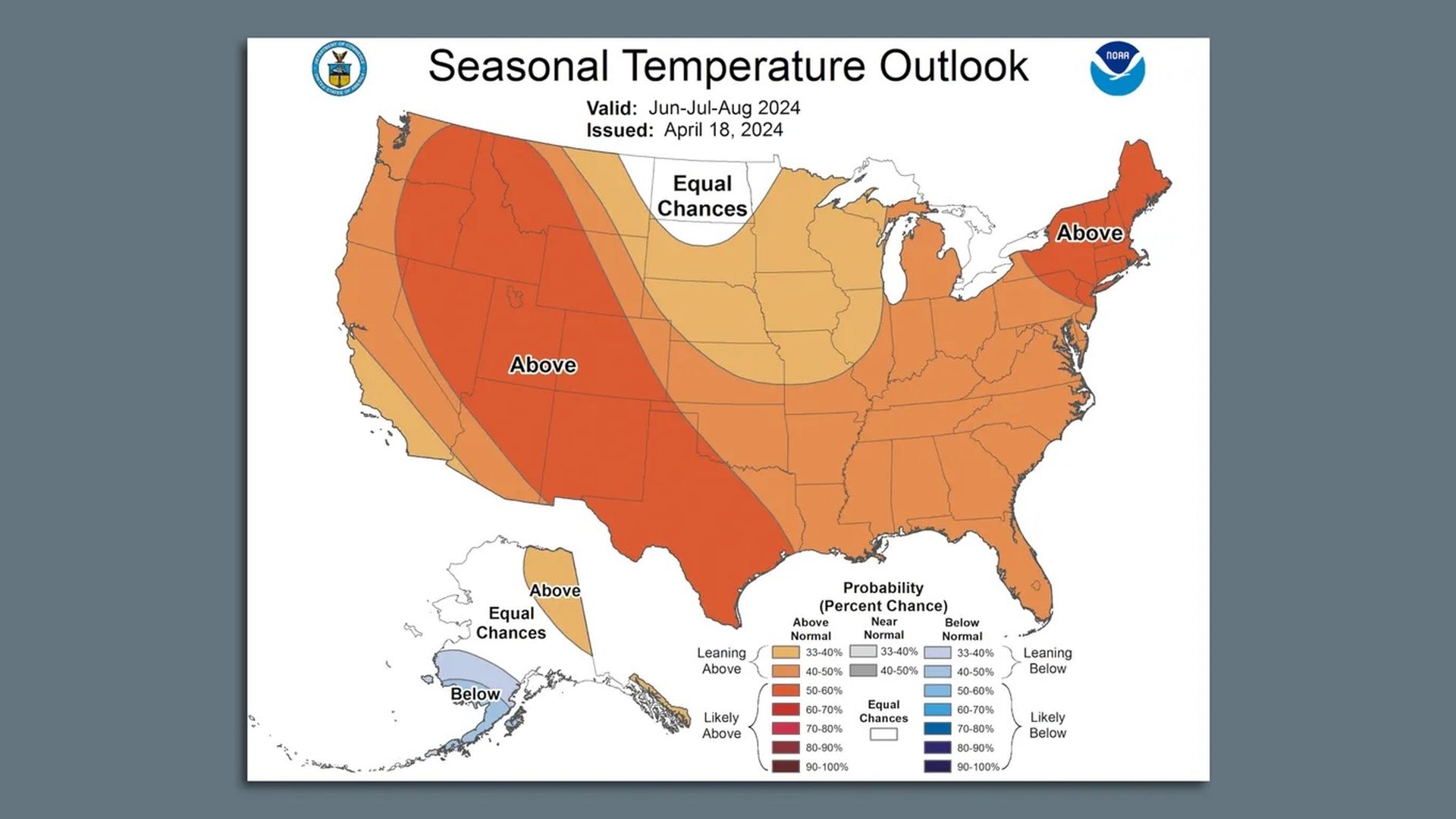
Image: NOAA/CPC
D.C. is expected to have a hotter-than-usual summer, according to new forecasts and scientific research.
Why it matters: Extreme heat is a major public health threat and plays a role in droughts and wildfires.
- Hot weather, particularly when it occurs during prolonged heatwaves, also threatens the reliability of the nation's increasingly strained electricity grid.
The big picture: Everywhere in the Lower 48 — except for North Dakota — is projected to be hotter than average, but with varying odds.
- D.C., along with areas spanning from Florida up to southern New Jersey, has a 40% to 50% chance of an unusually hot summer.
- Further north the odds increase to 60% to 70%.
Zoom in: The signs are certainly there for an unusually hot summer in D.C.
- This comes as summers have been getting hotter over time due to human-caused climate change and sprawl.
- D.C. now has 16 more summer days above the long-term average than it did in 1970, and 10 more days above 90°F during the same period, based on data crunched by Climate Central.
Threat level: The ways climate change is altering the character of American summers increasingly stands out, and is one reason to take note given the hotter-than-average outlook.
Yes, but: Anthony Artusa, a meteorologist at NOAA's Climate Prediction Center in Maryland, pushed back against recent media headlines suggesting the lower 48 could see its "hottest summer ever" in 2024.
- "Nevertheless, what [models] do support is an unusually hot summer this year, especially for the South-Central and Western areas of the contiguous U.S., and people should be prepared for this," he said.
The National Weather Service this week unveiled an expanded "HeatRisk" forecast map, with a color-coded scale aimed at communicating the health risks from heat exposure.