D.C.'s average air quality worsened last year

Add Axios as your preferred source to
see more of our stories on Google.
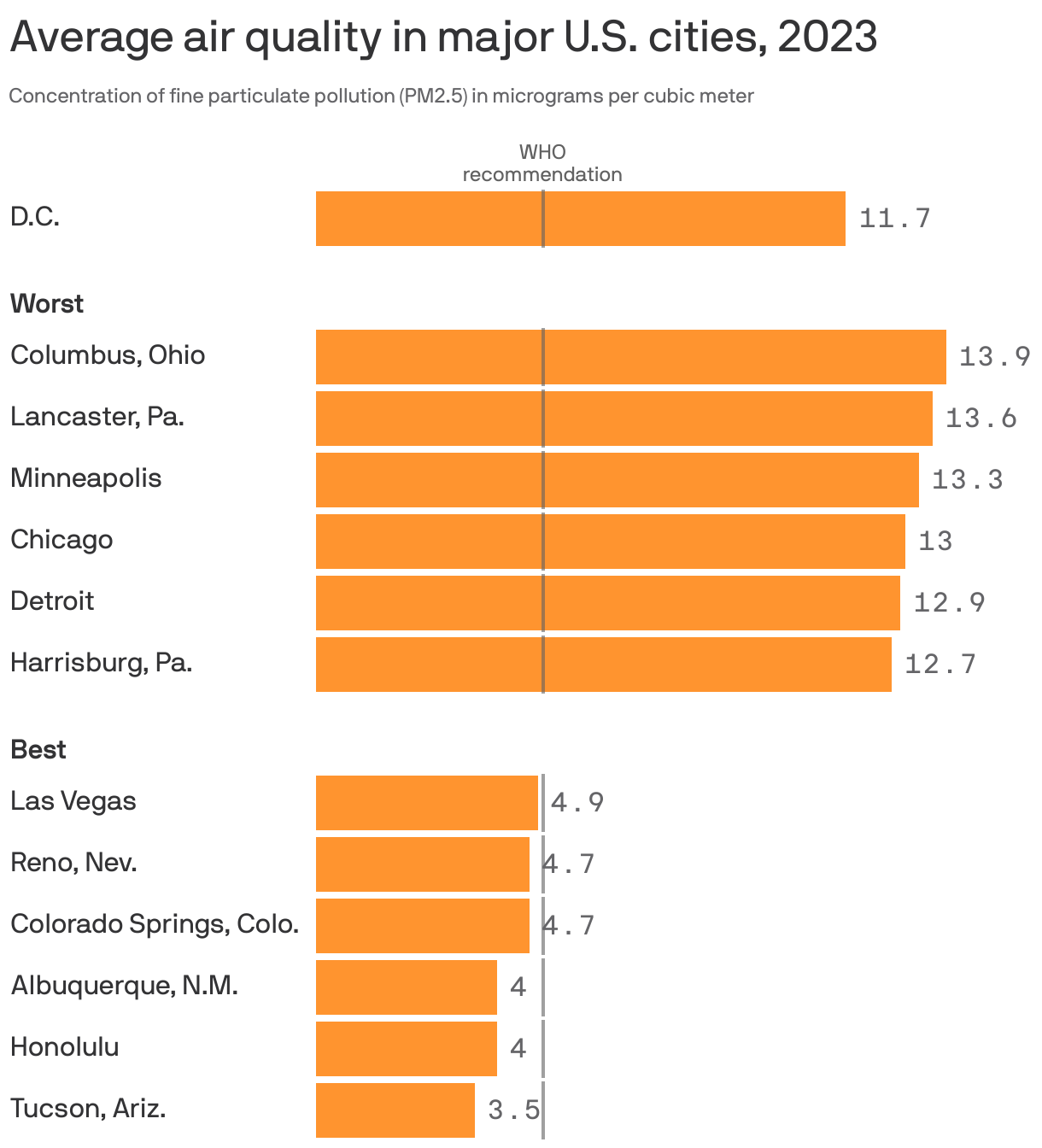
D.C.'s average air quality last year had particle pollution levels two to three times higher than what the World Health Organization (WHO) recommends, says a new report.
Why it matters: Air pollution is the world's leading environmental health threat, causing 6.7 million premature deaths every year, according to WHO estimates.
The big picture: Last year, D.C. saw the worst recorded air quality levels in years due to smoke from Canadian wildfires, causing the Metropolitan Washington Council of Governments (COG) to declare a rare Code Purple advisory.
- After decades of progress, air quality in the U.S. is expected to steadily deteriorate over the coming decades as climate change causes more large wildfires, heatwaves, and drought, writes Axios' Jacob Knutson.
By the numbers: D.C.'s average concentration of fine particulate pollution was 11.7 micrograms per cubic meter last year, up from 9.8 in 2022 and 9.1 in 2021.
- Columbus, Ohio, which had the country's worst air quality last year out of cities with at least 500,000 residents, clocked in at 13.9.
How it works: The report is from IQAir, a Swiss air quality technology company that maintains a global air quality system that continuously measures contaminants in thousands of cities across the world.
- The report examines the average level of fine particles less than 2.5 microns (PM2.5) in diameter — a particularly dangerous form of air pollution because the solid and liquid specks can penetrate deep into lung passageways.
- Inhalation of PM2.5 can exacerbate pre-existing lung and heart conditions. Evidence suggests it can also have neurological effects.
- Much of the fine particulate matter pollution in the U.S. and around the world is a byproduct of fossil fuel combustion and industrial activity, such as from car engines or concrete plants. Other drivers can include everything from dust storms to volcanoes, cigarettes, and air fryers.