Minnesota sees drop in new Black medical students


Add Axios as your preferred source to
see more of our stories on Google.
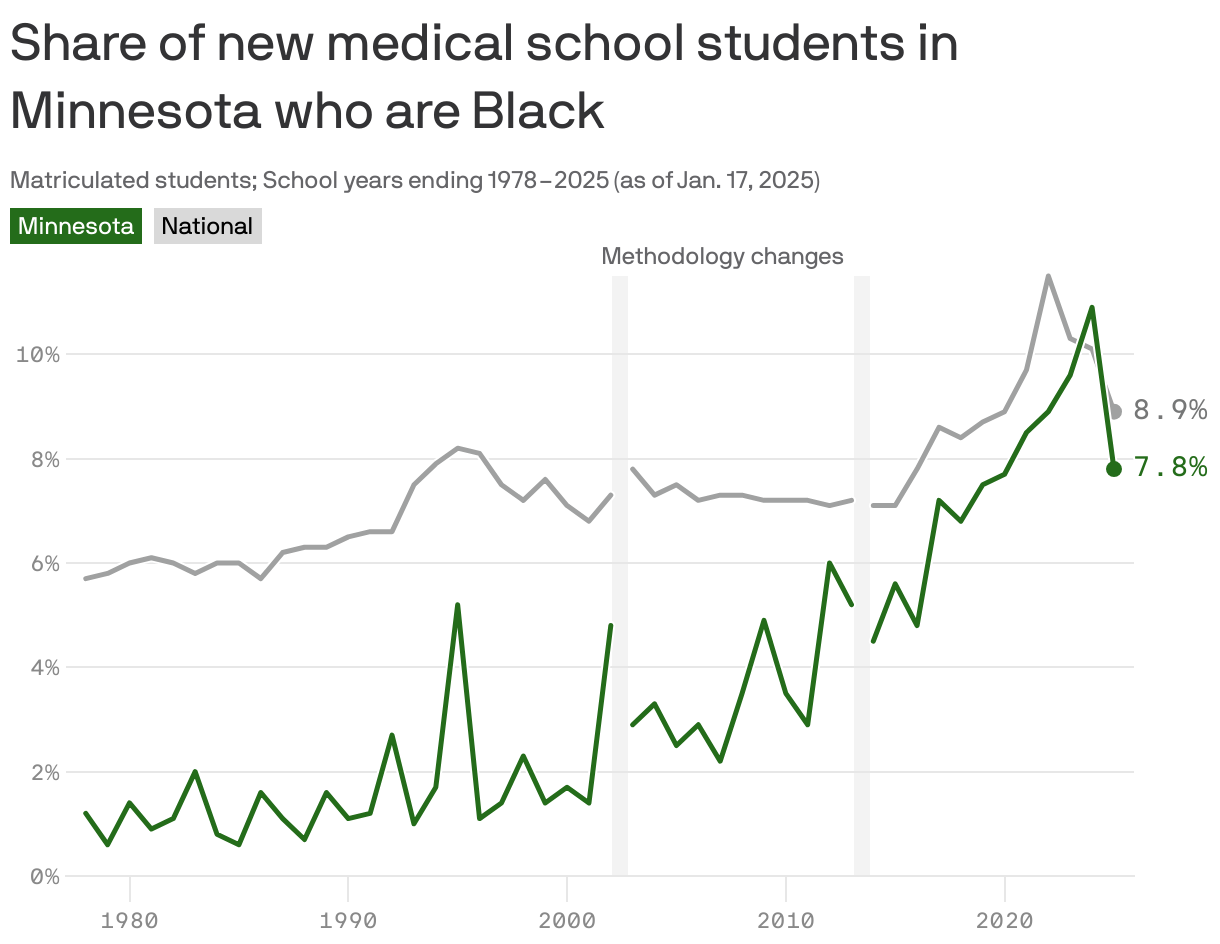
The number of first-year Black medical students in Minnesota programs dropped 3 percentage points last year, hitting its lowest level since 2019.
Why it matters: Having doctors who resemble the patients they're serving can improve health outcomes and enable patients to feel more comfortable voicing health concerns, multiple studies suggest.
- Black patients being treated by Black doctors may experience less medical racism, whether that means better treatment in the emergency room or not having pain dismissed.
Yes, but: Only 5% of doctors in America are Black — compared with 14% of the general population.
Flashback: Many institutions, including those in Minnesota, saw an uptick in the number of Black med school students following the murder of George Floyd.
- In Minnesota, the share climbed for three consecutive years starting in 2020, to a high of 10.9%.
By the numbers: Thirty Black first-year students enrolled in Minnesota's two medical schools for the 2024-25 school year, representing about 7.8% of the class, according to the Association of American Medical Colleges (AAMC).
- That's down from 10.9% (45 students) for the previous school year and below the national average of 8.9%.
Threat level: The declines are "much larger than we would expect," even taking into account the Supreme Court decision to strike down affirmative action in higher education, Norma Poll-Hunter, senior director of the Association of American Medical Colleges' human capital portfolio, tells Axios.
Zoom in: Enrollment data for the University of Minnesota Medical School, which has three campuses statewide, mirrors the trend.
- Nineteen new students who began last fall — about 7.9% of the 240-member class — are Black. That's down from 24 (10%) the year prior.
What they're saying: In a statement to Axios, the University of Minnesota said its medical school "has several pipeline and pathway programs that provide a variety of specialized supports designed to develop a physician workforce prepared to meet the needs of all Minnesotans."
- As an example, it pointed to an initiative meant to encourage undergraduates who are from rural or economically disadvantaged to pursue med school.
- Minnesota's other medical program, The Mayo Clinic Alix School of Medicine, did not respond to a request for comment.
What we're watching: The U.S. Department of Education recently warned academic institutions that it may cut federal funding for those with policies related to race or diversity.
- The letter specifically cited using race in decisions related to admissions, financial aid and scholarships.
Go deeper: Rate of Black med school students declines