What 2024 holds for Twin Cities real estate


Add Axios as your preferred source to
see more of our stories on Google.
/2023/12/13/1702481339434.gif?w=3840)
Illustration: Brendan Lynch/Axios
Twin Cities real estate experts predict the market will be less stagnant — but not wildly different — in 2024.
Why it matters: Many home shoppers stood still this year, waiting for mortgage rates to drop before they made a move.
- Major forecasters now expect rates to dip at least a little.
What they're saying: While there will likely be more homes for sale, the tight Twin Cities market will keep benefitting sellers, predicts Sharry Schmid, president of Edina Realty.
Zoom in: If mortgage rates dip enough to get people moving, multiple offers and competitive bidding could drive up prices, according to David Arbit, Minneapolis Area Realtors director of research.
- Yes, but: "Moving is first and foremost a life decision," Opendoor's Merav Bloch tells Axios.
Zoom out: If the economy is steady, rates could land around 6%. If the economy stumbles, mortgage rates could fall more significantly, says Greg McBride, Bankrate's chief financial analyst.
- No one can say with certainty just how much mortgage rates will change because they are impacted by inflation and the Federal Reserve.
What's happening: The Fed left interest rates unchanged at its final policy meeting of 2023 and signaled next year could bring cuts, Axios' Neil Irwin and Courtenay Brown report.
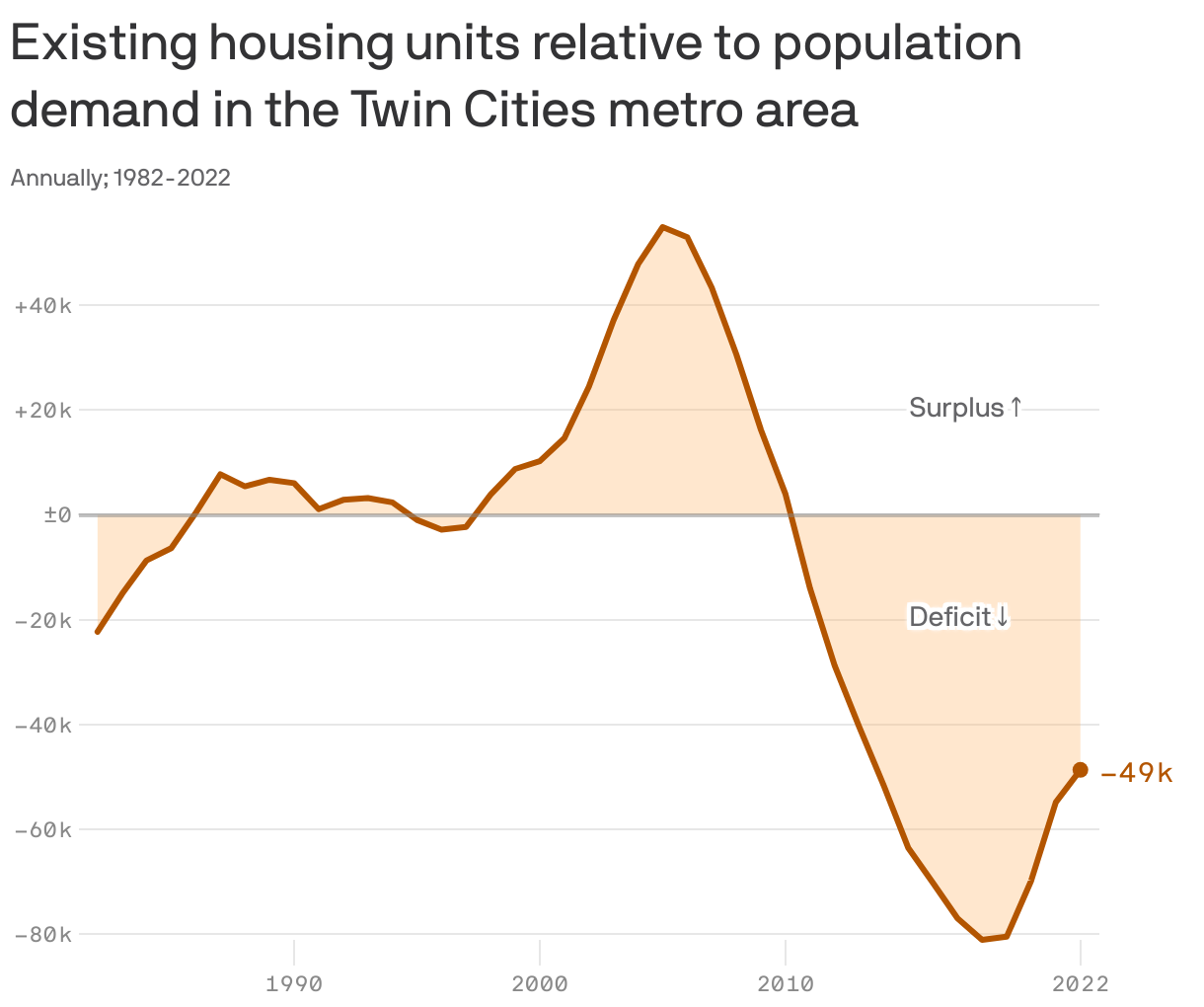
By the numbers: The Twin Cities is short around 49,000 homes, according to figures developer Hines shared with Axios.
- That's 3.4% of the 16-county Twin Cities metro's existing inventory as of 2022.
State of play: America needs three million more housing units, per the analysis, a shortage that's pushing up the cost of renting and buying.
- Hines compared the stock of existing homes, either to rent or buy, with what they calculated is the population's housing demand.
- The analysis includes housing units as defined by the census, which excludes dorms, skilled nursing facilities or other group quarters arrangements.
Go deeper: What really created the Minneapolis apartment boom