Drought watch: 70% of Minnesota is now "abnormally dry"

Add Axios as your preferred source to
see more of our stories on Google.
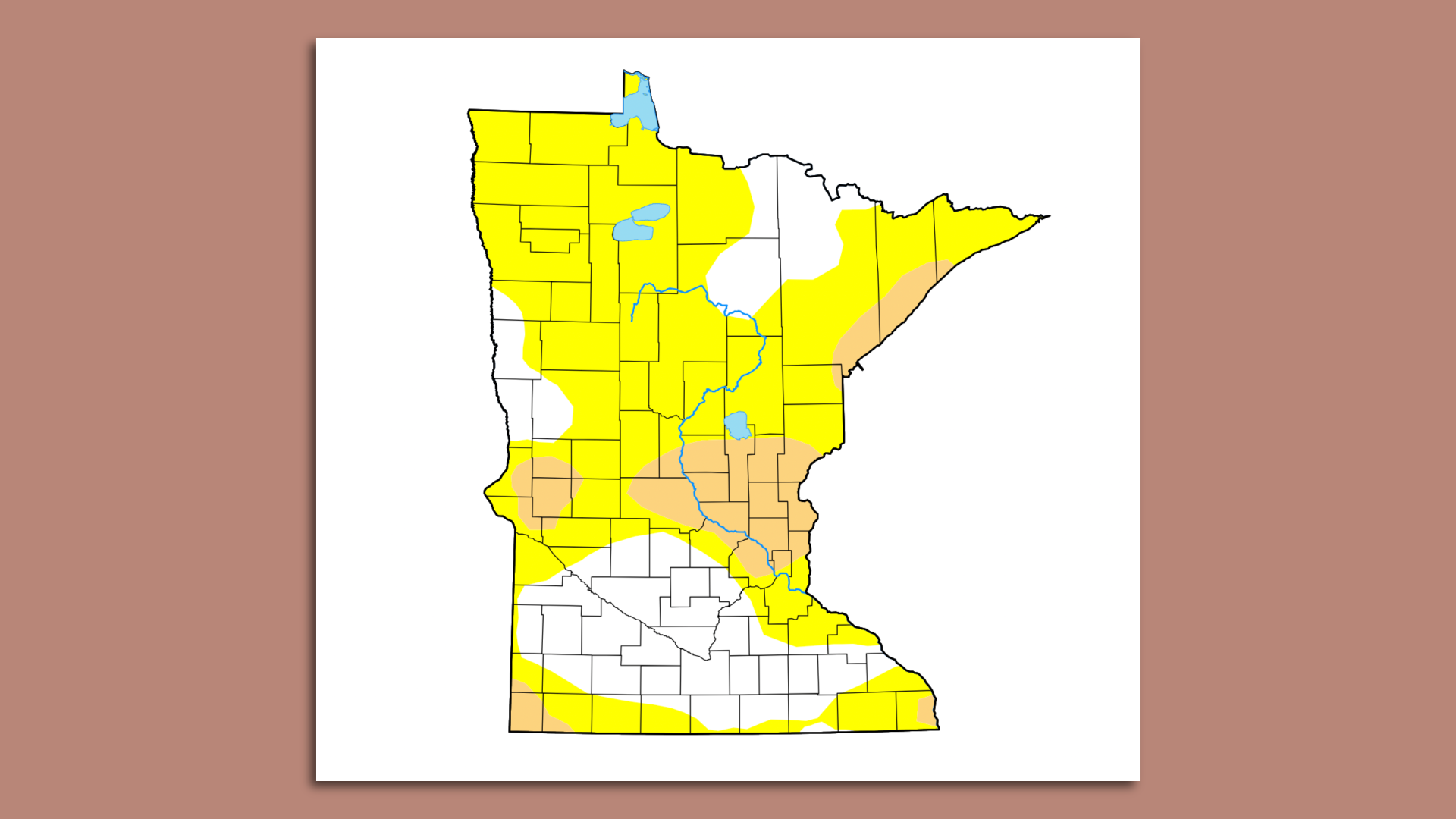
Yellow means abnormally dry, while tan is a moderate drought. Image via U.S. Drought Monitor as of June 8, 2023
The wet, snowy winter that ended a few months ago won't save the Twin Cities from another parched summer.
What's happening: More than 70% of Minnesota is now experiencing "abnormally dry" conditions, up from 56% three months ago, per the U.S. Drought Monitor.
- About 12% of the state, including parts of the metro area, is experiencing moderate drought.
Driving the conditions: The hot, dry start to the summer. The Twin Cities has so far seen just 0.03 inches of rain in June, NWS meteorologist Jacob Beitlich told Axios.
- Typically, the area would get an inch a week this time of year.
Between the lines: The soil was able to soak up a lot of the moisture from the wet winter, creating a "temporary reprieve" from the unusually dry conditions that marked the last several years, Beitlich said.
- But the parched state of the ground meant "there was a lot of room for it." Three weeks without much precipitation dried it back out.
Threat level: Minnesota experiences some level of drought most years. But 2021 was the worst since at least 1988, per the Department of Natural Resources.
- Last year, a bone-dry fall sent much of the Twin Cities into an extreme drought. Conditions persisted across much of the state through the start of the year.
- Heavy snow eased the drought this winter. But the dry spring largely evaporated those gains.
- Conditions are now far worse than this time last year when just 2% of the state was abnormally dry.
Between the lines: While back-to-back dry spells can cause long-term challenges for drought recovery, Beitlich said it helps that more serious conditions have shifted between different areas of the state, meaning the same areas have not been hard hit over and over again.
Be smart: June is typically Minnesota's wettest month — and two-thirds of the state's annual precipitation falls between May and September. So a lack of rain now can have an especially big impact on the state of the drought.
What we're watching: The forecast. And it's looking dry through at least the middle of next week.
- "We'll have a few scattered showers and thunderstorms," Beitlich said. "But as far as a widespread soaking rain? That is not in the immediate future."