California high-speed rail project faces reckoning

Add Axios as your preferred source to
see more of our stories on Google.
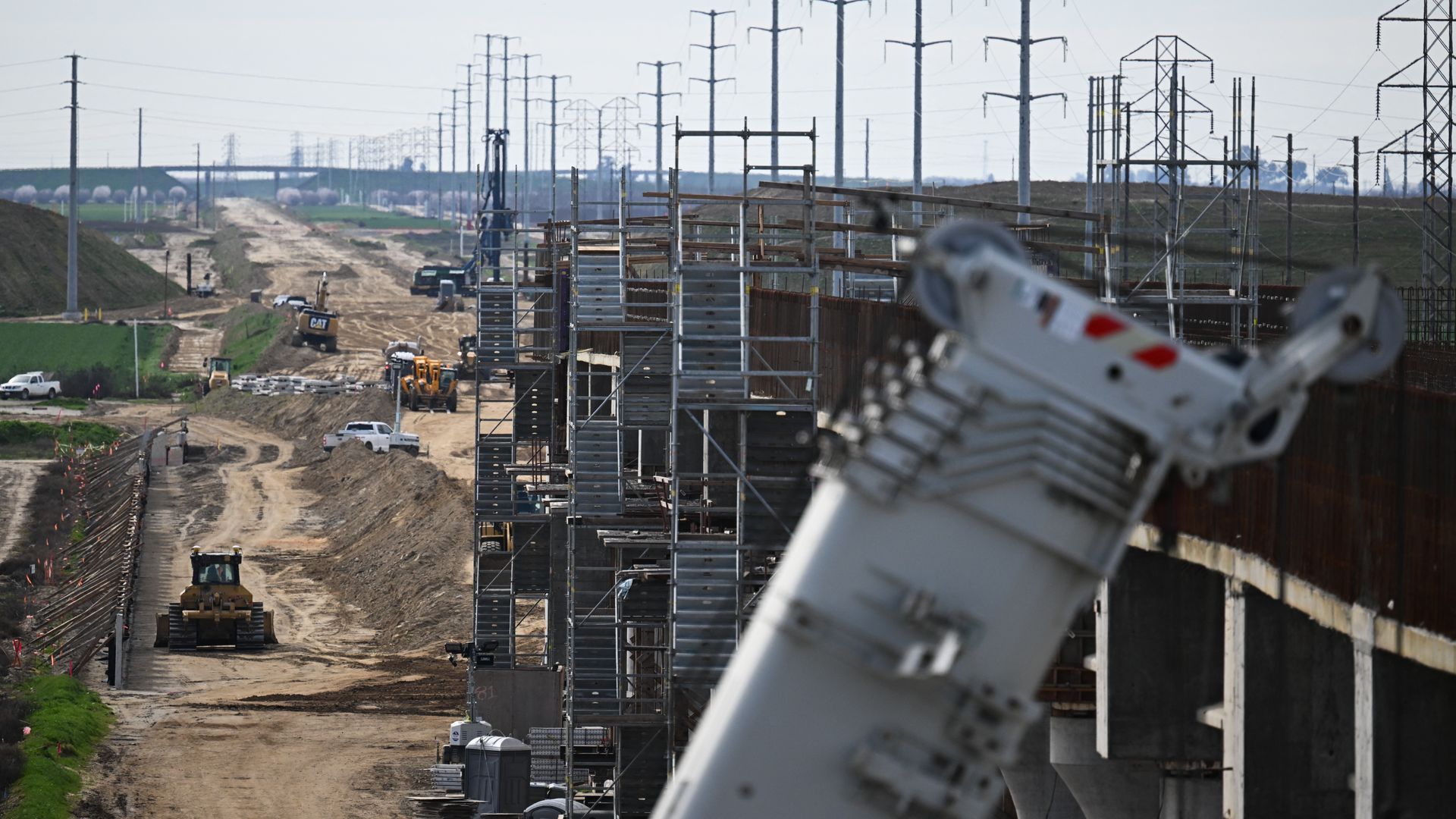
Construction workers build the Hanford Viaduct over Highway 198 as part of the rail project. Photo: Patrick Fallon/AFP
California's high-speed rail project was billed as the future of transportation, but with President Trump moving to pull $4 billion in federal funds, its future remains precarious.
Why it matters: The system was initially slated for completion in 2020. But because of funding challenges and other delays, construction has not started beyond the 171-mile segment in the Central Valley, which would connect San Francisco to Los Angeles and Anaheim.
Driving the news: In a compliance review released this week, the Federal Railroad Administration (FRA) called the project a "story of broken promises."
- Citing missed deadlines, costly change orders and the "lack of a credible plan" to close the $7 billion funding gap needed for the Central Valley segment, the FRA said it sees "no viable path" to a completed system.
- The California High Speed Rail Authority (CHRSA) has 37 days to respond to the review before the FRA moves to withdraw federal grants.
The other side: The CHSRA said in a statement that it "strongly disagrees with the FRA's conclusions, which are misguided and do not reflect the substantial progress made."
- It plans to "fully address and correct the record in our formal response."
What they're saying: While state Sen. Scott Wiener (D-San Francisco) acknowledged that the project has "taken too long," he told Axios "there are reasons for that in terms of issues around eminent domain, permitting."
- "We need faster project delivery, but that's not a reason to destroy the project," he added.
- Sens. Adam Schiff and Alex Padilla also issued a statement calling the announcement "devastating" for Californians.
Between the lines: One reason for the missed deadlines is a California policy that requires utility companies to review and approve relocation plans before public utility infrastructure can be moved to accommodate construction for a government project.
- The CHSRA inspector general said in a February assessment that there is "little incentive" for owners to do so in a timely manner and that CHSRA should instead work with legislators to revise state laws to minimize third-party delays.
By the numbers: Spending for the project totals $14 billion, with 82% from the state and 18% from federal funds.
- The entire budget for the system is almost $100 billion higher than the original $33 billion estimate provided in 2008, when voters approved the ballot to initiate the project.
Yes, but: Californians still largely support the endeavor.
- A recent Politico-UC Berkeley poll found that 67% of registered voters in the state back the project, compared to 33% who oppose.
- It's especially well-regarded in the Central Valley, where it's helped create more than 15,000 jobs, per the governor's office.
What's next: Wiener is spearheading legislation that would impose deadlines on local governments, telecom companies and utilities to comply with the approval process for transit projects.
- CHSRA chief executive Ian Choudri is also pushing the state to allow private funding, which it'd pay back over time, instead of taking out federal loans or issuing new bonds.