California to sue over federal attempt to revoke EV mandate


Add Axios as your preferred source to
see more of our stories on Google.
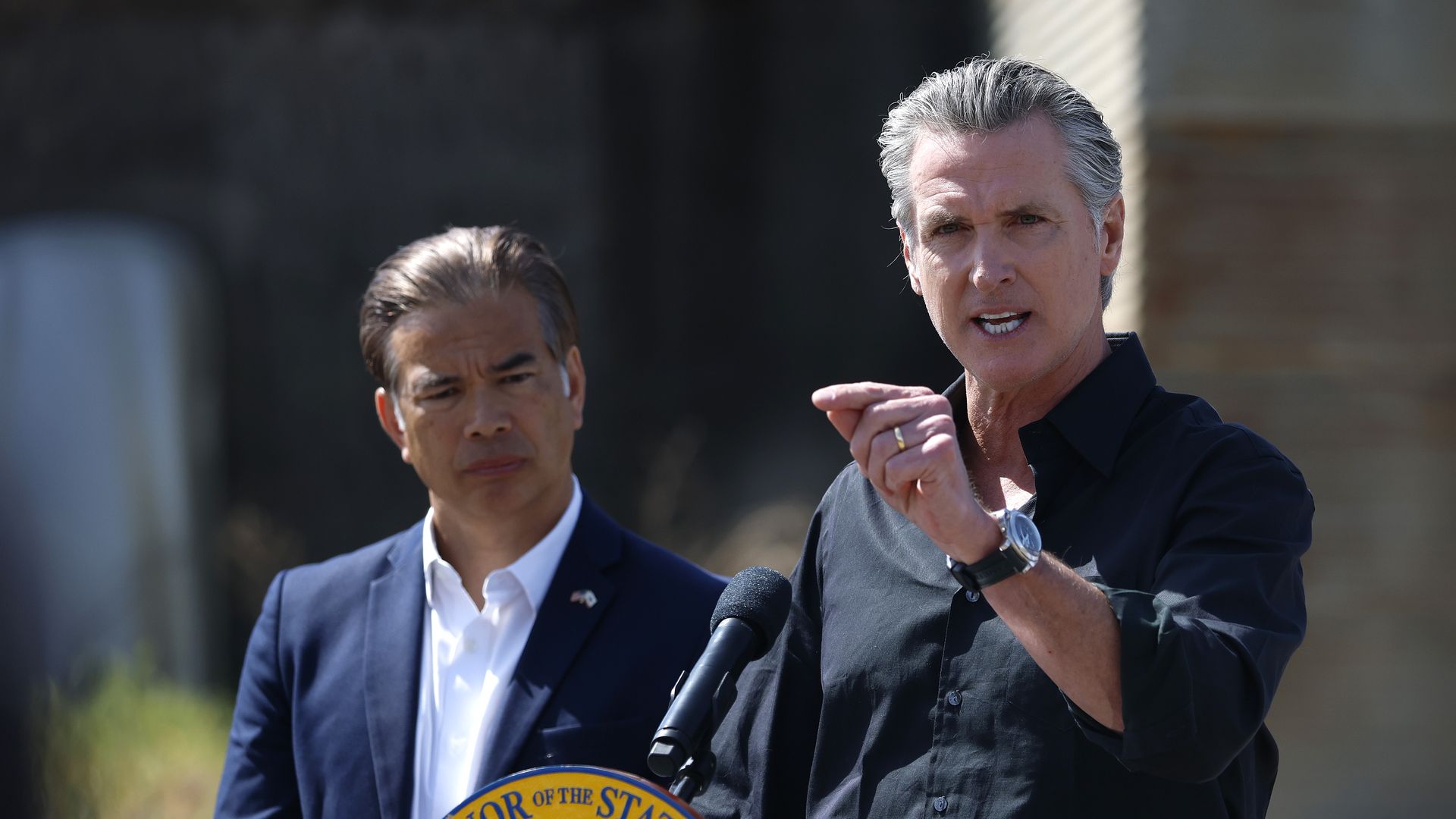
Gov. Gavin Newsom speaks alongside Attorney General Rob Bonta during a news conference. Photo: Justin Sullivan/Getty Images
In another swift rebuke of the Trump administration, California officials announced Thursday they plan to sue the federal government over the U.S. Senate's decision to revoke a waiver allowing the state to set its own air quality standards.
Why it matters: The Senate's action on Thursday to block California's emissions rules has the potential to jeopardize the long-term future of U.S. auto markets and the state's 2035 ban on new gas cars.
- The lawsuit marks the 23rd time the state has challenged President Trump in court just four months into his second term.
What they're saying: "Our lawsuit will be about ensuring California can enforce its state laws under the Clean Air Act," Bonta said at Thursday's press conference. "Waivers granted by the EPA have allowed us to improve our standards — they lower harmful emissions, they improve overall public health."
- "This Senate vote is illegal," Gov. Gavin Newsom added, citing the environmental record of Republicans like Ronald Regan who championed the state's clean air policies. "We won't stand by as Trump Republicans make America smoggy again. We're going to fight this unconstitutional attack on California in court."
Catch up quick: In a striking blow to California's authority to set stricter rules that exceed national standards, the Senate invoked the Congressional Review Act to overturn the state's Clean Air Act waiver in a 51-44 vote and send it to Trump's desk.
- Republicans, who had to execute a complex parliamentary maneuver to avoid filibuster rules, overrode opinions from an independent legislative agency and the Senate's bipartisan referee that the waiver isn't subject to that federal law.
The intrigue: On Thursday, Sen. Adam Schiff (D-Calif.) lambasted Republicans "for going nuclear" on the filibuster process and warned that such violations of Senate procedures over the Congressional Review Act could set a dangerous precedent if and when Democrats resume power.
- "If this gambit works, it will not be the last time this tactic is used," he said.
The big picture: California's climate goals and longstanding battle against air pollution hinge on the state's ability to decarbonize the transportation sector, which accounts for nearly 40% of all carbon emissions.
- Rolling back the state's waiver "undermines the 11 other states" — including Massachusetts, New York and Oregon — "that have adopted our standards and depend on our authority to defend their own communities' health," said Mary Creasman, chief executive officer of California Environmental Voters.
Flashback: In a historic move to reduce reliance on fossil fuels, California in 2022 enacted nation-leading rules to phase out all gas car sales by 2035, effectively forcing drivers to switch to zero-emission models.
- That mandate was made possible under the federal waiver, which was first granted to California by the EPA in 1970 under a bipartisan law to help the state address severe air pollution in Los Angeles.


By the numbers: California now leads the U.S. in EV sales, which have sharply increased in recent years as the state has expanded its charging network.
- Californians now own about 2.24 million EVs, including 620,175 vehicles in Los Angeles County, 186,728 in San Diego County, and 54,535 in San Francisco, per the California Energy Commission.
- About 23% of all new cars sold in California were zero emission in the first quarter of 2025.
What's next: The Senate also voted Thursday to revoke waivers for California's heavy duty trucks and nitrogen oxide emission standards. Trump is set to sign the resolutions into law in the coming weeks.