It's getting easier to charge your EV across California


Add Axios as your preferred source to
see more of our stories on Google.
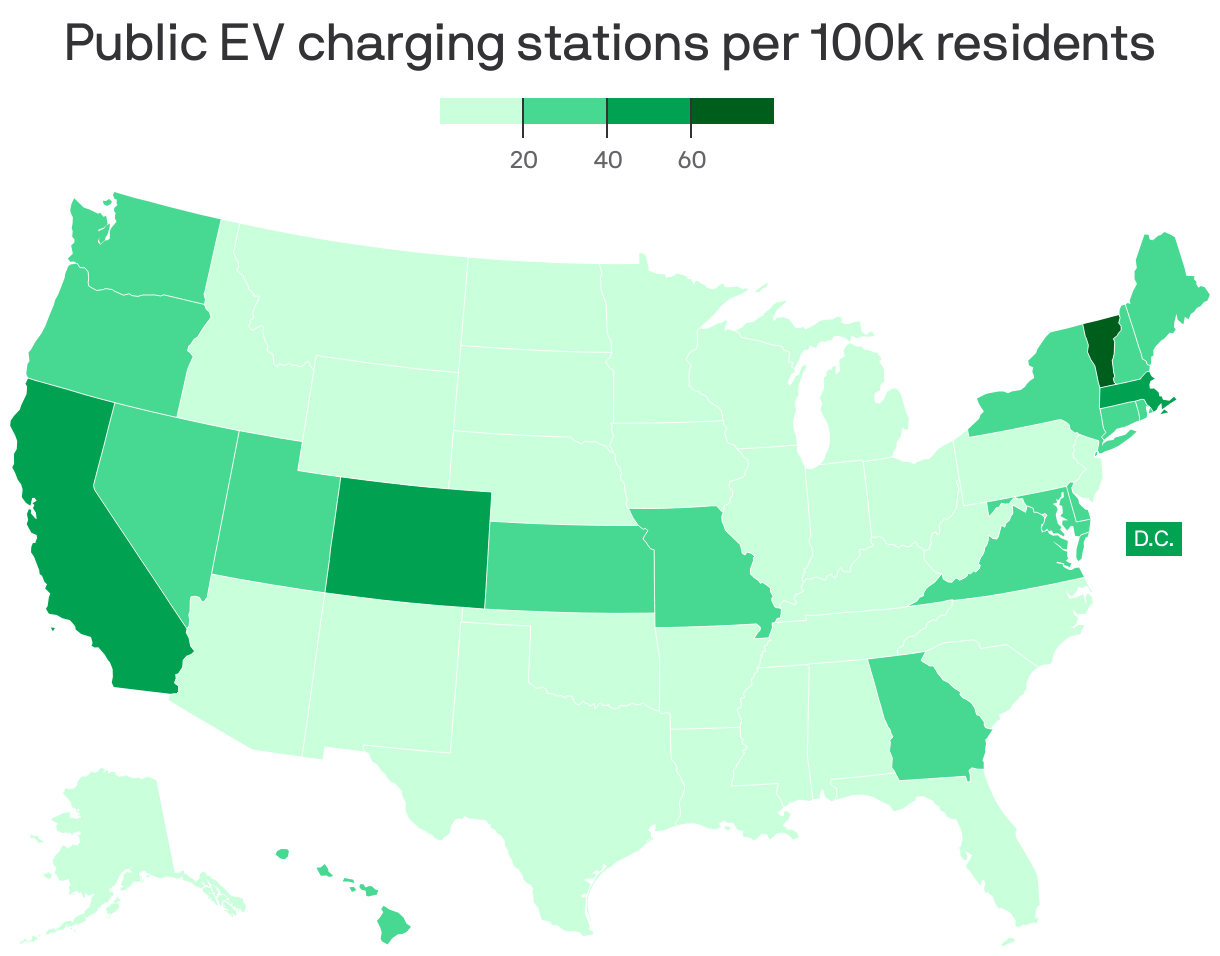
The number of public electric vehicle charging stations in California has more than doubled in the past four years, per federal data.
Why it matters: EVs and charging have been a chicken-and-egg-problem that's now getting a little easier.
- People won't buy an electric car unless they're confident they have somewhere to charge it.
- Companies won't invest in charging infrastructure without enough EV owners to plug in.
By the numbers: California is among the states with the most chargers — 18,224 public EV charging stations or about 46.8 EV stations per 100,000 residents.
- There are more than 152,300 total public and shared private chargers across California, per its dashboard.
- San Diego County has about 11,000 — one of the highest totals in the state.
- Nearly 2,000 public charging stations are in the city, 148 of which are free, according to PlugShare.
The big picture: There was a nationwide surge of public chargers, EV ownership and government funding under the Biden administration.
- The EV transition was a key part of Biden's climate agenda. He pushed a variety of policies — consumer EV tax credits, manufacturing incentives for carmakers and tougher tailpipe emissions laws — with the intent to make EVs account for 50% of new car sales by 2030.
Reality check: While charging might be getting easier, the U.S. is still far short of the estimated 1.2 million public chargers that will be needed by 2030.
- California is also behind on its goal. The state projects it will need a million public chargers by the end of 2030 to support the expected 7 million EVs on the road — nearly 10 times more than what's available today.
Zoom in: San Diego County is an EV hotspot and it's one of the top markets for EV-friendly homes.
- The San Diego Metropolitan Transit System and the San Diego Association of Governments recently received $8 million from the state to install EV charging stations, as the city expands its network.
- Another federally-funded project will build 20 fast-chargers along the major freeways in the region.
State of play: California's EV push has also been crucial to cutting carbon emissions.
- The state was the first to ban the sale of all gas-powered cars by 2035. The landmark regulation is being phased in gradually, beginning with 35% of 2026 models, increasing to 68% in 2030 and reaching 100% in 2035.
- In the second quarter of 2024, EVs made up 25.7% of all new vehicle sales in California — the second highest market share ever recorded in the state.
What we're watching: EV sales are growing, but far off the expected pace.
- More affordable models could help drive momentum — even as President Trump kills the consumer tax credits as expected, and other pro-EV policies.