San Francisco's coldest days are getting warmer


Add Axios as your preferred source to
see more of our stories on Google.
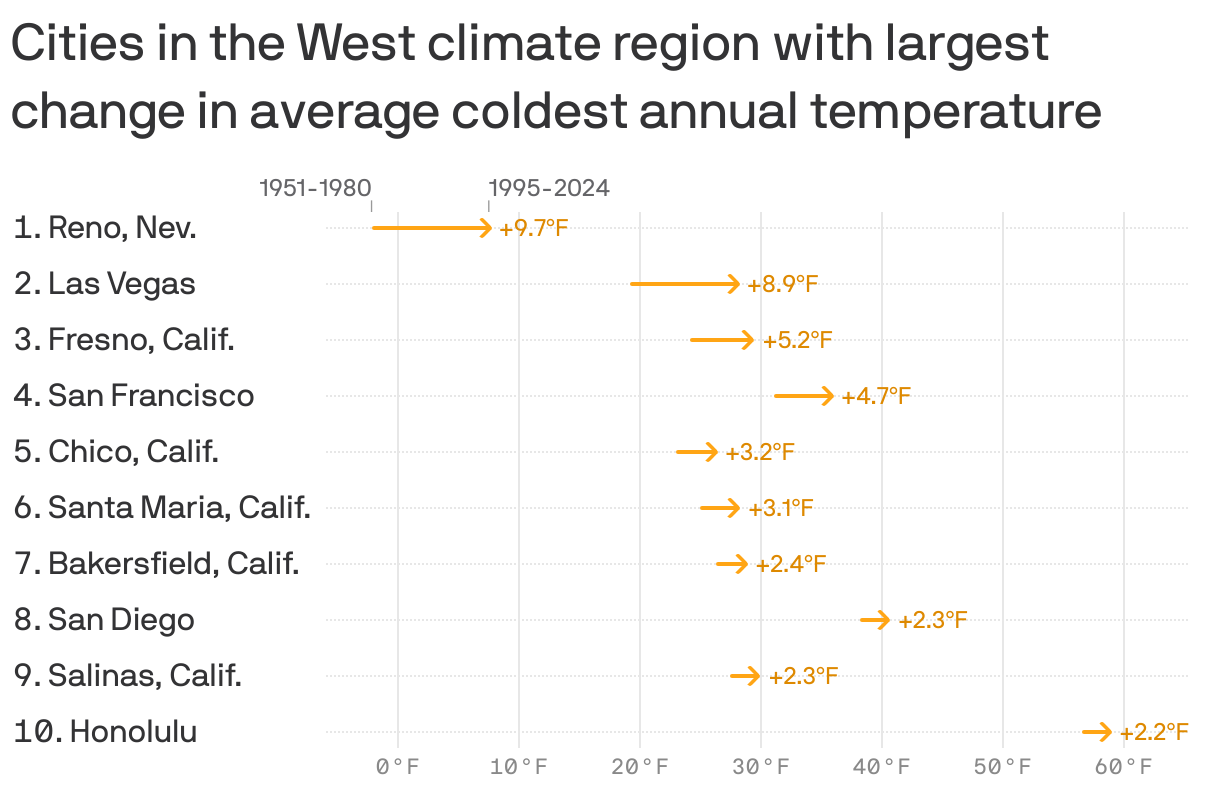
Thirty-year average coldest temperatures are rising almost universally nationwide, including in San Francisco, a new analysis found.
Why it matters: Such a shift can affect us in a variety of ways — changing which plants and insects thrive in our neighborhoods, for example, amid other impacts of climate change.
Driving the news: The 30-year average coldest temperature for 1995-2024 compared to 1951-1980 was higher in 97% of the 243 locations analyzed by Climate Central, a research and communications group.
- Among the locations with an increase, the coldest annual temperature was 3.7°F higher on average.
- The group's analysis is based on data from NOAA's Regional Climate Centers.
Zoom in: San Francisco saw a +4.7°F increase in average coldest temperature between the two 30-year periods.
- Spring season is also getting warmer, with the city experiencing a greater number of hotter days as extreme heat events become more frequent and intense.
Zoom out: In the west, Reno, Nevada (+9.7°F), had the biggest increase, followed by Las Vegas (+8.9); and Fresno, California (+5.2).
What to watch: The group also used climate modeling and NASA data to project future change between the 30-year period of 1995-2024 and the 2036-2065 period.
- It predicts that the 30-year average coldest temperature will rise in every one of the 243 locations analyzed between those periods, with an average gain of 5.6°F.