The Bay Area has limited upward mobility


Add Axios as your preferred source to
see more of our stories on Google.
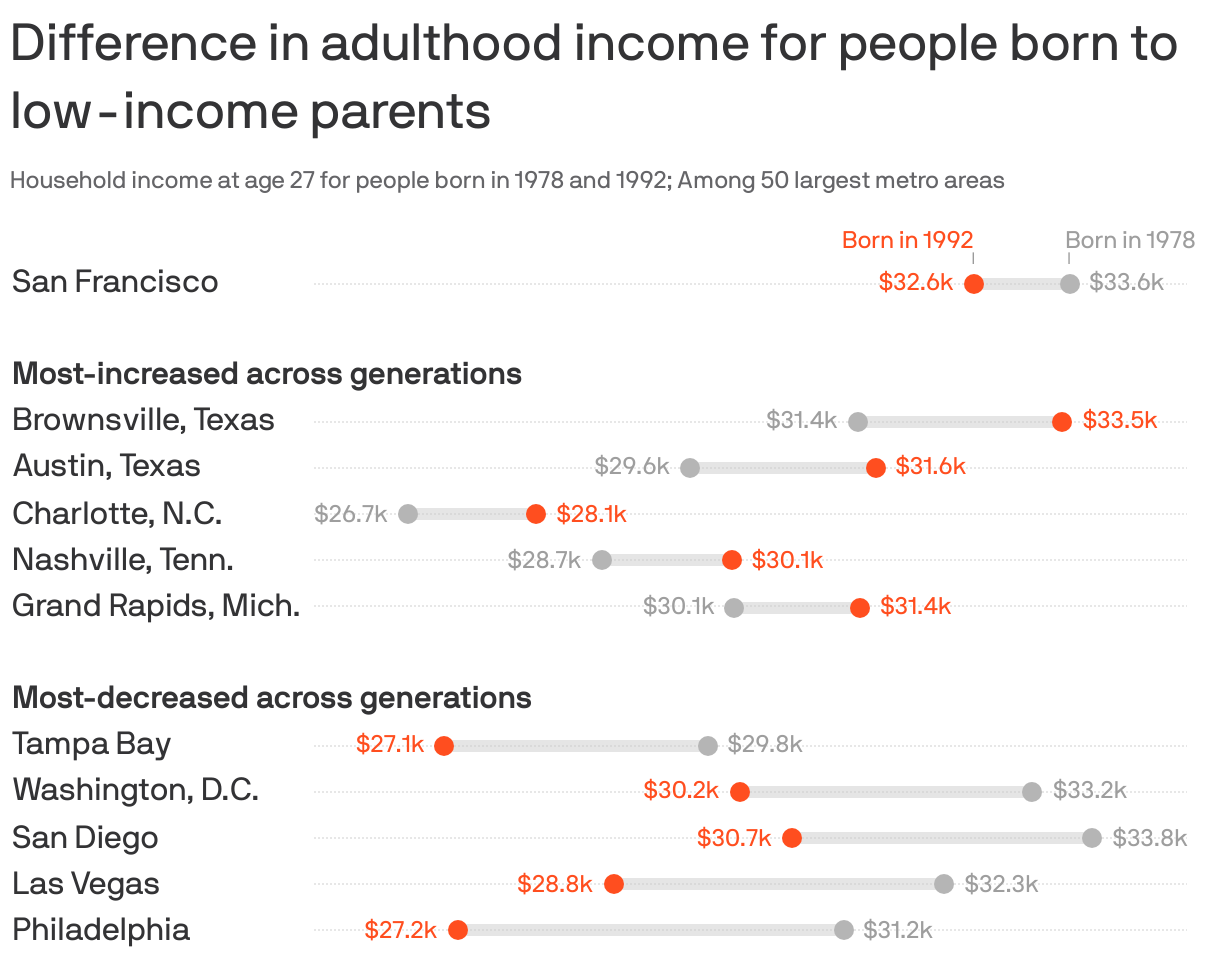
People born to low-income families in the Bay Area tend to be worse off than their parents, a new analysis shows.
Why it matters: Intergenerational mobility — the idea that you'll be better off than your parents — is core to the American dream, but it's far from a guarantee.
Driving the news: Among the 50 biggest U.S. metro areas, the Bay Area is one of 38 in which people born to low-income families are faring worse than the previous generation.
How it works: A new analysis from the Census Bureau and Opportunity Insights, a research group at Harvard University, seeks to measure intergenerational mobility at the county level.
- Researchers compared the average household income at age 27 for Americans born to low-income families in both 1978 and 1992 to get a localized picture of changing opportunities over time.
By the numbers: In the San Francisco metro, those born in 1992 had a household income of $32,600 at age 27, a nearly 3% decrease from the $33,600 for those born in 1978 (adjusted to 2023 dollars), according to the analysis.
Zoom in: Outcomes improved for low-income Black families in nearly every part of the country, including the Bay Area, while outcomes for low-income white families declined, according to researchers.
- In the Bay Area, Black people born in 1992 had a household income 5.2% higher than those born in 1978, compared with a 7% decline from 1978 to 1992 for white families.
- In San Francisco proper, however, white household income rose 1.3%, and Black families' increased 7.1%.
Yes, but: Black children born in 1992 still had poorer prospects of rising up than white children "in virtually every county in America, because initial Black-white disparities were so large," the researchers wrote.
Go deeper: You can explore more data about how intergenerational mobility has fared in San Francisco at the Opportunity Atlas.